
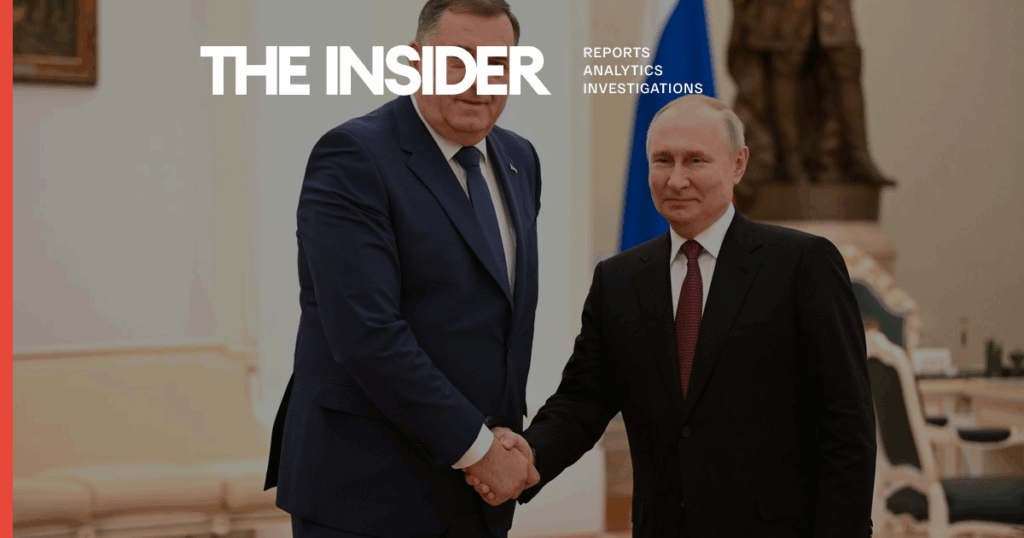
“Bosnia and Herzegovina — however weak it may be as a state — still functions. As political opposition in Republika Srpska gains strength, the conditions for dialogue will gradually emerge — a dialogue that is impossible under Dodik’s policies. His arrogance may have populist appeal, but it is politically unsustainable,” Kamberović believes.
Russia in Bosnia: more influence at others’ expense
In the early 2000s, Russia showed little interest in the region, pulling its small contingent of peacekeepers out of the Balkans in 2003 to focus on diplomacy and energy projects. In line with this approach, Moscow has never been among Bosnia’s major financial donors.
Topping that list are the EU, the United States, and Japan, which together have provided Bosnia with €6 billion in postwar assistance — spanning humanitarian aid, reconstruction of destroyed infrastructure, economic projects, and education. These same countries cover the cost of the High Representative’s work: the EU pays 54%, the U.S. 22%, and Japan 10%. Russia’s contribution is roughly 1%.
In recent years, Moscow has not supported a single joint statement by the Peace Implementation Council — this despite the fact that each one of them reaffirms Bosnia and Herzegovina’s sovereignty and territorial integrity and condemns separatist and nationalist rhetoric.
In recent days, Russian diplomacy has stepped up its activity in the Balkans. Foreign Ministry spokesperson Maria Zakharova denounced Dodik’s prison sentence as absurd, portraying him as a man supposedly fighting Western neocolonialism. On August 7, consultations were held at the UN Security Council, where Russia’s deputy permanent representative Dmitry Polyanskiy claimed that the prosecution of Dodik posed a threat to the stability of Bosnia and Herzegovina.
Observers have also noted an unusually blunt, almost threatening statement from the Russian Embassy in Sarajevo, warning that the Balkans risk once again becoming Europe’s powder keg.
In response, Bosnia’s Foreign Ministry sent letters to five Western countries — the United States, the United Kingdom, Germany, France, and Italy — warning of “serious threats emanating from Russia.” Foreign Minister Elmedin Konaković cautioned that the Kremlin is questioning “the very existence of Bosnia and Herzegovina as a single state,” calling it “the most acute and concentrated threat the country faces today.” “We know that Russia operates not only through political means. It is prepared to engage in espionage, cyberattacks, and disinformation,” the minister said.