
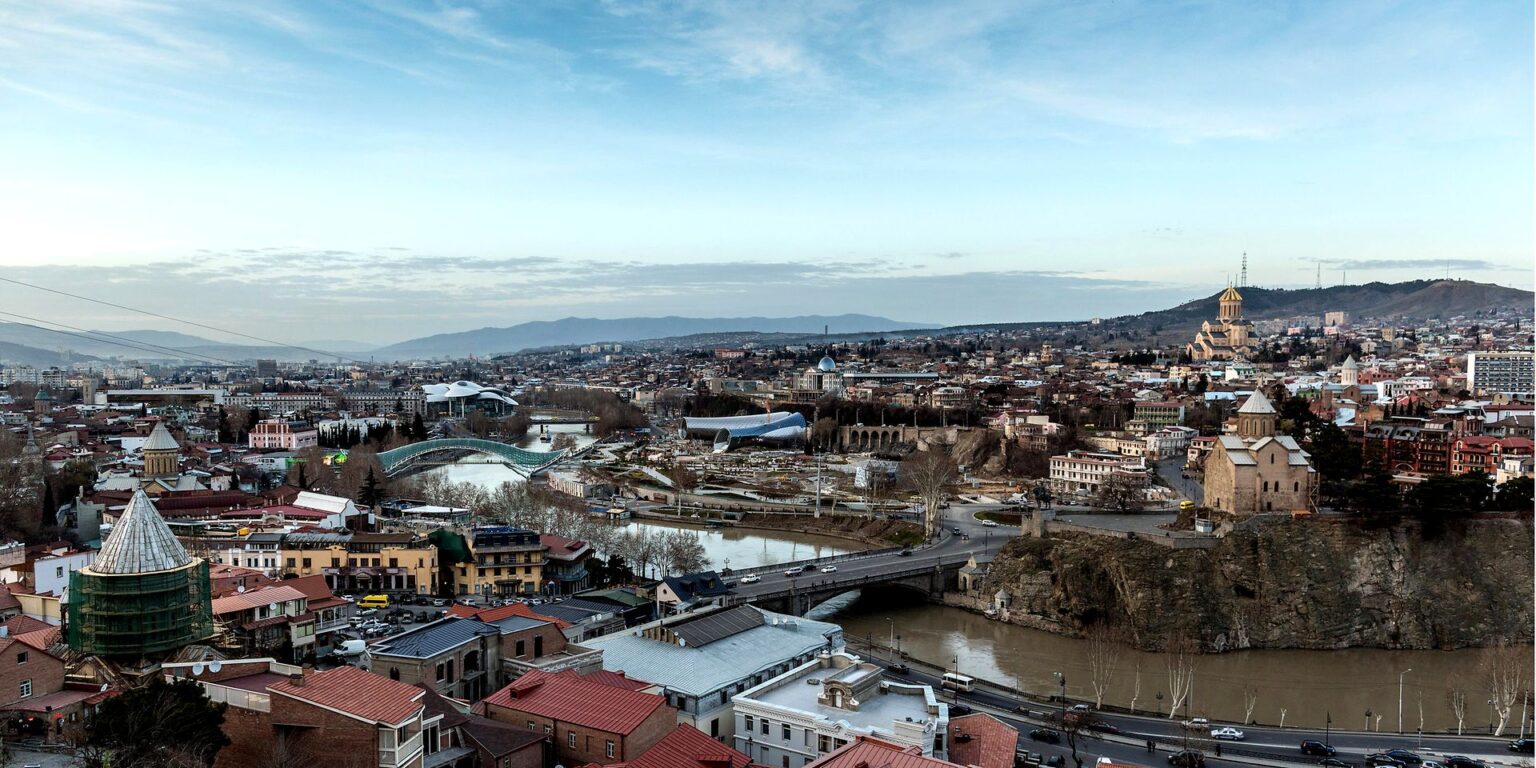
Friendly relations between Germany and Georgia date back to the 19th century, when Swabian immigrants settled in the South Caucasus. Following the disintegration of the Soviet Union, in 1991 Germany was the first country to recognise Georgia’s independence. Georgia’s geographical location makes it an important connecting point between Europe and Asia.
Straight to
Just under a year ago, the Georgian government began to depart from the course of EU and NATO rapprochement that it had been pursuing. Since then, it has enacted several laws that are incompatible with the EU’s canon of rights and values, for example a so-called Transparency Law, or a law on family values, which discriminates against LGBTIQ+ persons. In the parliamentary elections held in October 2024, the ruling Georgian Dream party was able to win a majority, but observers found major irregularities in the election process. On 28 November 2024, Prime Minister Irakli Kobakhidze announced that EU membership talks would be suspended until 2028, triggering pro-European mass protests.
In the past two decades, the Georgian government had undertaken major efforts to consolidate democracy and the rule of law, achieve alignment with European legal standards, fight corruption and create a more conducive climate for investment. For a long time, Georgia was thus considered a “reform leader” among the former Soviet republics in the Caucasus. In recent years, however, political disputes between the government and the opposition had slowed the country’s development, with important processes becoming bogged down. Yet there is still huge need for reform. Large sections of the Georgian population continue to suffer under poverty and unemployment.
Russia’s war of aggression against Ukraine has had major impacts on Georgia, too. Russia is an important market for Georgian products. Moreover, remittances from migrant workers account for a significant proportion of Georgia’s gross domestic product. The territorial conflict over Abkhazia and South Ossetia continues to be unresolved. The two breakaway regions are striving to achieve independence from Georgia, and are being supported by Russia in this endeavour. Since the war between Russia and Georgia in 2008 and the beginning of the presence of Russian troops in Abkhazia and South Ossetia, which continues to this day, Georgia and Russia have not had diplomatic relations.
Until recently, Georgia was seeking to build closer relations with Western nations. In 2016, an Association Agreement entered into force between Georgia and the EU, aimed at bringing the country closer to the EU in political and economic terms. In March 2022, Georgia – just like Ukraine and Moldova – applied for EU membership. In December 2023, Georgia was officially accepted as an EU accession candidate. The EU has stopped the accession process for the time being, following the adoption of the so-called Transparency Law in May 2024. Georgia also wants to achieve NATO membership. Like EU accession, that goal is also enshrined in the country’s constitution. The majority of the Georgian population, unlike the Georgian government, continues to support these goals.