
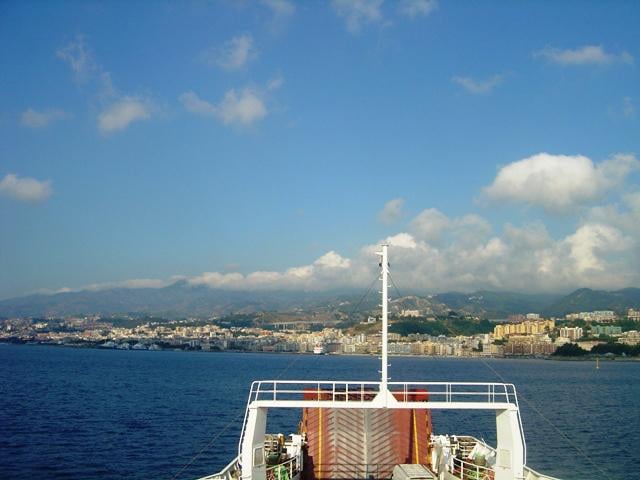
The decision to build the bridge over the Strait with this double viability project (both highway and rail connection) is not very justified.
There is no freight traffic in Sicily of this scope as to justify such an expensive and technologically advanced work. The reasons are many and I summarize them with:
- Sicilian ports have contained logistical capabilities. The only one who can move containers with a certain freight volume is that of Catania. Sicily is far away to be able to become a hub for the arrival and transport of freight to continental Europe. The competition of the great ports of the North (Trieste, Genoa, Livorno, Naples) is overwhelming.
- There is no goods handling in the Italian internal market to justify such an investment. The Sicilian industry is practically absent, if we remove the chemical pole of Priolo-Augusta (that of Gela has been closed since 2014). Which however has its enough port hub to all movements.
- The volume of passenger traffic is the only thing that approaches justifying such a large and expensive work, with almost 10 million moving passengers (data: Strait of Messina: 10 million passengers every year. All data). However, they are numbers lower than other large -style connections, such as the Eurotunnel which manages up to 3 million heavy vehicles/year and 1.8 million vehicle/year
- Travel times: I doubt that the realization of the six -lane bridge would convey many self -articles towards Salerno Reggio Calabria. They are 6h starting from Salerno (travel + pause), 7h from Rome. Considering fuel cost, half -wear and driver effort, tolls, perhaps ferry from Civitavecchia or Naples is still competitive compared to the long journey on the highway. I have my doubts that the bridge can attract freight traffic on rubber that starts from a more distant distance in Calabria. For car traffic maybe the conditions change a bit, but I’m not so sure that you change the cards on the table. From Tuscany, if I wanted to reach Sicily for vacation, I would consider the journey in the car as third choice, after plane from Perugia/Florence and boarding to Civitavecchia/Naples. Really too many hours by car.
- Costs that explode: it is the longest unique span bridge in the world, therefore a technological leap. The history of these works has the recurring feature of having costs and times of realization which are systematically underestimated compared to the final ones. The 13 billion expected, we all know it is useless to deny it, they will certainly be more than 20, and 2033 as the end of the works announced by the (S) Minister Salvini is completely optimistic.
Given these data, if you really want to create an infrastructure of this type, with the aim of strengthening the infrastructures and connections of southern Italy, but without exploding the costs, a bridge with only railway connection could already be sufficient. I don’t see the meaning to build a six -lane highway for passenger transport that could be managed widely by the railway connection. Machine transport could be built on the model of the Sempione tunnel or Euro-Tunnel model, then with cargo cars or heavy vehicles on the train and unloading on the other side. The two examples above show that infrastructures of this type are able to move a number of cars and passengers such as to satisfy the actual demand. 2/3 races per hour with ‘shuttle’ trains should be enough. We consider that a part of the 10 million passengers travels on trains embarked in the ferries, so a direct railway connection is already an advantage. Furthermore, precisely for the reasons mentioned above travel times and costs, such a work, which would have essentially repercussions on local transport more than nationally, would never justify such a high expenditure. But limiting the viability to rail transport alone could significantly reduce the costs and dimensions (less height of the bearing towers, less steel and concrete?)
Having said that, even considering the lower realization costs, I still have doubts about the cost/benefits ratio of a work of this courses, especially if compared to the alternatives. For example:
- Is a direct connection really necessary? Passenger transport could be conveyed on existing ferries, perhaps making a direct connection from the station via treadmill to the port. This would completely eliminate the need to embark on passenger trains. Already in this scenario, passenger transport on iron + ferry + iron would be competitive and would no longer justify the maintenance costs of an apparatus such as that of the FS Caronte ship for boarding trains. And an intermodal terminal at Villa San Giovanni made well, would perhaps make the bridge completely superfluous, at least for passenger transport. Would you earn 20 minutes would you ever justify an expense of 20 billion euros? I have my strong doubts.
Having said that, I exposed how I think, I await your opinions, perhaps of people who work in the logistics and transport sector and know more than me.
Idea sul ponte sullo stretto: solo collegamento Ferroviario
byu/QuarterOld8397 initaly
Posted by QuarterOld8397
16 Comments
Non dire fesserie.
Attraversano lo stretto 3,5 MILIONI di veicoli all’anno nonostante costi senza senso.
Se il problema è quello di contenere i costi, può bastare una corsia per senso di marcia, come per i trafori sulle alpi (Gottardo, s. Bernardino,…)
Nonsense.
Sulla linea di quello che dice OP, io direi di rimuovere anche la linea ferroviaria. Cioè costruiamo il ponte ma proibiamo a chiunque di usarlo. Perché cazzata per cazzata tanto vale spararla grossa
Post senza senso.
“Non f’è traffico merci in Sicilia di tale portata”
E secondo te il ponte a che serve? Non serve a migliorare la situazione?
La cosa importante qui è la posizione strategica della Sicilia… una volta costruito il ponte, si spera prima, l’importate sarà sfruttarlo.
https://i.redd.it/rsufrlhihdjf1.gif
https://preview.redd.it/kxh46ajohdjf1.jpeg?width=453&format=pjpg&auto=webp&s=ccdc5f4b49932be8d2c04fa8e70ec9aa45e6a868
Senza entrare nel merito del giusto o sbagliato costruire il ponte, è ovvio che se lo fai lo fai in modo un po’ lungimirante… direi. Sfruttando al meglio tutte le possibilità.
Magari il traffico merci è “scarso” proprio perché non c’è il ponte.
Che poi, a parte la cazzata espressa di base, vorrei capire come si risparmierebbe eliminando le auto visto che già un ponte ferroviario avrebbe requisiti tecnici esigenti, basti pensare al peso del solo armamento o alle pendenze a cui è vincolato un treno per raccordarsi al ponte. Un altro bel post (semi) nimby a cui mettere un downvote, già che ci sei vogliamo farne uno contro il nucleare?
Spero tu non abbia perso troppo tempo a scrivere questa idiozia.
E pensa che di corsie per autonce ne sono 3 per senso di marcia (+ corsia d’emergenza)!
Chiaramente non sei laureato. Sicuramente non in economia. Saluti!
Altra ideona geniale, invece di farlo dritto facciamolo tutto a curve. 3,3km porta sfiga, facciamolo tutto serpiginoso e di 5km, cifra tonda. Così il record mondiale di lunghezza lo battiamo di un bel po’
Ma facciamone 2 di ponti! Uno per i treni solo andata e uno per i treni solo ritorno! Carico minore sui singoli ponti e carico maggiore sui prezzi delle opere! Va’ che Ministro dei Trasporti sono!
Cristodio che boiata
MONOROTAIA