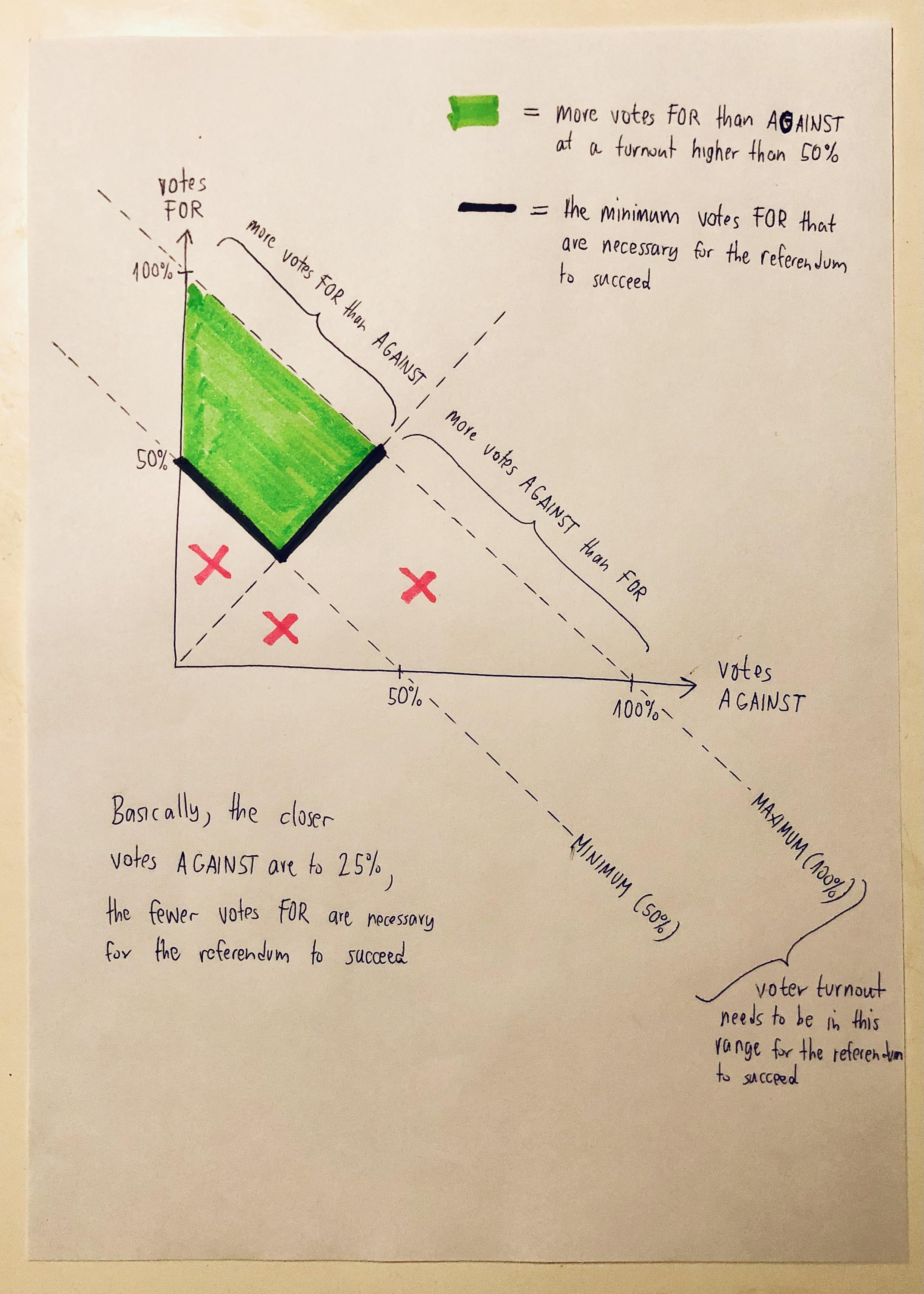
> The referendum is decided by the majority of the voters who voted, with the condition that the majority of the total number of voters in the Republic participated in the referendum.
One thing that I forgot to mention on the paper and that might be confusing is that the percentages on the x and y axes are percentages of the total number of (eligible) voters.
MyNameIsKvothe on
So weird, so if you are against it could be more beneficial not to vote than to vote against.
cdurgin on
OK, I think this makes sense to me. Basically, they are saying if something is important enough to effect everyone, you need to have at least a 2/3 of the people being at least OK with it. Essentially, the first quarter of the population is assumed to be not voting, but would be voting “No” on any referendum, therefore, at least half the population needs to vote yes to defeat it.
Essentially, no votes don’t matter, if less than half the population votes.
It’s a little convoluted, but it’s essentially a round about way of ensuring a 2/3rds majority on a referendum for any given population. If a referendum passes in this case, you can be pretty sure at least 2/3 people are happy or don’t care about it.

![[OC] Trying to figure out how referendums in Croatia are decided…](https://www.byteseu.com/wp-content/uploads/2025/08/1rqx3yciwhjf1-1097x1536.jpeg "[OC] Trying to figure out how referendums in Croatia are decided…")
3 Comments
> The referendum is decided by the majority of the voters who voted, with the condition that the majority of the total number of voters in the Republic participated in the referendum.
https://www.ljudskaprava.hr/themes/civic-participation/voting/referendums
One thing that I forgot to mention on the paper and that might be confusing is that the percentages on the x and y axes are percentages of the total number of (eligible) voters.
So weird, so if you are against it could be more beneficial not to vote than to vote against.
OK, I think this makes sense to me. Basically, they are saying if something is important enough to effect everyone, you need to have at least a 2/3 of the people being at least OK with it. Essentially, the first quarter of the population is assumed to be not voting, but would be voting “No” on any referendum, therefore, at least half the population needs to vote yes to defeat it.
Essentially, no votes don’t matter, if less than half the population votes.
It’s a little convoluted, but it’s essentially a round about way of ensuring a 2/3rds majority on a referendum for any given population. If a referendum passes in this case, you can be pretty sure at least 2/3 people are happy or don’t care about it.