
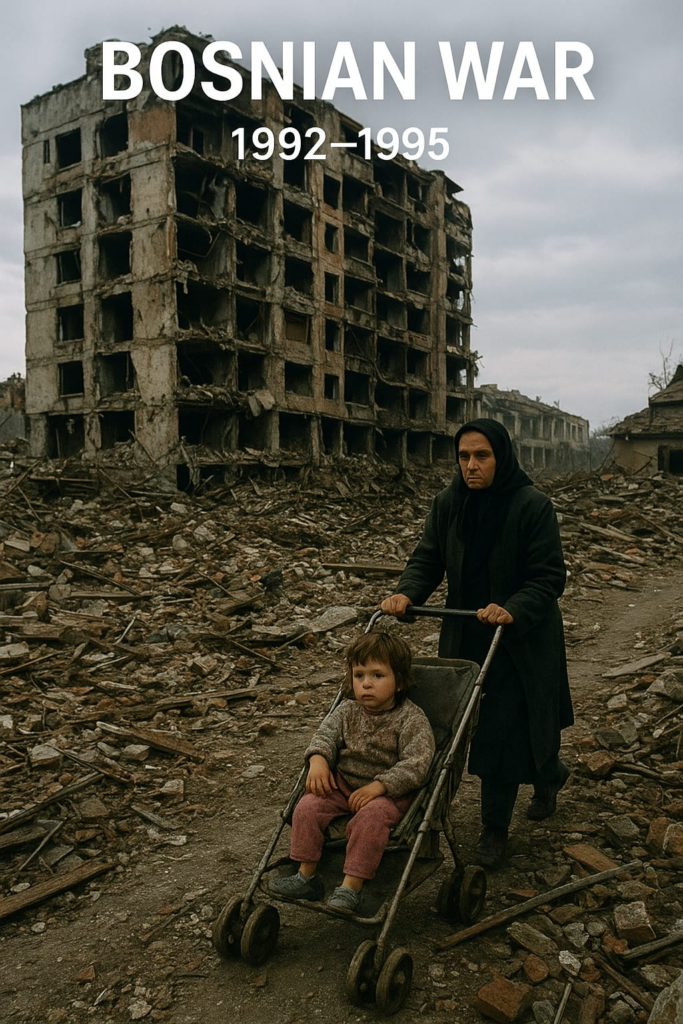
The Bosnian War (1992–1995) was a brutal conflict that erupted following the disintegration of Yugoslavia, a multi-ethnic federation that had held together for decades under the rule of Josip Broz Tito. After Tito’s death in 1980, nationalist tensions began to rise across the region. With Slovenia and Croatia declaring independence in 1991, Bosnia and Herzegovina also sought sovereignty. However, unlike Slovenia and Croatia, Bosnia was far more diverse—home to Bosniaks (Bosnian Muslims), Serbs (Eastern Orthodox), and Croats (Catholics).
The declaration of independence by Bosnia in March 1992 triggered fierce opposition from Bosnian Serbs, backed militarily and politically by Serbia under Slobodan Milošević. They rejected the independence move, fearing marginalization in a new Bosnian state. What began as a political dispute quickly spiraled into a full-scale war.
Who Were the Main Parties Involved in the Conflict?
The Bosnian War was essentially a three-sided conflict:
Bosniaks (Bosnian Muslims): Primarily supported independence and sought a unified Bosnian state. They were led by President Alija Izetbegović.
Bosnian Serbs: Opposed independence, aiming to remain within a Serb-dominated Yugoslavia. Their military arm, the Army of Republika Srpska, was commanded by Ratko Mladić and politically directed by Radovan Karadžić.
Bosnian Croats: Initially allied with Bosniaks against Serbs, but tensions later emerged, leading to clashes between Croats and Muslims as each sought greater autonomy.
International actors also played a role. Serbia supported the Bosnian Serbs, while Croatia often aided the Bosnian Croats. Western powers and NATO intervened later in the war, primarily to end hostilities and prevent further humanitarian disasters.
What Made the War Particularly Brutal and Unique?
The Bosnian War was marked by systematic ethnic cleansing, mass killings, forced deportations, and widespread use of rape as a weapon of war. Civilians were frequently targeted, and towns and villages were ethnically divided by force.
One of the defining features of the war was the Siege of Sarajevo (1992–1996), the longest siege in modern history, lasting nearly four years. Sarajevo’s residents endured relentless shelling and sniper fire, with food, medicine, and utilities severely limited.
Another dark hallmark was the use of concentration camps where prisoners—mostly Bosniaks and Croats—suffered abuse, starvation, and execution. These atrocities shocked the world and revived chilling memories of World War II.
What Was the Role of Ethnic Cleansing and Genocide?
Perhaps the most infamous event of the Bosnian War was the Srebrenica Massacre of July 1995. In this UN-declared “safe zone,” more than 8,000 Bosniak men and boys were executed by Bosnian Serb forces under Ratko Mladić. It was later ruled a genocide by international courts—the worst atrocity in Europe since the Holocaust.
Ethnic cleansing became a deliberate strategy by all sides but was most systematically executed by Bosnian Serb forces, aiming to carve out a Serb-dominated territory by removing or killing non-Serbs. Mass rape, particularly of Bosniak women, was also used as a tool of terror and ethnic destruction.
How Did the International Community Respond to the War?
The international community initially hesitated, often criticized for being slow and ineffective. The United Nations deployed peacekeepers (UNPROFOR), but their mandate was limited, preventing them from effectively stopping violence. Safe zones like Srebrenica tragically became death traps due to weak UN protection.
NATO’s involvement grew after repeated atrocities and attacks on civilians. In 1994–1995, NATO launched airstrikes against Bosnian Serb positions, marking a decisive shift in the conflict. Meanwhile, international humanitarian organizations attempted to deliver aid, but access was often blocked.
Eventually, international outrage at massacres like Srebrenica and the Markale marketplace shelling in Sarajevo pressured Western powers into stronger action. The U.S., under President Bill Clinton, led diplomatic efforts culminating in peace negotiations.
What Brought the War to an End?
The conflict ended with the Dayton Peace Agreement, negotiated in Dayton, Ohio, in November 1995 and signed in Paris the following month. Brokered by U.S. diplomat Richard Holbrooke, the accord established Bosnia and Herzegovina as a single sovereign state but divided it into two autonomous entities:
1. The Federation of Bosnia and Herzegovina (mainly Bosniaks and Croats).
2. The Republika Srpska (mainly Serbs).
The agreement stopped the fighting but cemented ethnic divisions, effectively freezing the conflict rather than resolving underlying tensions.
What Were the Human and Social Costs of the War?
The human toll was staggering:
Around 100,000 people were killed, with civilians making up the majority of victims.
Over 2 million people were displaced, making it one of the largest refugee crises in Europe since World War II.
Widespread destruction left Bosnia’s infrastructure, economy, and social fabric shattered.
Survivors endured deep psychological trauma, while communities were permanently scarred by ethnic divisions.
The war also reshaped the demographic map of Bosnia, as ethnic cleansing drastically reduced the multi-ethnic coexistence that once characterized the region.
How Has the Bosnian War Shaped Modern Bosnia and the World?
The Bosnian War remains a painful legacy in the Balkans and beyond. For Bosnia itself, the Dayton framework has kept peace but entrenched political paralysis. Ethnic divisions persist, with politics often dominated by nationalist rhetoric. Reconciliation has been slow, and trust between communities fragile.
Internationally, the war highlighted the dangers of unchecked nationalism and the limitations of peacekeeping without decisive action. It spurred the development of international criminal justice, with the creation of the International Criminal Tribunal for the former Yugoslavia (ICTY). Leaders like Milošević, Karadžić, and Mladić faced trials for war crimes, crimes against humanity, and genocide.
The conflict also reshaped NATO’s role, proving that the alliance could act beyond traditional defense to enforce peace and prevent humanitarian catastrophe.
What Lessons Can Be Learned from the Bosnian War?
Early intervention is crucial: The world’s hesitation allowed atrocities to escalate.
Nationalism can fuel mass violence: The war showed how identity politics can destroy diverse societies.
Peace deals may stop war but not solve divisions: Bosnia’s current fragile peace highlights the limits of agreements that prioritize cessation of violence over reconciliation.
Accountability matters: The prosecution of war crimes has been vital in setting precedents for international justice, even if it cannot undo the suffering.
Conclusion: Did the Bosnian War Truly End, or Is It Still Echoing Today?
While the guns fell silent in 1995, the war’s legacy continues to shape Bosnia and Herzegovina. Ethnic divisions remain institutionalized, and the memories of genocide, displacement, and loss weigh heavily on its people. The conflict stands as both a stark warning of the consequences of ethnic hatred and a testament to the resilience of those who survived.
The Bosnian War was not just a regional tragedy—it was a global lesson on humanity’s vulnerabilities and responsibilities in the face of mass atrocities.