
However, it’s unclear if Macedonia will follow the prescribed EU ViDA model.
Continuous Transaction Control potential model
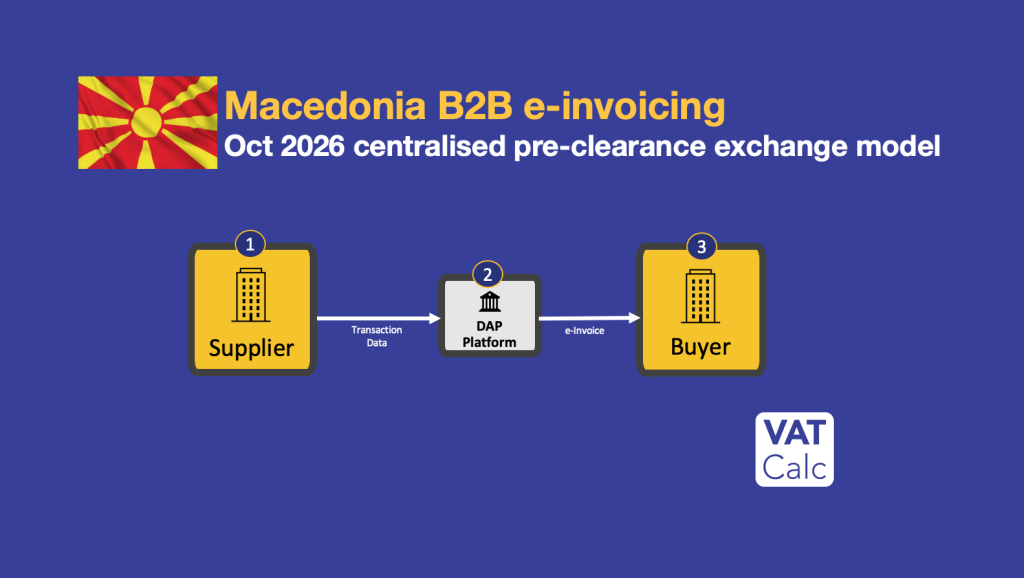
Whilst there are limited details yet, the regime to be developed and managed by DAP, marks a significant shift in how non-cash transactions are controlled and reported in the country.
Under the new framework, all invoices for non-cash transactions will be issued and validated electronically through DAP’s central platform. Each invoice will receive a unique code after validation, which ensures traceability and real-time oversight.
The process is fully automated: whether generated through an enterprise’s own software or directly via the DAP-provided application, each invoice is transmitted to DAP, verified in real time, and then simultaneously forwarded to the recipient within the same digital infrastructure—eliminating the need for manual delivery via email or physical copies.
Drawing from the CTC Model
This system closely mirrors the Continuous Transaction Control (CTC) model increasingly adopted by tax authorities globally. CTC systems require the real-time or near-real-time transmission of invoice data to the tax authority for approval or clearance before the invoice can be legally used. Such models offer governments stronger tools to combat VAT fraud, reduce the VAT gap, and improve compliance across sectors.
Notable examples of countries that have adopted CTC models include Italy (with its Sistema di Interscambio), Mexico, and Chile. These systems typically require integration with taxpayer ERP software and offer APIs for real-time interaction, allowing tax authorities to monitor economic activity as it happens.
Potential divergence from EU’s ViDA proposal
However, Macedonia’s adoption of a centralized real-time clearance model could place it at odds with the European Union’s 2030 Digital Reporting Requirements under the VAT in the Digital Age (ViDA) initiative. While the EU supports the expansion of e-invoicing as a tool for VAT reform, it favors a more decentralized approach that avoids mandatory real-time clearance models, in order to protect the integrity of the internal market and reduce the administrative burden on cross-border trade.
The ViDA proposal encourages structured e-invoicing and digital reporting, but recommends member states move away from models that require tax authority pre-clearance of invoices—arguing such systems could fragment the single market if adopted unevenly across jurisdictions.
Although North Macedonia is not yet an EU member, its alignment with EU norms remains a strategic priority. As such, the divergence in invoicing models may eventually require regulatory adjustments or interoperability measures, particularly if Macedonia progresses toward deeper economic integration with the Union.
Europe e-invoicing