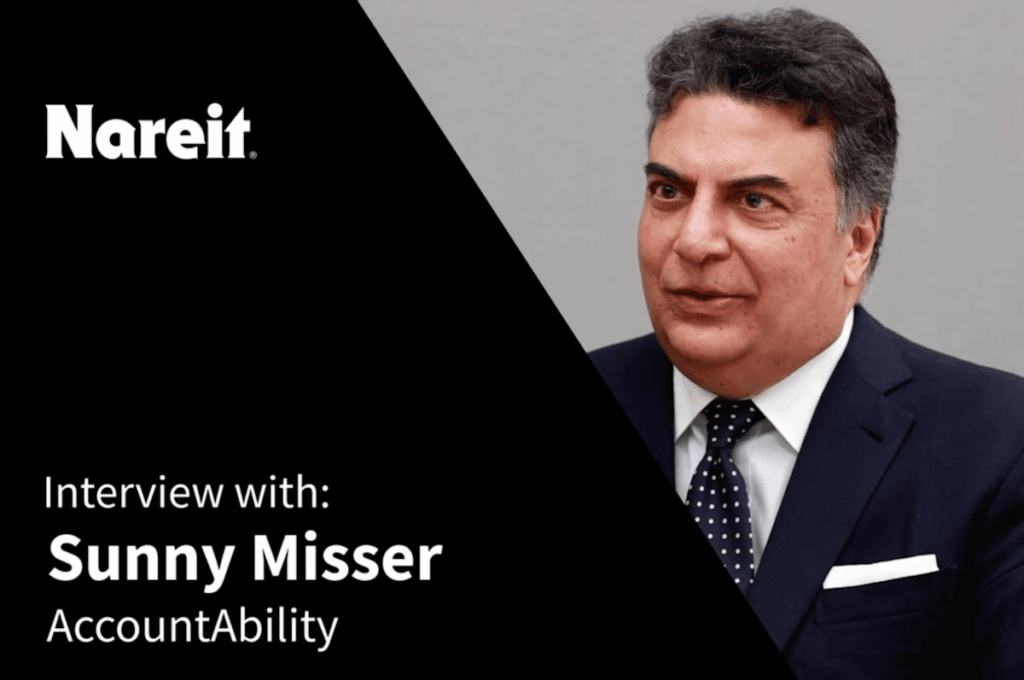
AccountAbility CEO, Sunny Misser on Uncertainty & Change Facing Business Leaders
NORTHAMPTON, MA / ACCESS Newswire / August 20, 2025 / In an environment of intensifying geopolitical tensions, shifting regulatory frameworks, and inconsistent stakeholder expectations, AccountAbility CEO, Mr. Sunil (Sunny) A. Misser urges global corporate leaders to recalibrate for a balanced approach to sustainability and business resilience at this time of uncertainty and volatility.
Mr. Misser outlined a pragmatic path forward during his annual interview with Nareit, the leading voice for US-based REITs and real estate companies, at their Washington, D.C. headquarters.
“Geopolitical risks – from state backed armed conflict, to commercial aggression, to the erosion of civic freedoms – very quickly manifest themselves in adverse geoeconomic outcomes like supply shocks, inflation, and unemployment,” said Mr. Misser. “Corporate resilience will depend on the ability of business leaders to anticipate, adapt, and respond to these larger forces at play.”
Five Key Themes Shaping Corporate Sustainability in 2025
“Businesses face a convergence of risks that are systemic, complex, and constantly evolving,” said Mr. Misser. “Leaders must move toward a proactive and integrated approach to sustainability – one that embeds risk management, collaboration, and innovation at the core of their operations.”
Mr. Misser emphasizes five key themes that emerged from AccountAbility’s recent report, Rethinking Sustainability in Corporate America – 2025:
-
The Trump Test – While political shifts have not halted sustainability efforts, they have reshaped external messaging and stakeholder engagement. Companies are focusing on material issues and further aligning sustainability initiatives with business needs in order to maintain resilience amid regulatory uncertainty.
-
The Brussels Effect – Companies with the Corporate Sustainability Reporting Directive (CSRD) and EU regulatory frameworks post significant cost and resource burdens, but they nonetheless are seen as a pathway towards global standardization. U.S. companies with European operations continue to heavily invest in reporting resources and legal teams to meet these stringent standards.
-
From the Sideline to the Bottom Line – Sustainability functions are expected to drive financial value, reflecting and requiring comprehensive business integration. Companies embedding sustainability within their core business strategy are unlocking greater value through innovation and operational efficiency.
-
The Supply Chain Black Box – Companies struggle to measure Scope 3 emissions and comply with global Supply Chain mandates. Despite increasing investor and regulatory pressure, supply chain data and information remain inconsistent and difficult to verify.
-
Green Finance, Red Tape – Access to sustainable finance remains limited due to shifting government incentives and wide-ranging investor expectations. Companies must navigate a labyrinth of requirements to unlock green funding and investment opportunities.
The report draws on extensive interviews with Chief Sustainability Officers across industries and geographies, revealing the growing integration of sustainability across organizations, extending beyond ESG or compliance efforts into risk management, strategic planning, operations, and capital allocation.
Three Major Systemic Risks
“People often tend to focus on a risk based on the probability and likelihood of its occurrence – which is critical. I also tend to evaluate risks on their intensity and the impact that they are likely to create. A risk with a slightly lower probability of occurrence that can wipe you out should be taken very seriously”, said Mr. Misser.
These themes exist within a backdrop of three primary categories of systemic risk that companies must be prepared to navigate immediately and in the near future:
-
Geopolitical Events and Geoeconomic Shocks – state-backed armed conflict and escalating commercial aggression can have serious consequences including supply chain disruption, volatility in the cost and supply of energy, and amplify unemployment, inflation, and the cost of capital.
-
Environmental Risks – ranging from extreme weather events (which are becoming more commonplace and routine) to biodiversity loss combined with intensifying pollution and natural resource depletion (water, air, food), require advanced risk modeling, resilience planning, and mitigation efforts.
-
Technological Threats – the rapid increase in technological connectivity combined with the exponential advancement in computing power creates a high-risk environment for rampant and unethical AI misuse, cyberterrorism, and unintended societal consequences.
A Strategic “Way-Forward” Framework for Sustainability Management
To help companies navigate this complex terrain, Mr. Misser highlights AccountAbility’s proven framework, “The Three C’s” – Collaborate, Calibrate, and Commercialize. The framework is not a singular effort but an ongoing process that must be rigorously embedded to enable organizations to remain resilient and competitive.
-
Collaborate – Establish continuous, structured coordination both internally and externally. Internally, sustainability must be fully integrated with finance, legal, operations, and other key functions. Externally, companies must actively engage their stakeholders – suppliers, regulators, investors, and civil society to build trust, share data, and scale impact.
-
Calibrate – Regularly assess and realign sustainability strategies, governance, and risk frameworks in response to evolving geopolitical, environmental, and technological risks. Companies must continuously iterate and prioritize what matters most – adjusting metrics, investments, and oversight to reflect current realities.
-
Commercialize – Move sustainability from a compliance obligation to a driver of competitive advantage and growth. Companies must systematically identify and develop innovative, revenue-generating opportunities linked to sustainability, positioning these efforts as core to business performance.
“As the velocity of global change accelerates, we are seeing the basic algorithm of governance shifting from the hierarchical model to a collaborative one. Businesses and their ecosystems will require a fundamental reset.”
________________
About AccountAbility
Established in 1995, AccountAbility is a leading global consulting and standards firm dedicated to advancing the sustainability and ESG agenda. The firm works with businesses investors, governments, and multilateral organizations to improve sustainability performance, drive innovation, and create lasting impact. Operating as a Public Benefit Corporation, AccountAbility has a global presence with offices in New York, London, Riyadh, and Dubai. The firm has been recognized by the Financial Times, Forbes and Capital Finance International for its excellence in sustainability, strategy, and governance and its website is archived by the United States Library of Congress.
Media Contact
Evan Achiron
Head of Marketing & Communications
(646) 507-5903
evan.achiron@accountability.org
AccountAbility CEO, Sunny Misser on Uncertainty & Change Facing Business Leaders
View additional multimedia and more ESG storytelling from AccountAbility on 3blmedia.com.
Contact Info:
Spokesperson: AccountAbility
Website: https://www.3blmedia.com/profiles/accountability
Email: info@3blmedia.com
SOURCE: AccountAbility
View the original press release on ACCESS Newswire