
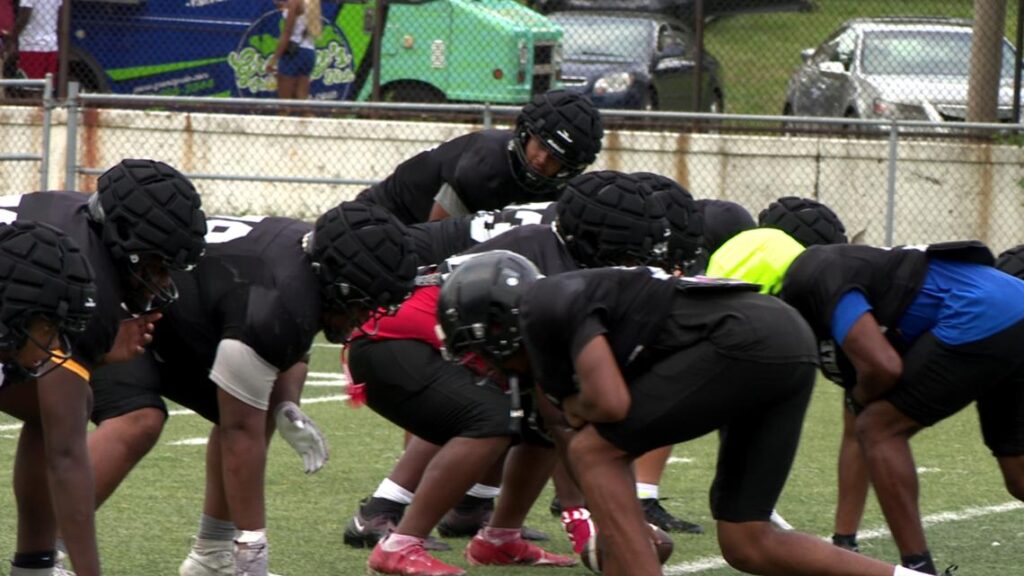
Numbers obtained by 3News Investigates reveal football plays a crucial role in funding high school sports across the state of Ohio.
CLEVELAND — In Ohio, high school football isn’t just the biggest draw: It’s the biggest bankroll in youth sports.
Numbers obtained by 3News show football is the primary financial lifeline for prep sports across the state. Without it, other sports could face major cuts or disappear entirely.
Few people understand the sport’s impact better than Ted Ginn Sr., who is preparing for his 28th season as head coach at Glenville High School in Cleveland.
Under his leadership, the Tarblooders have won multiple state titles and sent dozens of players, including his son, Ted Ginn Jr., to the NFL.
“It’s all about Ohio,” Ginn admitted with a smile. “We’re hard-nosed, blue-collar type people. We’re not fancy like that. Ohio’s got tough football.”
According to the Ohio High School Athletic Association (OHSAA), football drew more than 540,000 fans in 2024; nearly 100,000 fans more than every other fall sport combined.
Financially, the sport generated $1.78 million in profit for the OHSAA, while every other fall sport together lost $209,465.
Why it matters across Ohio
As a nonprofit, OHSAA uses money raised by high school sports to fund those same high school sports. It’s a cycle that depends on generating profit to maximize the student-athlete high school experience.
“We certainly need football,” admitted Tim Stried, OHSAA Director of Media Relations. “That revenue funds a lot of what we do.”
When asked how Ohio sports would function without the money that football brings in every fall, Stried confirmed that the landscape would look very different.
“We would probably not have as many sanctioned sports,” Stried claimed. “And for the sports that we do have, we’d most likely have to downsize what we do for those sports.
More than money
Beyond dollars and cents, football also leads in participation. OHSAA reports more students play football than any other sport.
Whether in urban or rural districts, large or small schools, or public and private programs, football often serves as a community gathering point.
“Show them love,” Ginn said, explaining his approach to developing student-athletes. “Show them that you can become somebody. We’re just doing it through football.”
Stried agreed: “It is the thing to do in that town, for that school, for that Friday night. It’s special, it’s unique. Not every state has these kinds of communities.”
At Glenville, located on Cleveland’s east side, players practice in a community often challenged by crime and aging infrastructure. But on the football field, those problems fade.
“It’s not about you, it’s about everybody else,” Ginn explained. “It’s about your community, it’s about what you represent.”
For many across Ohio, that message, combined with the sport’s financial backbone, underscores just how vital high school football is to schools, communities and kids.