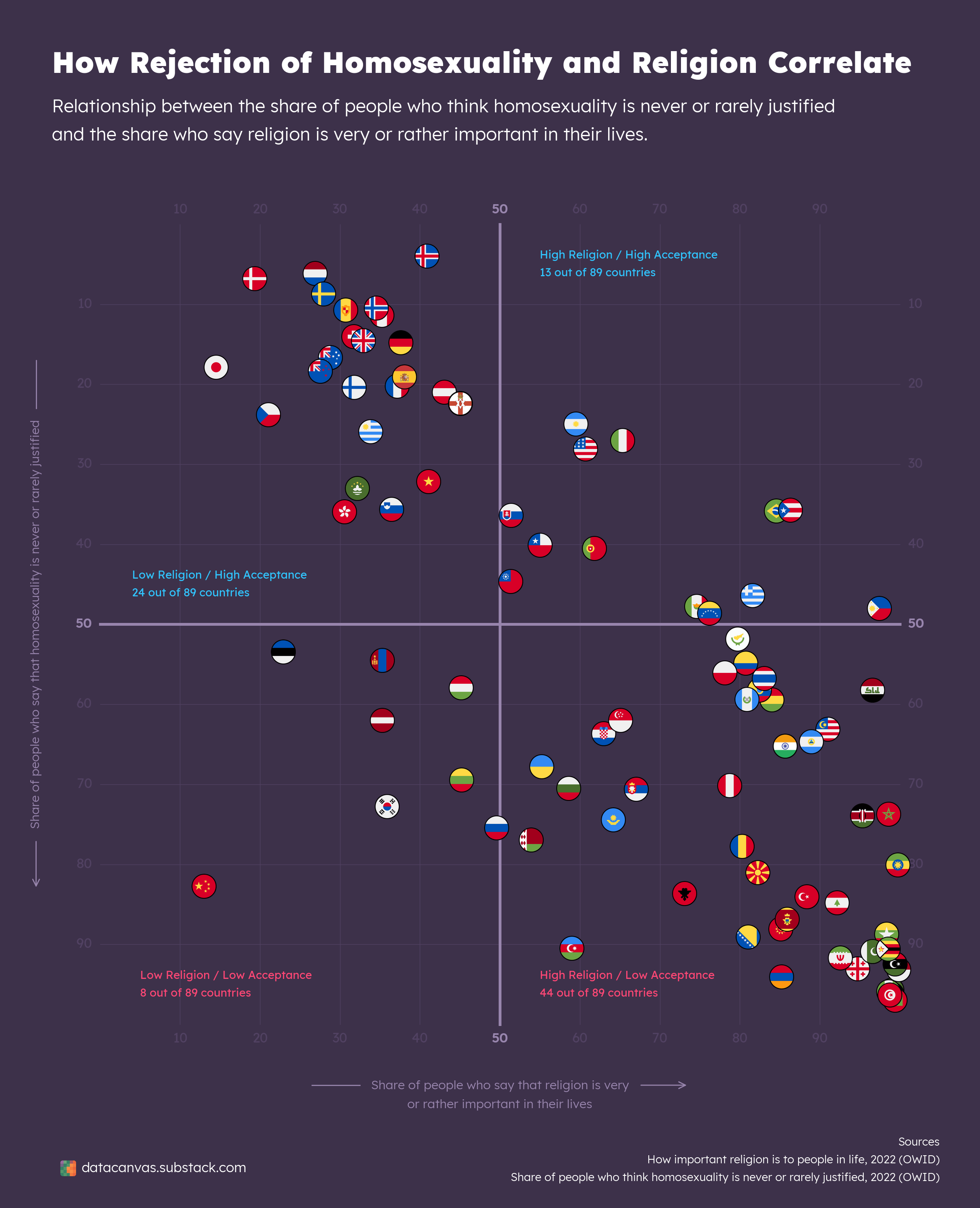
I wanted to create a scatterplot showing how rejection of homosexuality and the importance of religion correlate. I added the quadrants to make the pattern clearer.
Note about the data: The years represent the end date for the survey. The survey that ended in 2022, for example, started in 2017.
Some patterns:
1. All countries in the “Low Religion / Low Acceptance” quadrants are either Asian or have a strong historic connection to the Soviet Union.
2. At the very bottom right are the countries where religion plays the most important role and where homosexuality is rejected by almost everyone. These are often Muslim countries or Christian countries in Africa.
3. It’s clear that “Low Religion / High Acceptance” and “High Religion / Low Acceptance” outnumbers the other two quadrants.
I spent too much time trying to figure out the axis and their directions.
DrTonyTiger on
The text needs to be a lot bigger and with more contrast. Try previewing this on a phone, and see whether you beautifully reach the conclusion the data indicate.
CMDR_omnicognate on
My understanding is Japan’s religious population numbers are quite skewed, in that it’s quite difficult to measure compared to western countries. Most people practise some form of Shinto beliefs but don’t consider themselves to actually be religious for example.
Just thought it would be interesting to point out given it’s one of the lowest countries in the religiousness scale of the graph
pleaseallowthisname on
Quick update! This is better and easier to understand!
Chewquy on
I didn’t realize the text was supposed to represent the quarter and not the axis
Roubbes on
If I speak I’m in big trouble
DootyBusta on
Why point the y axis down? I’m so confused
SyrupyMolassesMMM on
America ‘high acceptance’ of homosexuality….
Eesh. The worlds a bad place eh.
Course I dont believe this graph for a second for australia is massively more religious than nz, but it looks pretty…
Tinder4Boomers on
hmmmm after having lived in Japan for 3 years, I’m suspicious of the methodology in this study. should be way closer to Korea and China
DossieOssie on
Thailand low acceptance of homosexuality?
Give me a brake.
We’re the Ladyboy Factory of the world, for crying out loud.
Firecracker048 on
I notice a pattern. I know reddit also noticed a pattern. I know this will be ignored, again, because its not convenient for certain political beliefs and affiliations.
bruhbelacc on
Religion, the biggest cancer ever.
Admirable-Length178 on
south korea is low religion?? they have a proportionate christian population, and I’m talking about evangelical type of christian,
also religion in the sense that we’re talking about organized religion, but the fact is that many countries in east asia follows folk religions, or a shinto type of belief. it’s easy for them to be sorted into low religion.
for example, Vietnam in generally is quite acceptance, yes. but it’s frown upon or considered still, a taboo.
Miserable_Corgi_764 on
China is extremely spiritual, but most wouldn’t claim to be religious, making results like these kinda pointless
KAY-toe on
This is an interesting visualization but pretty busy, and there are so many flags no one will be able to tell which icons represent every country. I believe this data can also be cut by religion (and possibly denominations?), maybe instead of doing it by country that would give you less icons and get the point across more clearly.
trashpandac0llective on
I don’t feel like the US belongs in the high religion/high acceptance quadrant at *all.* Maybe my perception is skewed because I live in Texas, but I’d be really interested to know how that data was gathered.
ipsum629 on
Iceland: don’t have to check ancestry if you can’t have kids with your partner
okktoplol on
An odd choice for the y axis to increase downwards. Also the label colors IMO don’t give it enough emphasis.
Nonetheless interesting
Relevant-Outcome3529 on
I thought Ukraine is fighting for european democray and lgbtq?
Fywq on
Being from Denmark myself, I am not so surprised by the majority of these, as we hear about it from time to time on the news, especially differences internally in Europe and EU, but also in the Americas and Africa. For me the really interesting data is the Asian countries. Many of them are not surprising to me but a few are really interesting:
The discrepancy between mainland China and Hongkong + Macau is really big. I guess it makes sense, but a bit surprised that Macau is also so open considering its Portuguese/catholic heritage (on the other hand Portugal surprised me negatively).
Also massive difference between China and Taiwan..
South Korea and Japan are much further apart than I expected. I knew Japan was placed around where they are based on another statistic I saw the other day, but I am surprised how bad South Korea is.
Mongolia is a positive surprise for me. Although I had nothing to base it on, I assumed they would be more negative towards homosexuality.
Uruguay again being almost Nordic, and definitely leaning towards sharing views with Northern Europe on both parameters is no surprise to me, but that is due to having a personal connection to the country. I guess it could surprise a lot of people.
SATorACT on
A bit disapointed that israel is not on the map. It shoudl be an interesting outlier.
ArmordilloY on
Love the flags, haven’t seen data on so much countries presentet this well hardly ever. I would suggest bigger font for text and more contrast on the axis label. It’s hard to read even on a big monitor. I would maybe even bold word religion and homosexuality on axis label.
I don’t like that Y axis is starts at 100 and ends at 0, but i still think its better than other options (NE being high/high is nice).
What tool did you use to make this graph btw?
Bonitlan on
I think this is an example of correlation ≠ causation.
More authoritarian/populist long standing regimes accept diverse populations much harder because they have to frame someone as the cause of all hardship.
Religion just so happens to be a useful tool in keeping the population in check
R3v3r4nD on
Now separate into different religions
Think_Loss6476 on
More than half of the world’s non-believers are Chinese citizens. Therefore, if we take into account absolute numbers, non-believers in the world are not as tolerant as it might seem.
BidnyZolnierzLonda on
Is India really more against homosexuality than Poland? Hinduism is much supportive on that than Catholicism.
plumberdan2 on
Love this chart but I spent too much time realizing that the quadrant labels are not axis labels
LowPowerModeOff on
„(..) homosexuality is never or rarely justified“
So… how can I be justifiably homosexual?
NittanyOrange on
Your standard note that correlation doesn’t equal, or imply, causation.
ErasablePotato on
Thailand seems very wrong, they a very high LGBT+ in general and gay specifically acceptance.
multiinstrumentalism on
Does OWID ask any questions about spirituality?
Tired_of_politics_75 on
Let’s stay out of each others lives and all will be good
shortandginger on
Korea is really religious why is it in low religion category?
Desert_Hiker on
Why stop only at 89? Can you do one in the future with more countries and maybe also a system that will make it visualize better countries that are kind of cluster together.
Brewe on
Just looking at the few countries where I have knowledge, the religiosity measurement seems to not look at actual religiosity, but instead what religion people are officially a member of. Take Denmark for example. Sure, most people are members of the state church, and many would probably also say they are Christian. But if you ask them if they are religious and the vast majority would say no.
Same thing applies to many of the countries in the upper left quadrant.
Long story short for any study correlating acceptance of anything related to LGBTQAI+ and religion is that all major religions are against it, and that stance seeps out to their members.

![[OC] How Rejection of Homosexuality and Religion Correlate](https://www.byteseu.com/wp-content/uploads/2025/08/9amubrzis5lf1-1247x1536.png "[OC] How Rejection of Homosexuality and Religion Correlate")
39 Comments
Data sources:
– [How important religion is to people in life (OWID)](https://ourworldindata.org/grapher/how-important-religion-is-in-your-life)
– [Share of people who think homosexuality is never or rarely justified (OWID)](https://ourworldindata.org/grapher/share-of-people-who-think-homosexuality-is-never-justified)
Tools used: Matplotlib
I wanted to create a scatterplot showing how rejection of homosexuality and the importance of religion correlate. I added the quadrants to make the pattern clearer.
Note about the data: The years represent the end date for the survey. The survey that ended in 2022, for example, started in 2017.
Some patterns:
1. All countries in the “Low Religion / Low Acceptance” quadrants are either Asian or have a strong historic connection to the Soviet Union.
2. At the very bottom right are the countries where religion plays the most important role and where homosexuality is rejected by almost everyone. These are often Muslim countries or Christian countries in Africa.
3. It’s clear that “Low Religion / High Acceptance” and “High Religion / Low Acceptance” outnumbers the other two quadrants.
If you want more charts and analysis on the topic, I wrote a post about it here: [https://datacanvas.substack.com/p/religion-and-homosexuality](https://datacanvas.substack.com/p/religion-and-homosexuality)
Appreciate any feedback I can get 🙂
China truly a league of their own
I spent too much time trying to figure out the axis and their directions.
The text needs to be a lot bigger and with more contrast. Try previewing this on a phone, and see whether you beautifully reach the conclusion the data indicate.
My understanding is Japan’s religious population numbers are quite skewed, in that it’s quite difficult to measure compared to western countries. Most people practise some form of Shinto beliefs but don’t consider themselves to actually be religious for example.
Just thought it would be interesting to point out given it’s one of the lowest countries in the religiousness scale of the graph
Quick update! This is better and easier to understand!
I didn’t realize the text was supposed to represent the quarter and not the axis
If I speak I’m in big trouble
Why point the y axis down? I’m so confused
America ‘high acceptance’ of homosexuality….
Eesh. The worlds a bad place eh.
Course I dont believe this graph for a second for australia is massively more religious than nz, but it looks pretty…
hmmmm after having lived in Japan for 3 years, I’m suspicious of the methodology in this study. should be way closer to Korea and China
Thailand low acceptance of homosexuality?
Give me a brake.
We’re the Ladyboy Factory of the world, for crying out loud.
I notice a pattern. I know reddit also noticed a pattern. I know this will be ignored, again, because its not convenient for certain political beliefs and affiliations.
Religion, the biggest cancer ever.
south korea is low religion?? they have a proportionate christian population, and I’m talking about evangelical type of christian,
also religion in the sense that we’re talking about organized religion, but the fact is that many countries in east asia follows folk religions, or a shinto type of belief. it’s easy for them to be sorted into low religion.
for example, Vietnam in generally is quite acceptance, yes. but it’s frown upon or considered still, a taboo.
China is extremely spiritual, but most wouldn’t claim to be religious, making results like these kinda pointless
This is an interesting visualization but pretty busy, and there are so many flags no one will be able to tell which icons represent every country. I believe this data can also be cut by religion (and possibly denominations?), maybe instead of doing it by country that would give you less icons and get the point across more clearly.
I don’t feel like the US belongs in the high religion/high acceptance quadrant at *all.* Maybe my perception is skewed because I live in Texas, but I’d be really interested to know how that data was gathered.
Iceland: don’t have to check ancestry if you can’t have kids with your partner
An odd choice for the y axis to increase downwards. Also the label colors IMO don’t give it enough emphasis.
Nonetheless interesting
I thought Ukraine is fighting for european democray and lgbtq?
Being from Denmark myself, I am not so surprised by the majority of these, as we hear about it from time to time on the news, especially differences internally in Europe and EU, but also in the Americas and Africa. For me the really interesting data is the Asian countries. Many of them are not surprising to me but a few are really interesting:
The discrepancy between mainland China and Hongkong + Macau is really big. I guess it makes sense, but a bit surprised that Macau is also so open considering its Portuguese/catholic heritage (on the other hand Portugal surprised me negatively).
Also massive difference between China and Taiwan..
South Korea and Japan are much further apart than I expected. I knew Japan was placed around where they are based on another statistic I saw the other day, but I am surprised how bad South Korea is.
Mongolia is a positive surprise for me. Although I had nothing to base it on, I assumed they would be more negative towards homosexuality.
Uruguay again being almost Nordic, and definitely leaning towards sharing views with Northern Europe on both parameters is no surprise to me, but that is due to having a personal connection to the country. I guess it could surprise a lot of people.
A bit disapointed that israel is not on the map. It shoudl be an interesting outlier.
Love the flags, haven’t seen data on so much countries presentet this well hardly ever. I would suggest bigger font for text and more contrast on the axis label. It’s hard to read even on a big monitor. I would maybe even bold word religion and homosexuality on axis label.
I don’t like that Y axis is starts at 100 and ends at 0, but i still think its better than other options (NE being high/high is nice).
What tool did you use to make this graph btw?
I think this is an example of correlation ≠ causation.
More authoritarian/populist long standing regimes accept diverse populations much harder because they have to frame someone as the cause of all hardship.
Religion just so happens to be a useful tool in keeping the population in check
Now separate into different religions
More than half of the world’s non-believers are Chinese citizens. Therefore, if we take into account absolute numbers, non-believers in the world are not as tolerant as it might seem.
Is India really more against homosexuality than Poland? Hinduism is much supportive on that than Catholicism.
Love this chart but I spent too much time realizing that the quadrant labels are not axis labels
„(..) homosexuality is never or rarely justified“
So… how can I be justifiably homosexual?
Your standard note that correlation doesn’t equal, or imply, causation.
Thailand seems very wrong, they a very high LGBT+ in general and gay specifically acceptance.
Does OWID ask any questions about spirituality?
Let’s stay out of each others lives and all will be good
Korea is really religious why is it in low religion category?
Why stop only at 89? Can you do one in the future with more countries and maybe also a system that will make it visualize better countries that are kind of cluster together.
Just looking at the few countries where I have knowledge, the religiosity measurement seems to not look at actual religiosity, but instead what religion people are officially a member of. Take Denmark for example. Sure, most people are members of the state church, and many would probably also say they are Christian. But if you ask them if they are religious and the vast majority would say no.
Same thing applies to many of the countries in the upper left quadrant.
Long story short for any study correlating acceptance of anything related to LGBTQAI+ and religion is that all major religions are against it, and that stance seeps out to their members.
Isn’t gay marriage still illegal in Italy?