
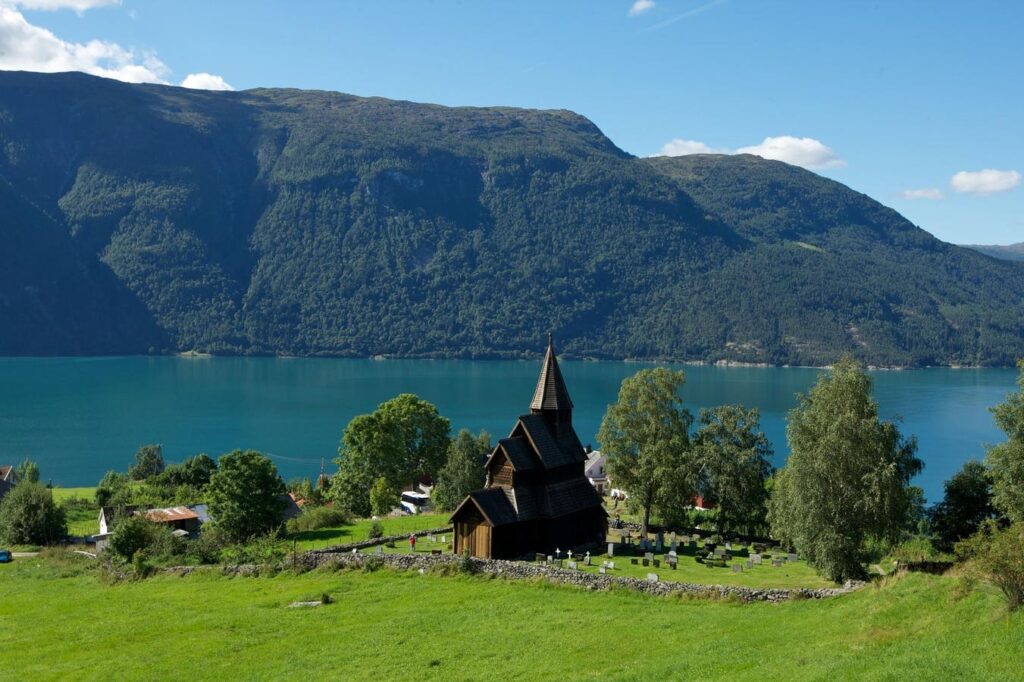
Urnes Stave Church against the stunning backdrop of the Lustrafjord.
Getty Images
High above Norway’s beautiful Lustrafjord, Urnes Stave Church has stood watch for nearly nine centuries. This dark, wooden church is a masterpiece of architecture and storytelling, carved in timber at a time when Norse myths and Christian faith collided.
Believed to date from the 1130s, Urnes is the oldest surviving stave church in Norway and one of just 28 still standing. These wooden churches were once common across the country, built when Christianity was still new and pagan traditions lingered.
Today, their rarity and beauty make them among the most sought-after cultural sights in Norway.
Urnes Stave Church
At first glance, Urnes seems almost modest, a compact Romanesque-style building perched on a hillside overlooking the fjord. Step closer, however, and its extraordinary detail comes alive, such as the arched entrance porch and dramatic carvings that captures a society in transition.
Urnes Stave Church in its hilltop location.
David Nikel
Archaeologists believe the site itself has hosted religious structures long before the current church was built, with three earlier buildings likely raised here.
That continuity makes Urnes not just a Christian monument but a sacred site spanning different belief systems.
Though modest in size, Urnes feels timeless. Its survival owes much to both the remote location and the thick coats of tar applied over centuries to protect the wood from Norway’s harsh weather.
One side of the church appears darker than the other, simply because the sun has faded the coating unevenly. When tar is reapplied, the entire exterior takes on the same deep, almost black sheen.
Inside Norway’s Oldest Stave Church
Stepping through the heavy wooden door is like crossing into another world. Wooden posts — the “staves” that give the churches their name — rise up to support the structure.
Exposed wood with original carvings dominates the interior of Urnes Stave Church.
David Nikel
A historic crucifixion scene, along with other medieval artwork, survives on the walls. The combination of thick timber, small windows, and centuries of ritual creates a hushed, intimate atmosphere.
A UNESCO World Heritage Site
In 1979, Urnes was added to UNESCO’s World Heritage List, recognized for its artistry and historic value. That international spotlight has drawn travelers from across the globe to this quiet corner of western Norway.
UNESCO picks out the origins of the ‘Urnes style’ decoration found on the exterior of the church as a contributing factor to its listing. It says the “exquisite quality” of the strap-work panels and elements of Viking tradition from the previous building are also found in other parts of Scandinavia and North-Western Europe.
This style of decoration on Urnes Church has become known as ‘Urnes style’.
David Nikel
But even with its fame, visiting Urnes doesn’t feel like a mass tourism experience. The church is small, and entry is managed by guided tours to protect the fragile interior.
These take place daily during the summer months from May through September, when the road and ferry schedules align with visitor demand.
The Journey Is Part of the Experience
Getting to Urnes is an adventure in itself. Most visitors arrive via the Solvorn–Ornes ferry, a short but scenic crossing of the Lustrafjord.
The 20-minute journey offers sweeping views of mountains plunging into the water and traditional boathouses lining the shore. Watching your car, or even a tour bus, maneuver onto the small ferry is part of the charm.
From the ferry dock in Ornes, a winding road leads up the hillside to the church. As you climb higher, the building suddenly comes into view, its tar-dark timbers standing out against the greenery. For many visitors, that first glimpse is a moment of awe.
Urnes can also be visited on organized excursions from cruise ships docking in Skjolden, at the far end of the fjord.
The Lustrafjord glistens below Urnes Stave Church.
David Nikel
This longer approach allows travelers to see more of the Lustrafjord, with highlights including the Feigefossen waterfall and the idyllic village of Solvorn, where white wooden houses and waterfront boathouses create one of the region’s prettiest stops.
Around the fjord, farms cling to steep hillsides, their rhythms shaped by the seasons and the water. Villages like Ornes and Solvorn offer a taste of traditional fjord life, with small cafés, guesthouses, and hiking trails.
Other stave churches in the region are worth a detour too. Kaupanger Stave Church, also on the Sognefjord, is larger and better suited to understanding the scale of these buildings when they served entire communities. But none can rival Urnes for its age, artistry, and location.
Planning Your Stave Church Visit
Reaching Urnes from the regional capital of Sogndal takes less than an hour by car, including the ferry crossing.
Sogndal is itself well connected by road and air, making it an excellent base for exploring the Sognefjord region.
If you are traveling independently, check the ferry timetable in advance, as crossings are limited. Arriving early allows time to explore Solvorn, where a small hotel and a handful of cafes make for a pleasant pause before heading across the fjord.
Guided tours are short but informative, highlighting both the architectural details and the wider historical context. Because Urnes Stave Church is small, tours are scheduled in time slots, especially in the peak summer months. First come, first served.
MORE FROM FORBESForbesSkjolden Delivers Big Views And Cultural Depth On Norway CruisesBy David NikelForbesThe Anglo-Saxon Church That Still Stands Today In Brixworth, EnglandBy David NikelForbesHeddal Stave Church: Norway’s Wooden MasterpieceBy David Nikel