
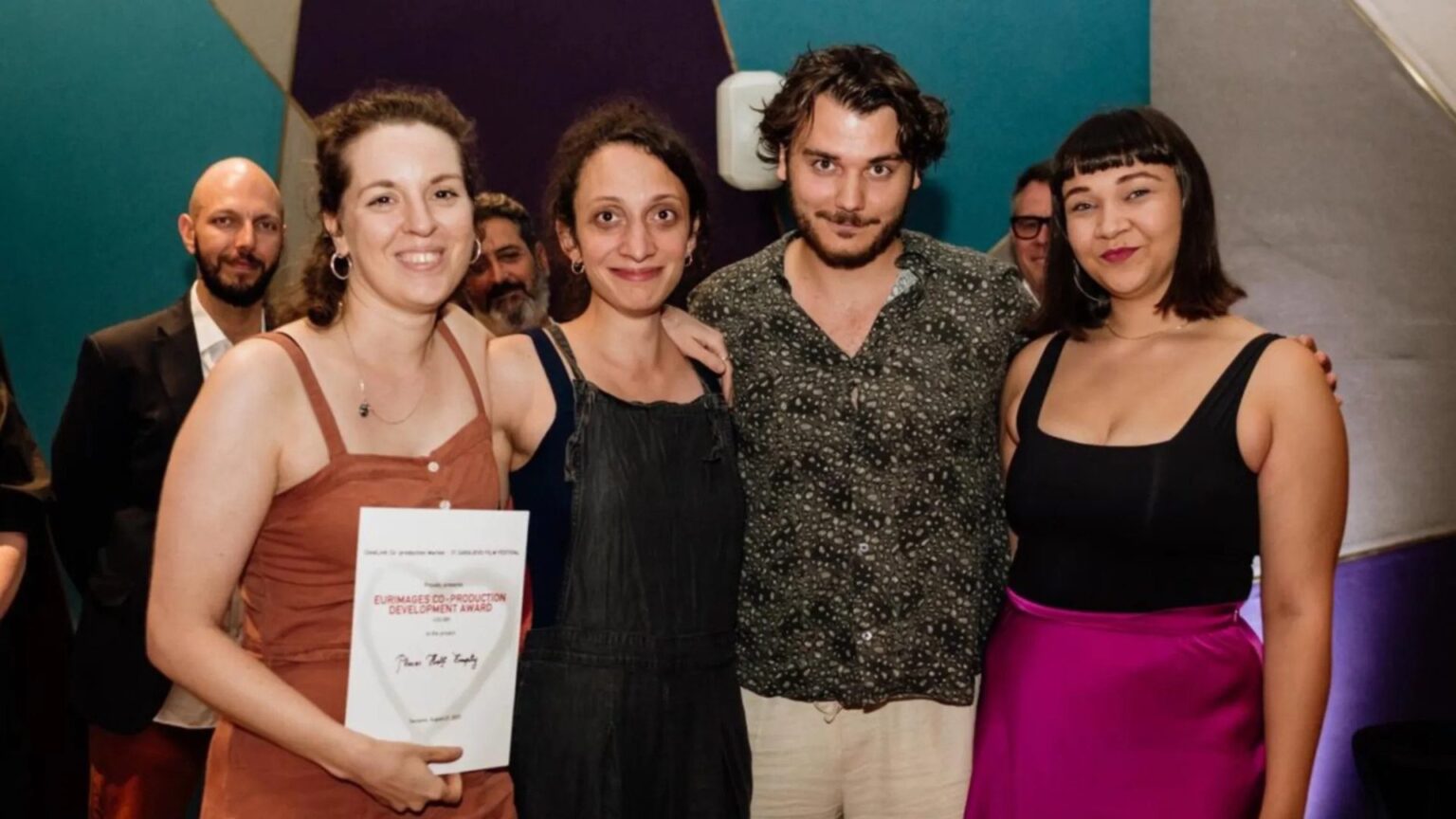
When Places Half Empty secured the Eurimages Co-Production Development Award at Sarajevo’s CineLink Industry Days in August 2025, it was a breakthrough moment for the team behind the film. With €20,000 in development funding, the queer romance directed by Dorka Vermes proved that independent Hungarian productions can compete and succeed in the international film industry — even without a cent of government support.
This matters. In Hungary today, state funding structures dominate the film landscape, and projects that fall outside political alignment or mainstream genres often face exclusion. That Places Half Empty has been recognized abroad at such an early stage signals both the strength of its creative vision and the resilience of its production team.
A Director’s Vision Driving Production
For director Dorka Vermes, the film is more than a narrative choice — it is the foundation on which the production is built. Her focus on lived experiences of love and belonging underlines the importance of creating space for independent stories.
“Can one find a sense of home in a society that offers no room to be different—not socially, emotionally, or physically?”
– Vermes says.
By resisting symbolic or ideological simplifications, Vermes creates a story that resonates internationally. This is crucial from a production standpoint: films that can communicate local realities while speaking to global audiences have a greater chance of drawing festival attention, co-production partners, and distribution opportunities.
Producing Independence
The production team has been instrumental in turning vision into reality.
Producer Evelyn Balogh left behind a conventional career in economics to pursue film production:
“In the production department, I discovered the perfect balance between artistic expression and logistical, strategic thinking—an intersection that fuels my motivation and ambition.”
Her ability to navigate the practicalities of development, financing, and partnerships has given the project stability at a time when government-backed projects dominate Hungary’s funding pipelines.
Co-producer Botond Lelkes frames the film’s independence in more direct terms:
“My goal is to create and sustain communities that support free and high-quality culture without censorship.”
For Lelkes, keeping the film outside state structures is not only a financial reality but also an ethical choice. By combining their strengths, Balogh and Lelkes represent a new model for Hungarian producers: agile, international, and determined to sustain culture without compromise.
Béla Tarr: A Signal of Legitimacy
The involvement of Béla Tarr as executive producer gives the film added industry credibility. Tarr’s mentorship of Vermes is more than symbolic — his backing signals to international partners that Places Half Empty is a project worth trusting. In an industry where co-productions rely heavily on reputation and networks, Tarr’s presence in the credits is a production asset.
International Recognition as Industry Leverage
Winning the Eurimages Co-Production Development Award is more than a symbolic gesture of encouragement. It is a stamp of approval from an international jury that can attract further financing, festival invitations, and partners for completion.
As Screen Daily noted, Sarajevo’s CineLink Industry Days has become a launchpad for promising projects across Europe, while The Hollywood Reporter underlined that Places Half Empty stood out for its originality. Cineuropa went further, calling the award “a recognition of the film’s strong development potential.”
This recognition positions Vermes’ film alongside past CineLink successes that went on to secure international festival slots and distribution deals. For independent producers, such awards can be the difference between a stalled project and a completed film.
Financing Strategies: Lessons from the Region
Producing without government support is not unique to Hungary. Across Central and Eastern Europe, filmmakers often patch together financing through a combination of:
- Eurimages: a pan-European co-production fund that supports projects crossing national borders. Films like Radu Jude’s Bad Luck Banging or Loony Porn benefited from such mechanisms, pairing local funds with international backing.
- Broadcasters like ARTE or ZDF/ARTE: which regularly step in as minority co-producers, offering both financing and distribution guarantees. Céline Sciamma’s Portrait of a Lady on Fire leveraged ARTE’s involvement early in its financing process.
- Regional co-productions: Projects often involve multiple production companies from neighboring countries. Romania’s Collective and Serbia’s Quo Vadis, Aida? were realized through such models, combining Balkan, Western European, and NGO funding.
- Development platforms: Sarajevo’s CineLink, Karlovy Vary’s Works in Progress, and Rotterdam’s CineMart are crucial in connecting independent filmmakers with international sales agents, distributors, and co-financiers.
Places Half Empty is now following this model. By securing the Eurimages Development Award in Sarajevo, the team has gained not only financial support but also credibility that will make it easier to approach broadcasters, sales companies, and European co-producers. For a Hungarian production without state backing, this international strategy is not optional — it is the only viable path forward.
Hungary as an Independent Hub
Hungary is no stranger to producing internationally successful independent films. Yorgos Lanthimos’ Poor Things, which shot extensively in Hungary, became one of the most acclaimed films of the decade, despite being an eccentric project on paper. Its success demonstrates the country’s ability to host independent voices with global impact.
Places Half Empty builds on this potential but under far stricter financial conditions. Unlike Poor Things, which had the backing of international studios, Vermes’ film is relying on piecemeal development support and community commitment. The comparison highlights the unique achievement of producing a film of this ambition without state or studio safety nets.
More than a movie – case study of independent projects
For Hungary’s film sector, Places Half Empty is more than a story about two women’s love. It is a case study in how independent projects can be mounted in a politically challenging environment. Its recognition at Sarajevo shows that international juries and financiers are willing to invest in Hungarian stories that would otherwise struggle at home.
As the film moves further into development, its progress will be watched closely not just by festival programmers but by producers and filmmakers across Central Europe. It represents a model of resilience: how to leverage mentorship, international recognition, and strategic production planning to make independent cinema possible in Hungary today.
For producer Levente, the Sarajevo award is more than symbolic recognition — it is a tool for building the project’s financing and international positioning.
“For us, filmmaking has meant international partnerships from the very beginning, opening horizons and ensuring our films can reach audiences beyond the Hungarian market,”
he explained to Budapest Reporter.
The team is currently developing new screenplay drafts while negotiating with international producers and structuring financing strategies, with a sales agent already engaged at the development stage to ensure the film enters the market with a clear distribution pathway. As Levente put it, the award is
“a significant validation of our work and of the new wave of value-driven filmmaking we believe in — and the very reason NoN Lieu Film Productions exists.”
Beyond Places Half Empty, he stressed that Sarajevo has opened doors to new collaborations that will shape the company’s future projects as well.
With Places Half Empty, Vermes, Balogh, and Lelkes have proven that independent cinema in Hungary can still thrive. The project’s recognition abroad validates its artistic vision while strengthening its production prospects. More importantly, it demonstrates that even in an environment where state funding is inaccessible, dedicated filmmakers can build sustainable, internationally relevant projects.
As the film continues its journey through financing and development, it carries with it the hopes of Hungary’s independent sector: that stories untethered from politics can still find their place on the world stage.