
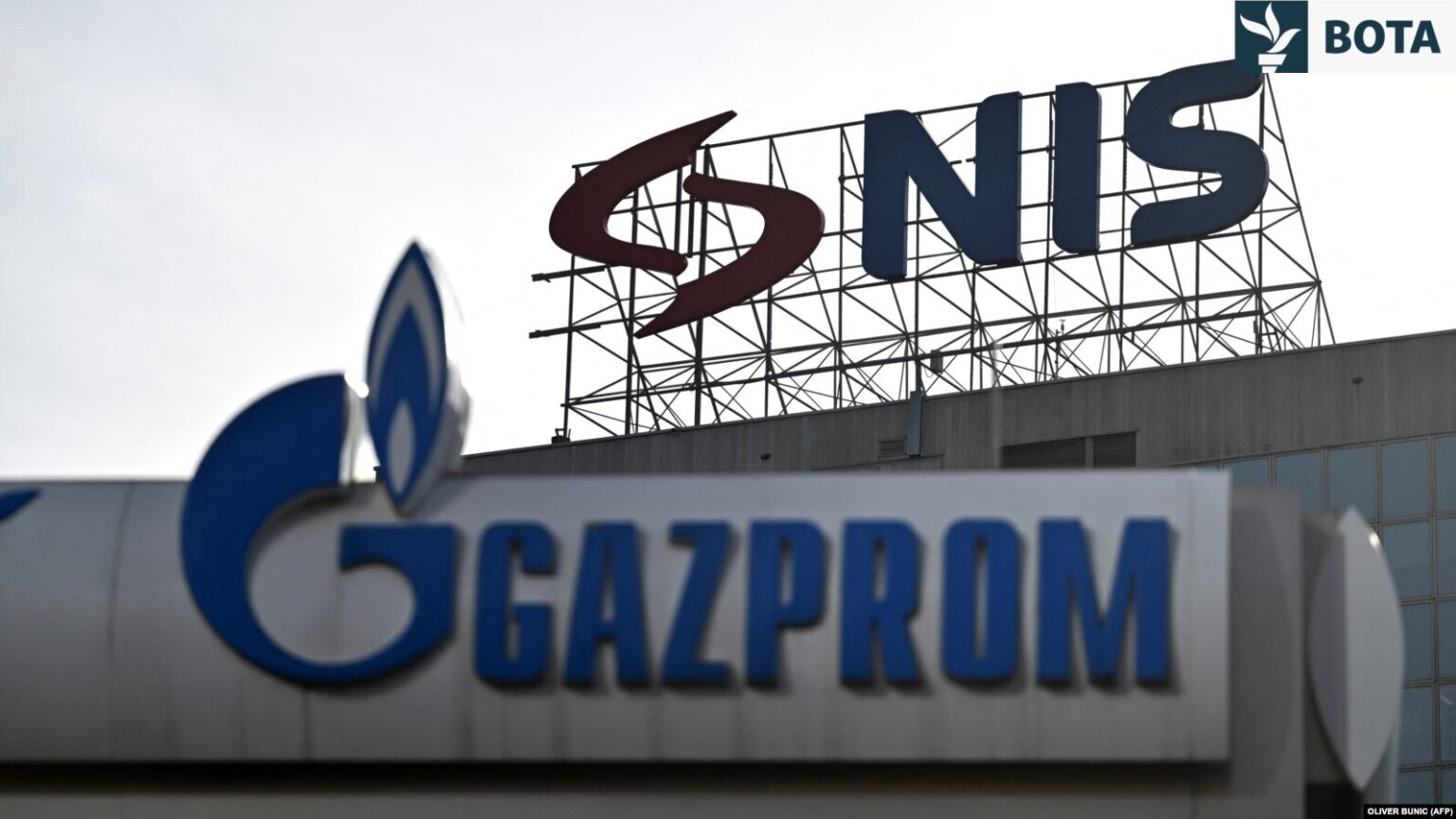
Will Serbia buy Russian shares in NIS?

Express newspaper
25/08/2025 8:20
Has Serbia officially made an offer to buy shares of the Oil Industry of Serbia (NIS)?
The Ministry of Mines and Energy has not answered this question, although the director of the Srbijagas company, Dušan Bajatović, had stated this earlier in August.
Bajatović, according to the media, said in early August that Serbia would buy this company, but the Russian side says that NIS is not for sale.
Radio Free Europe/Radio Liberty’s Balkan Service has not received a response from the director of Srbijagas for more details on what Serbia has offered. It has not received a response from NIS either.
NIS was added to the US sanctions list in January due to its ties to Russia’s Gazprom Neft, which is under Western sanctions over Russia’s invasion of Ukraine.
On July 28, the US postponed the implementation of sanctions for the fifth time.
What has the Serbian side undertaken and what has the Russian side done?
Serbian President Aleksandar Vučić said in January that “Russia’s complete exit from NIS ownership” is being sought, which will require a transformation of ownership.
On March 14, NIS submitted a request to the US Treasury Department to be removed from the sanctions list, while Gazprom Neft transferred about 5 percent of its share to Gazprom, a Russian company not included in Western sanctions.
Currently, Gazprom Neft’s ownership stake in NIS is around 44.9 percent, the Serbian state has 29.9 percent of the shares, while Gazprom holds around 11 percent. The remaining shares belong to smaller shareholders.
Serbia’s Energy Minister, Dubravka Gjedovic Handanovic, said on August 12 that, looking at the long-term perspective, the current situation with the postponement of sanctions against NIS on a monthly basis “is bringing a lot of uncertainty.”
“The only long-term solution for NIS is removal from the sanctions list,” she stressed.
She had earlier, in July, said that “concrete measures are being taken to reduce uncertainties in the functioning of the NIS.”
Among other things, as he stated at the time, the election of two independent members of the Board of Directors is in process “in order to meet the requirements of OFAC [Office of Foreign Assets Control in the US Department of the Treasury] regarding the management of the company.”
NIS is the only company in Serbia that deals with the exploration, production and processing of oil, as well as the production of natural gas.
“Compulsory acquisition or reorganization”
Milan Kovacevic, an expert on foreign investments, tells Radio Free Europe that Serbia has the opportunity to force the “Russian side” to sell its shares in NIS, but it is not doing so for political interests.
“If any member of the company makes success difficult simply by being a member, the entire activity of the company must be subordinated to its success. So, there is a possibility that someone will be ‘forced’ out of ownership, but the question is whether Serbia will follow this path,” he says.
Serbia, despite being a candidate country for membership in the European Union, refuses to comply with Western sanctions against Russia. Serbian officials maintain contact with their Russian counterparts even as the Russian invasion of Ukraine continues, while Serbia hopes for Russian support in negotiations over Kosovo, its former province, which it does not recognize as an independent state.
Kovacevic emphasizes that there is also the possibility of a reorganization of NIS, where “the business is transferred to a company with different ownership.”
According to him, the position of the Russian partner, who does not want to sell its share, is understandable.
According to NIS data, the volume of investments in this company since 2008, when the company was privatized, reaches over 4 billion euros.
“Under normal conditions, a transaction depends on whether the seller is willing to sell. However, this is not a simple transaction. It remains to be seen how harmful it is for the company that they [the Russian partners] remain,” he says.
One of the previously mentioned scenarios for NIS is nationalization. It would occur through a special law of the Serbian Parliament, which would provide for a transaction with a certain compensation for the shares.
Serbian President Aleksandar Vučić rejected in January the possibility of nationalizing NIS, adding that Serbia would not participate in the confiscation of Russian assets.
“Attraction strategy”
Economist Milan Kovačević estimates that at the moment it does not appear that the Serbian Government is taking steps that would solve the NIS problem.
“I fear that [Serbian officials] will continue to try to outdo others and sit ‘on more than one chair.’ This could lead to even worse conditions than now,” he says.
Minister of Mining and Energy, Dubravka Gjedovic Handanovic, said in July that the ministry she leads had asked the US to postpone the sanctions for 180 days, but the US only postpones them for 30 days each time.
According to her, the ultimate goal is to remove NIS from the US sanctions list. She added that for this, the most important thing is “progress in the dialogue between the US and Russia.”
US President Donald Trump had suggested that a deal with Russia over the war in Ukraine could be reached in the near future after his meeting with Russian President Vladimir Putin in Alaska on August 15.
However, no agreement was reached at this meeting to end the war in Ukraine.
Economist Milan Kovačević believes that it is not wise for Serbia to expect that negotiations between the US and Russia will resolve the NIS issue.
“Only a postponement, not a lifting of sanctions, can be achieved here. Depending on the agreement that will be reached on Ukraine, over time there may be some adjustments and easing of sanctions, but not radical lifting,” he says.
NIS Business
NIS representatives announced in August that the company ended the first half of the year with a loss of 3.6 billion dinars (30 million euros).
The financial director of NIS said that, in addition to US sanctions, the company’s results were also affected by the decline in oil prices on the world market, the effect of expensive stocks of oil and its products, as well as the negative financial result of HIP Petrohemija, which NIS took ownership of in 2023.
NIS leaders also announced that they will continue to work to remove the company from the US sanctions list.
Serbia, in 2008, sold 51 percent of NIS shares to Gazprom Neft for 400 million euros.