
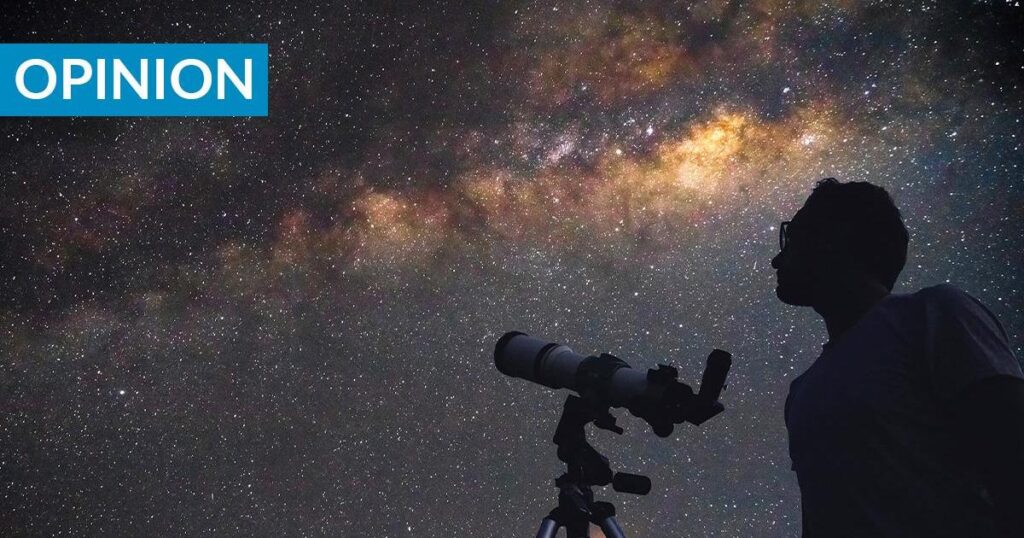
Recently, the government announced that Fort Binġemma will serve as a “space hub” and “astronomy park”. Regenerating such historic sites for educational and scientific endeavours is a great use of public land, contrasting with what happened to other places such as Manoel Island and Fort Chambray. This effort is to be commended.
Indeed, the Astronomical Society of Malta – a voluntary organisation which, as part of its mission to spread knowledge about astronomy, has been holding regular events for the public since its formation in the early 1980s – had long been pushing for such a space in Malta.
Since then, it has to be said, the Maltese islands and their nightscape have changed a lot. Light pollution – the enemy of observational astronomy – has proliferated across the archipelago, largely on account of an increase in urban sprawl and a near-complete lack of legislation on lighting.
Since 2017, my research group has been measuring and monitoring the night sky brightness (NSB) in the Maltese islands. In 2020, we published the first NSB map for the archipelago, which we use as a reference point against which to compare more recent measurements.
Not only did we find, back then, that Malta’s night sky has become a wash of white because of skyglow (which was not surprising in itself) but the quantification of this brightness has allowed us to ascertain that, in many places across the islands, the situation keeps getting worse year on year.
You would be right to ask: But what is the situation at Binġemma like? Our measurements show that, while the quality of the night sky here is better than in several places in Malta, light pollution is not “minimal”, as some have stated. It is certainly not as good as in other coastal areas in the vicinity, the best being Rdum tal-Vigarju (cliffs off Baħrija). Neither does it approach the night sky quality of some areas in Gozo.
Of these, the most notable are the northwestern and northeastern stretch of coast (for northern views); and Dwejra, which, so far, is the best site on the islands (especially for western and southern views, therefore being the best location from where to observe the Milky Way).
Such areas in Gozo are protected on paper: policy GZ-DARK-1 of the Gozo and Comino local plan establishes Dark Sky Heritage Areas (DSHAs) in Gozo and Comino, prohibiting the use of any lighting in these rural and coastal areas unless for maritime or aerial navigation. This helped to keep these zones dark, serving as a respite for nocturnal animals and offering us a glimpse at the wonders of our universe. (Even so, they have been deteriorating; more on this shortly.)
The case has repeatedly been made that a similar designation should apply to (and enforced in) the southwestern stretch of coast in Malta. The hope was that this would likewise help preserve it. Alas, these pleas have fallen on deaf ears.
But let us get to the core of the matter: can Binġemma really serve as a location from where to conduct astronomical observations?
First off, for such an endeavour to be successful, artificial lighting around this area must be banned, just as in DSHAs. But that is nowhere near enough. The principal issue is that light pollution has been left to grow unchecked all over Malta. Our country is tiny; as a result, light pollution easily impinges upon darker areas such as Binġemma, heavily compromising them.
The solution – let me be clear – is not to turn off all lighting on the islands and take our country back to the times of candlelight (incidentally, a common retort by detractors). While the area around Binġemma would indeed have to be kept lighting-free, what the rest of the country needs are very simple measures that, nonetheless, can make a big difference.
Where policies regulating light pollution do exist, one witnesses an abject failure at enforcing them- Joseph Caruana
First, ensure all lighting is “full cutoff”, meaning it is directed downwards, not sideways or (worse) skywards.
Second, use lighting only where required and do not over-illuminate; adhere by the ALARA principle – As Low As Reasonably Achievable.
Third, do not use blue-rich (cold) LEDs that have a colour-correlated temperature (CCT) higher than 3000 Kelvin; employ LEDs with a CCT below 2700 Kelvin, emitting warm light that scatters far less (besides carrying other advantages).
Adhering to such practices would not only help bring back the stars but also be of benefit to ecology and human health. The scientific literature is replete with examples of the adverse effects of light pollution upon wildlife and the circadian rhythm, potentially contributing to a host of health issues. Mitigating light pollution in Malta is not just about Binġemma’s night sky but about a better and healthier environment all around.
One would think that, given the simplicity and efficacy of the above measures, which offer only advantages, the authorities would be rushing to implement them. However, light pollution guidelines announced in 2020 by the ERA and the PA have never been finalised and published. If guidelines have been stuck for five years, what hope do we have for enforceable policies?
The problem runs deeper. Even our most treasured sites, the likes of Dwejra, have been left to degenerate, despite their being designated as DSHAs.
The problem has worsened to the extent that, this March, no fewer than 15 organisations and academic institutions were compelled to publish an open letter to the ministers for the environment and for Gozo and planning, urging action. The call was reiterated in July.
Even in those instances where policies regulating light pollution do exist, one witnesses an abject failure at enforcing them.
This is the backdrop against which Fort Binġemma’s future needs to be assessed. Just as one cannot breathe good-quality air in a smog-filled city, one cannot observe a starry sky if engulfed by light-pollution. Astronomy and the safeguarding of the natural environment go hand in hand.
Fort Binġemma holds promise and I, for one, was glad to learn that the government intends to use it for an educational purpose. It would complement the astronomical observatory in Gozo (operated by the Institute of Space Sciences and Astronomy and used largely for university student training and research purposes).
However, astronomical facilities, if they are to be successful, require long-term, holistic planning. If the government is serious about astronomical observation and outreach in Malta, it first needs to address the problem of light pollution permeating the country.
The way forward is simple; the will has been lacking. One hopes that politicians and the authorities start to listen – in more domains than one – to what science has to say. Perhaps, Fort Binġemma may help pave the way.
Joseph Caruana is an astrophysicist at the Department of Physics and Institute of Space Sciences and Astronomy, University of Malta.