
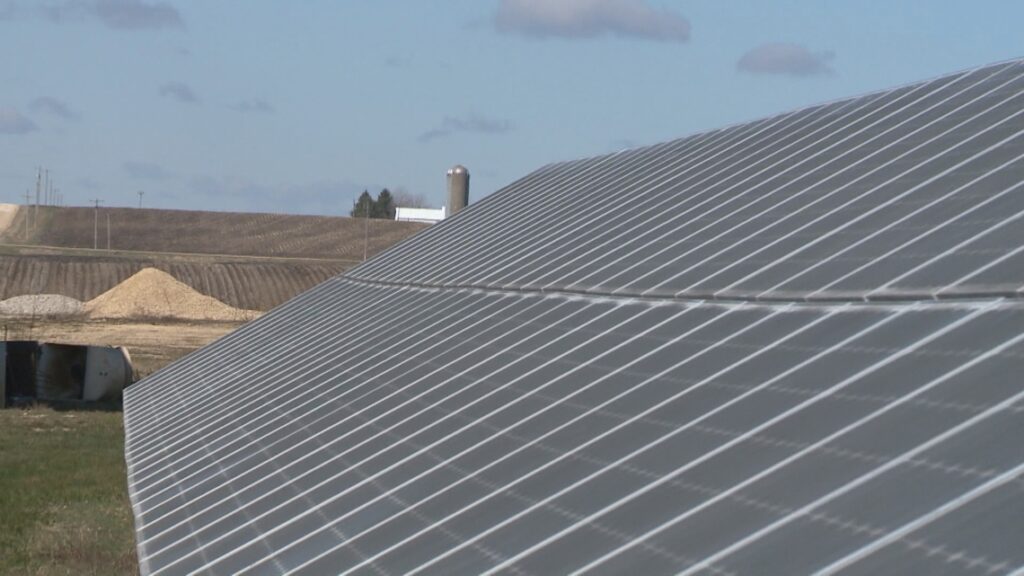
The U.S. Department of Agriculture is pausing its Rural Energy for America Program, citing concerns over land access for young farmers.
DES MOINES, Iowa — The U.S. Department of Agriculture is rolling back a grant and loan program supporters say was designed to increase rural economic development through renewable energy. However, some Iowa farmers are pushing back.
Agriculture Secretary Brooke Rollins said wind and solar infrastructure is stealing farmland away from young people to get into the business. That’s why the Rural Energy for America Program has been put on pause.
Landowner Mike Carberry spoke at an Iowa Farmers Union virtual get-together on Thursday.
“It’s just nuts,” he said.
Rollins made the announcement last week, as part of President Donald Trump’s efforts to move away from renewable energy sources.
“It has been disheartening to see our beautiful farmland displaced by solar projects, especially in rural areas that have strong agricultural heritage,” Rollins said in a statement. “One of the largest barriers of entry for new and young farmers is access to land.”
However, some members of the Iowa Farmers Union argue that the department’s choice is placing restrictions on families who have owned their land for generations.
“It’s your own land that you’re farming, and all you’re trying to do is reduce your costs as a farmer or a rural business so you can make more money,” Carberry said.
According to a report on Iowa’s renewable energy sector from the American Clean Power Association, wind and solar energy are projected to produce over $125 million in land lease payments to farmers by 2030. On top of economic benefits, Carberry said solar panels are mutually beneficial on a farm because animals can graze around them while keeping cool in the shade.
“It’s rotational grazing, and they’ll graze a certain area, and they’ll have an electric fence, and then keep moving them,” he said. “And it’s actually cheaper for these solar developers and the owners to pay basically these sheep to mow the lawn.”
While applications are paused until the end of September, Rollins did indicate smaller projects are still likely to be approved moving forward, including any type of solar system under 50 kilowatts.