
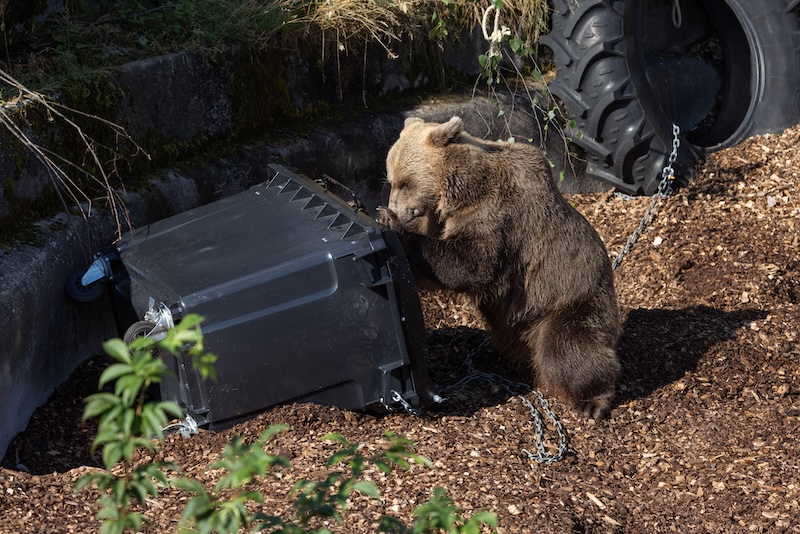
Two brown bears at Helsinki’s Korkeasaari Zoo were enlisted to test bear-resistant waste containers in a trial led by the Finnish Wildlife Agency. The goal is to reduce bear encounters in residential areas by making refuse inaccessible.
The test follows a rise in bear incidents across rural Finland, where animals have been increasingly attracted to domestic waste bins. This year alone, multiple regions reported bears returning repeatedly to the same yards, drawn by food scraps and other household waste.
“Bears are intelligent and quick to learn. Once they find an easy food source, they tend to return,” said Kai-Eerik Nyholm, wildlife planner at the Finnish Wildlife Agency. “Our aim is to eliminate those attractants near people’s homes.”
With few opportunities to observe wild bears interact with bins under controlled conditions, the agency turned to Korkeasaari’s two female brown bears. There, zookeepers helped simulate realistic conditions using two reinforced bin models widely used in scattered rural housing.
Both bins were fitted with metal reinforcements and locking mechanisms. The modifications were designed to be practical for waste collection and daily use, without adding complexity for residents or sanitation workers.
For the trial, the zoo placed strongly scented treats—honey and dried fish—inside the bins to ensure the bears took interest. The response was immediate. The bears pushed, rolled, climbed on, and bit at the containers, but failed to breach them.
“Neither bin opened during the tests,” Nyholm confirmed. “This gives us a good starting point for further development.”
Once the trial ended, the bears returned to eating fruit provided as part of their usual breakfast.
According to Ulla Tuomainen, who coordinates research activities at Korkeasaari, the zoo was keen to participate. “When field studies are difficult, a zoo environment can provide controlled conditions to support wildlife conservation and welfare,” she said. “Helping develop bear-resistant bins is a step toward coexistence between humans and large carnivores.”
Bin testing is one part of a broader campaign by the Finnish Wildlife Agency to educate rural residents on how to secure properties and reduce bear attractants.
Efforts include practical advice on managing compost, storing feed, and maintaining clean outdoor areas. The aim is to avoid habituation, particularly during autumn, when bears intensify foraging to build fat reserves for winter hibernation.
The bin development programme will continue, with more tests planned and technical improvements expected. The agency also hopes to create guidelines for municipalities and private homeowners on installing and maintaining bear-resistant bins in known bear habitats.
HT