LLMs Don’t Need Search Engines: They Can Search Their Own Brains
https://medium.com/towards-artificial-intelligence/llms-dont-need-search-engines-they-can-search-their-own-brains-b39b98dd33d2

LLMs Don’t Need Search Engines: They Can Search Their Own Brains
https://medium.com/towards-artificial-intelligence/llms-dont-need-search-engines-they-can-search-their-own-brains-b39b98dd33d2
4 Comments
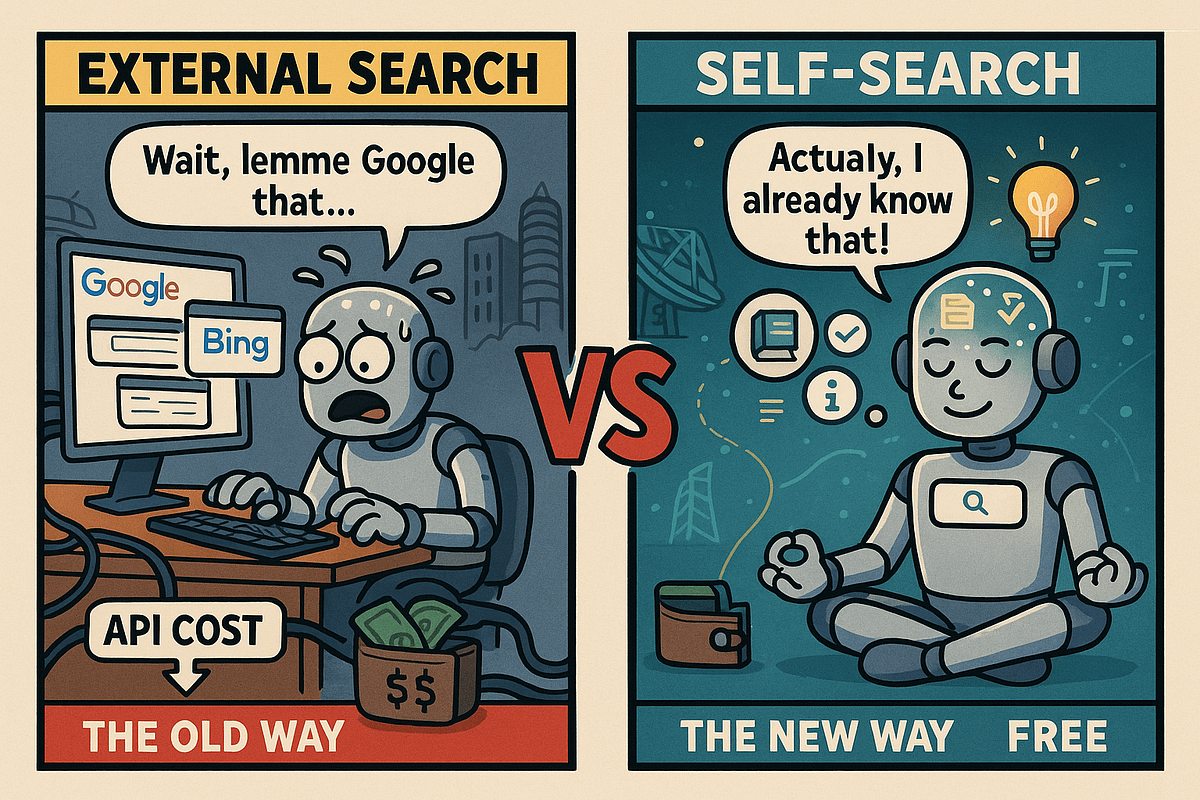
This discovery forces us to rethink the future of AI development. If LLMs can already search their own “brains” for knowledge, do we still need billion-dollar search integrations and massive external data pipelines?
The future may not be about building ever-larger models, but rather about teaching existing ones to utilize their internal knowledge more effectively. That could democratize AI by making smaller, cheaper systems competitive, reducing dependence on Google-scale infrastructure, and enabling powerful offline AI agents.
But it also raises risks: what happens if overconfident models stop checking reality and amplify outdated or hallucinated knowledge?
In the 2030s, will we see a world of autonomous “self-searching” AIs running locally on consumer hardware, or will tech giants maintain control through hybrid external/internal search systems?
How we balance autonomy, accuracy, and corporate power may define the next era of AI.
Then let them search their brain for a weather forecast 😀
They can’t “search their own brains” for something more recent than their training data, so being able to search for up-to-date info online makes sense.
ugh.
i am so tired of the use and abuse of neuroscientific and psychological terms for fancy word prediction spreadsheets. These things don’t have “brains”, they don’t “learn”, they don’t think, feel, experience, or even sense, let alone comprehend the meaning of what they regurgitate from their statistical databanks.
The whole AI field is guilty of this, peddling anthropomorphization and fueling hype for an extremely wasteful technology, and I cannot wait for this damn bubble to finally pop.