
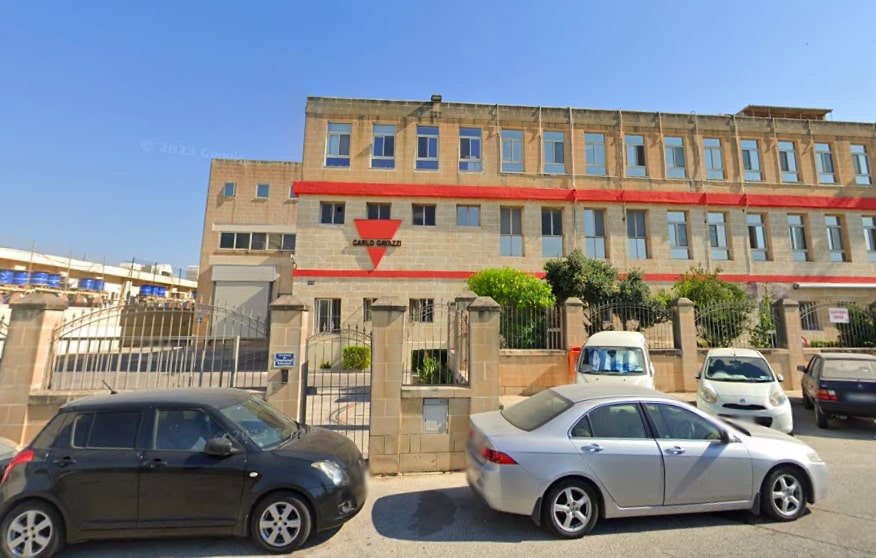
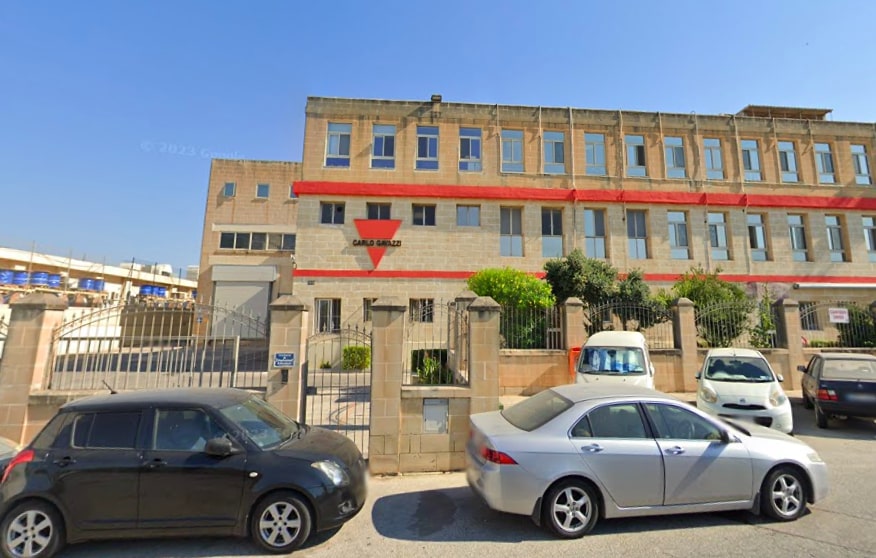
 Image: Google Street
The General Workers’ Union has been informed of Swiss multinational Carlo Gavazzi’s decision to close its Malta manufacturing plant, ending a 37-year presence on the island and putting 140 jobs at risk.
In a meeting held this morning at the company’s request, management announced a phased closure of the Bulebel facility as part of a restructuring exercise that will see production transferred to group locations in Mexico and China. The first redundancies are not expected to take effect for at least seven months.
“This is a serious blow to a loyal and long-serving workforce who have given decades of their lives to this company,” GWU secretary-general Josef Bugeja said. “Our absolute and immediate priority is the welfare of these 140 workers and their families.”
Company blames global pressures, government concerned
The company attributed the closure to a “combination of long-term challenges, including year-on-year revenue pressures driven by rising global costs, such as tariffs, supply chain expenses, and ESG-related requirements, the increasing need for regionalisation of the business, highly competitive landscape for recruiting skilled talent in Malta, and the ongoing consolidation and restructuring of the Carlo Gavazzi Group.”
In its official statement, the company expressed “deep appreciation for the decades of collaboration with the Maltese Government and the dedication of its local workforce.”
The group’s Chief Executive Officer emphasised the company’s approach: “We are approaching this process with care and respect for all those affected. Our priority is to ensure that the process is conducted in a fair and dignified manner, with open dialogue and support for our employees and stakeholders throughout.”
In reaction, economy minister Silvio Schembri said government “is deeply concerned about the impact of this decision on the dedicated employees who have contributed to the company’s success in Malta over many years,” adding that their wellbeing and future “are our immediate priority.”
The minister also noted that government has already initiated discussions with Carlo Gavazzi and other key stakeholders “to ensure that every affected worker receives full support,” including assistance in securing alternative employment and access to training opportunities where required.
The union has now entered a formal 30-day consultation period with the company and is meeting with all plant employees today to communicate the situation. Bugeja stressed that the GWU would “use its full strength and resources throughout the consultation period to ensure every single employee’s rights are rigorously upheld.”
Carlo Gavazzi established its Malta operations in 1988 as a small assembly facility, but the local workforce was instrumental in transforming it into a comprehensive research and development, product management, and manufacturing centre.
By 2006, the group had designated the Malta plant as one of its principal production locations, recognising the skill and dedication of its employees.
The company specialises in electronic and electro-mechanical control components for industrial automation, producing sensors, solid state relays, energy metres, and monitoring equipment.
However, the plant has faced challenges before. During the 2008 financial crisis, falling orders forced the company to implement a four-day working week for its employees.
Union seeks alternative employment
The GWU is now focused on securing the best possible compensation packages for affected staff whilst exploring alternative employment opportunities. The union plans to enter discussions with the Ministry for the Economy, Malta Enterprise, and private companies to identify potential placements for displaced workers.
The closure reflects broader trends in global manufacturing, where companies are increasingly diversifying production locations to build supply chain resilience following disruptions experienced during the COVID-19 pandemic. By establishing manufacturing presence in multiple regions, companies can mitigate risks from geopolitical tensions, trade disputes, and logistics challenges.
Carlo Gavazzi’s decision appears consistent with industry-wide strategies of “nearshoring” and diversification that have gained momentum since 2020. Companies have been reassessing single-location production models that proved vulnerable to global supply chain disruptions.
The shift to facilities in Mexico and China would provide Carlo Gavazzi with better access to North American and Asian markets respectively, whilst potentially reducing exposure to tariffs and trade restrictions that have affected international commerce in recent years.
PN: Redundancies confirm government’s ‘failure’ in manufacturing
In reaction, the Nationalist Party framed the closure as a direct consequence of the Government’s “failure” in the manufacturing sector.
While expressing “full solidarity” with the workers of Carlo Gavazzi, the PN described the decision as “a clear sign of the instability that is hitting the manufacturing sector in our country,” a sector it called a “vital” contributor to the economy.
The PN accused the Labour Government of making empty promises and failing to deliver, stating it “has failed to retain existing companies, let alone attract new ones, and has not created a single new sector in our economy capable of generating quality jobs.”
Calling the closure a “stark demonstration of failure in both industrial policy and national vision,” the PN further criticised the Labour government for turning “a blind eye to Malta’s serious competitiveness challenges.”
The opposition claimed that instead of investing in strategic sectors and helping companies adopt new technologies, the government “prefers to squander taxpayers’ money on empty consultancies and jobs-for-the-boys, as seen in the cases of Chris Cardona and Neville Gafà.”
Presenting its own vision, the PN pledged to channel national funds into “technological advancement, innovation and automation” to create and retain jobs. The party also highlighted the lack of government investment in worker training, noting it was an issue even raised by the company itself.

The PN promised “unprecedented investment” in providing workers with new skills and financial support.
In reply, the Labour Party said “it is incredible that the Nationalist Party tries to say that the Labour Government has failed when it comes to the economy and manufacturing,” as it claimed that “under the Labour Government, the number of full-time workers in manufacturing sector increased from 20,000 in 2012 to 26,000 today – an increase of around 30%.”
Accusing the PN of negativity and lack of vision, Labour said “they do not know what they are saying about how the government is attracting foreign direct investment, which has not only increased jobs considerably, but the value of investment by foreign companies in Malta has doubled from €250 million in 2012 to around €500 million today.”
This increase stems from unprecedented investments in advanced manufacturing, automation and productivity improvements, the party in power said, adding that “the PN’s statement is an offense (sic) towards the thousands of workers who give their best every day and thanks to them Malta managed to attract and retain investment.”

