
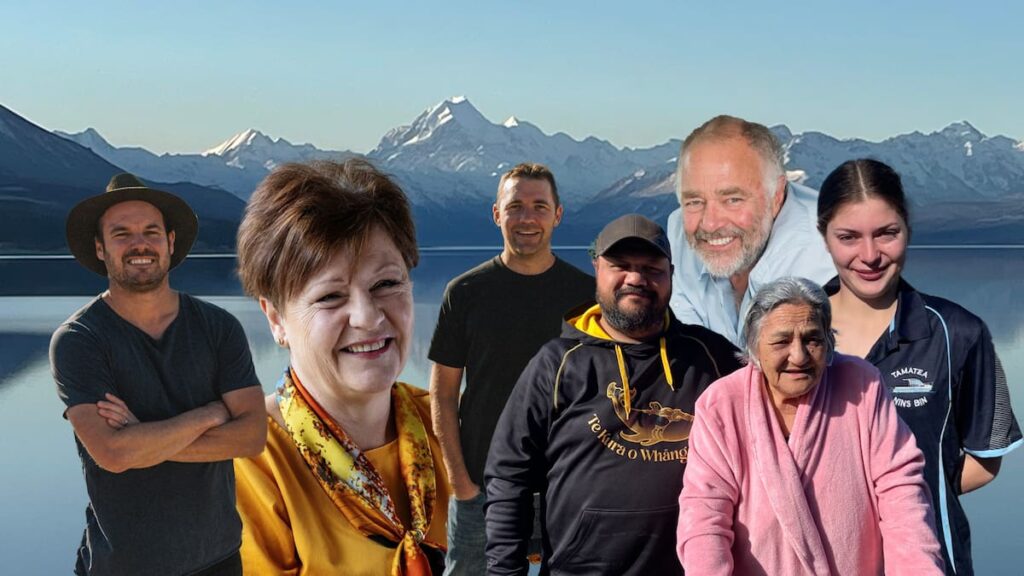
I wasn’t originally planning to head to Whāngārā, but after learning of the death of Whale Rider producer John Barnett – one of our most esteemed film industry leaders – I thought it a poignant visit.
I walked the single, private road three times before finding anyone, a young guy lying on a backyard bench seat in the lunchtime sun. He went inside to get his mum; she pointed me in the direction of “Aunty Ding” – apparently living in the grey and green house up the road.
Avoiding two rather ferocious-looking dogs (they turned out to be fine), I called out four times. Eventually, Te Rama Whanarere came to the door. He welcomed me in and introduced me to his mum, Te Maringiwai (aka “Aunty Ding”).
I had a brilliant hour with them. Whanarere and Te Maringiwai have very happy and special memories of the months that Whale Rider was shot in the village. Their house was used as the key office for the film-makers. Whanarere made a cameo appearance in the movie.
But I also got the sense of an opportunity lost. Out-of-town tourism firms used to bring minibuses, full of people, to the edge of the village, profiting off Whale Rider’s success and the location. Whāngārā residents didn’t see any of that income.
Big smiles in small towns
This year’s Great New Zealand Road Trip took me from Otago and Southland to Northland in two weeks. I travelled more than 3000km.
The mood in the South Island certainly felt more positive; we know from an official Kiwibank survey that Otago and Southland are leading the economic recovery, thanks to tourism and building activity. The evidence is also anecdotal: I repeatedly heard of the difficulty of finding a tradie who wasn’t already flat out in the deep south.
Like in Whāngārā, everyday New Zealanders in some of our most extraordinary, out-of-the-way locations invited me into their homes.
In Nightcaps, 73-year-old former coal miner Rommy Hunt told me all about life in one of New Zealand’s most peaceful and endearingly-named villages.
“There are that many stories,” says Hunt, on how the Southland village came to be named. “They reckon it was when the snow was on the hills and it looked like a nightcap on your head – they weren’t completely covered. That’s one of the theories.”
A fair few Aucklanders and other outsiders have moved into this paradise over the years. House prices have risen more sharply in recent years. Someone once bought a place for $1; others used to sell for only a few thousand. Now a decent home costs between $300,000 and $400,000.
“It’s nice and peaceful,” said Hunt. “You haven’t got traffic lights and traffic jams… [For] anyone who loves hunting and fishing, you’ve got everything here.”
In an armchair alongside Hunt, local publican Selena Jukes eyed me suspiciously at first, likely wondering the angle of the story. She warmed up, and later sent me incredible photos of life in Nightcaps – including shots of the aurora, visible from the main street.
Down the road, Bev Evans, 82, had the jug on and a plate of her Nightcaps-famous scones and pikelets ready to fuel me for my onward journey to Invercargill.
She’s lived in the village her whole life, including the last 50 years in her beautiful three-bedroom cottage on a massive section. She and her late husband Brian bought the property for $2000. “That was a lot back then; you could buy a house around here for less than that.”
Just north of Christchurch, I travelled to Gore Bay – officially New Zealand’s smallest village by size of permanent population. Just 10 people live there fulltime, according to Stats NZ.
“I love living here,” said one of them, Raewyn Hill, as we sat in the living room of her home of five years, overlooking some wild Pacific Ocean waves. “I’m very happy in my own company. Solitude – fine. I’ve bought myself a camera; I get out and I photograph birds and seals and waves and God knows what …”
Plenty of characters
Pic Picot was receiving a pedicure when he spoke to me. A renowned entrepreneur – he started Pic’s Peanut Butter with the help of a concrete mixer – he continues to live his best life in Nelson, and is specifically now regenerating a property at Mārahau, including wetlands.
Halfway through the conversation, he dropped a peanut butter bombshell – he’d recently sold 51% of the company to a private Australian firm. Pic’s chief executive Aimee McCammon confirmed the news in a follow-up interview. Scoop!
Talking of scoops, Michael Thomas spoke to me in Arrowtown about his own exclusive, as a photographer for the Mail on Sunday. He and a journalist interviewed Virginia Giuffre about her alleged sex encounter with Prince Andrew – it was Thomas who photographed the infamous hard-copy image of Giuffre and the prince together. The photo is one of the most famous – or infamous – in the world.
Thomas and Exponents bass guitarist David Gent are the unofficial mayors of Arrowtown – I had a hilarious time with them at The Fork and Tap.
Amanda McLaren is the only child of Kiwi motorsport legend Bruce McLaren, a name synonymous with Formula One supremacy. The McLaren cars and drivers are dominating the Formula One season.
We sat down with Amanda earlier this week – she was only 4 when her father was killed and has no memory of him directly. But she does have a catalogue of incredible black and white images of McLaren as a dad.
And she is determined, as a trustee of the Bruce McLaren Trust, to continue his legacy by inspiring future generations of New Zealanders.
Booming businesses
The stories generated page views in their millions – people love reading about New Zealand and the characters within. They especially love reading about small villages – many of us perhaps harbour a quiet ambition for a more peaceful life – and successful businesses.
The new $30 million Scapegrace whisky distillery overlooking Lake Dunstan promises to be a must-see destination when it opens its doors to the public in 2026.
Daniel McLaughlin, Mark Neal and Richard Bourke have come a long way in a very short time – they formed the company in a tiny Ponsonby office in 2014 and literally walked into bars to encourage bartenders and owners to check out their gin.
That’s what you call a can-do spirit (literally). It featured everywhere on the trip.
It’s how Ron Clark came to set up Nin’s Bin on the side of State Highway 1 just north of Kaikōura in 1977 and – four caravans later – continues to be one of our most iconic road-trip food stops.
Ron’s granddaughter, Rochelle Riddell Clark, 19, was setting up for the day when I called in. She cooked up a bowl of mussels and fries that I chomped on at a nearby picnic table – the best sit-down meal of the trip.
“They kind of thought [grandad] was mad,” Riddell Clark told me. “Back in the day, it was ‘you sleep in caravans. Why would you sell food out of it?’ That kind of thing.”
Similarly, we heard a remarkable story of the history of Magness Benrow – and “Adrienne and John” who voice their quirky radio ads.
The sponsor of the road trip this year, Night ‘n Day, deserves a special shoutout. I stopped at many of its stores along the way; I can thoroughly recommend their Helova coffee and, if you have a sweet tooth, a raspberry cream doughnut.
Reader poll and feedback
Throughout the road trip, we conducted an unscientific online poll measuring the mood of the country. People could rate their feelings on a scale of 1-10 – 1 being meh, and 10 being joyful/happy as.
A record 55,000-plus people voted and I’m pleased to report we seem to be a slightly happier bunch than in 2023 and 2024, when we asked the same question.
This year, 78% of respondents rated themselves a 5 or higher; last year it was 76% and in 2023, it was 74%.
This year, 16% rated themselves a 10 and 5% rated themselves a 1. Last year, the numbers were 13% and 6% respectively.
I received lots of feedback, directly and through social media.
Cas says she thinks I have the best job in the world. When I look back on the trip, I agree.
One bloke didn’t like my story about the town icon once voted New Zealand’s worst – Waipawa’s Pawa the duck – and my mild amusement that the story featured people with the surnames Gosling and Drake. He made fun of my own name and bald head, shame!
Clan Currie in Scotland wrote to me, out of the blue. They loved hearing all about New Zealand, and want to do a story on the stories – cool!
There were so many story ideas and places recommended. We will get to more of them in coming months and during future road trips.
Kiwi drivers
Based on another unscientific poll, of one person, I am also pleased to report that our driving has improved, compared with the road trips in 2023 and 2024.
The worst behaviour I saw was an idiot in an early-model silver Mercedes-Benz tailgating and passing on a yellow centre-line on State Highway 57 just south of Shannon. Otherwise, ka pai.
The rebuilt State Highway 1 hugging the Pacific coastline between Blenheim and Kaikōura continues to be a marvel; the new-ish Puhoi-Warkworth highway is a godsend.
The Lindis Pass and central Mackenzie Country drives were mindblowing, once again, but my favourite section of road this year was the new State Highway 3 between Woodville and Dannevirke. It still has a new-car smell about it.
Weaving its way through Te Āpiti Wind Farm, you’re up close and personal with those incredible turbines. Progress all round.
That’s a wrap
We live in an incredible country. Sometimes we need to shut down our technology and view it through our irises, rather than iPhones.
At the core of New Zealand is a community of characters – great people doing their best. They’re finding it tough right now in some corners, but they remain, generally, hopeful and optimistic.
In business, our Kiwi number-eight-wire mentality is still present. It may be suppressed at times, but it’s alive.
Finally, on this last day of winter, some good advice, from Whananaki shopkeeper and community radio boss Dallas Gurney, who we featured yesterday.
“We are just coming to the end of our winter hibernation, and things start to get busy again with visitors and holidaymakers. Get out into the regions and spend, spend, spend, Aucklanders!
“Don’t go overseas, head somewhere you haven’t been before and drop some cash.
“The economy is doing it harder than the Government is saying it is, all our suppliers are saying it’s the worst they can remember. Spend at small businesses like ours … it makes a massive difference to a tiny economy like Whananaki.”
Thank you to everyone who took part in or assisted with this year’s adventure. We’ve reached the end of the road.
The 2025 Great NZ Road Trip
Best city: Christchurch – a remarkable transformation is under way; the opening of its new stadium, Te Kaha, next year is a game-changer.
Best town: Waipawa – in the heart of central Hawke’s Bay. Love or hate the duck, there’s plenty to see and do at the upcoming Spring Fling festival.
Best village: Nightcaps, Southland – the pending closure of the last coal mine has not crushed a determined spirit.
Best really small village: Gore Bay (10 permanent residents!)
Best vibe: Arrowtown
Worst vibe: Queenstown at night – weirdly, quite overwhelming. It reminded me of Queen St in Auckland in the 1990s. Everywhere else in central Otago is just pure bliss.
Best highway: The new SH3, Ashurst-Woodville
Worst highway: Cyclone-damage repairs are still under way on SH2 between Napier and Gisborne – the workers are achieving miracles.
Best drive: Lindis Pass
Best experience: The Dark Sky Project, Takapō – a night under the stars.
Best sign: Real estate agent’s sign on SH3 – everything he touches turns to SOLD. An oldie but a goodie.
Best beach: Whananaki South
Best view: Mt Cook, from SH8 looking across Lake Pukaki
Best road trip snacks: Night ‘n Day, of course!
Editor-at-Large Shayne Currie is one of New Zealand’s most experienced senior journalists and media leaders. He has held executive and senior editorial roles at NZME including Managing Editor, NZ Herald Editor and Herald on Sunday Editor.