
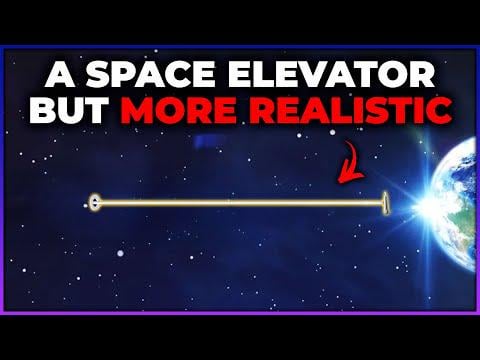
Rocket launches may dominate headlines, but the true bottleneck in space exploration lies not in reaching low Earth orbit (LEO), but in venturing beyond it. From LEO to the Moon or Mars, spacecraft still require costly kick stages or oversized boosters. A decades-old idea known as the skyhook could change that equation.
A skyhook is a rotating orbital tether: essentially, a long, strong cable that swings a spacecraft from one orbit to another, much like a sling. Unlike the space elevator concept, a skyhook looks much more buildable with current technology. By lowering the cost of Earth/Moon & interplanetary transport, skyhooks and related tether technologies could help make space travel beyond LEO economically feasible. The linked interview with Marcus Landgraf, from ESA, connects this to breaking resource limitations and enabling prosperity through space expansion.
Space Elevators may be decades away, but 'Skyhooks' – LEO orbiting tethers that boost things to higher orbits/deep space – could be built now, and an ESA scientist thinks we should.
byu/lughnasadh inFuturology
5 Comments
The Shuttle Program soured lots of folks on the virtues of air/space hybridization, primarily because heat tile maintenance and re-entry stress eliminated all the theoretical cost savings of a reusable vehicle.
However, there’s tons of value in conventional aircraft *assist* rather than just launching straight from the ground. If we can build planes that can carry multiple Abrams, there’s no reason whatsoever we can’t build one that can carry a payload halfway to orbit and separate to allow rocketry to cover the other half.
If we ever calm down enough to undertake orbital construction projects, though? Taking a conventional aircraft up and handing off the space vehicle to a skyhook would be an insane way to sidestep fuel costs. Especially if electric flight continues the way it has been.
> Unlike the space elevator concept, a skyhook looks much more buildable with current technology.
Can you give more detail why? (not just redirect to watching a video).
I was just reading the tethers in space handbook and it is really amazing to see what we have done with tethers. Some of the most impressive missions were:
SEDs-2: deployed a 20 km tether and rotated with 4 rpm
TiPs: deployed a 6 km tether, which survived in orbit for 10 years (had a planned lifespan of 2 years)
YES2: deployed a 31.7 km tether and even changed the trajectory of an onboard payload, which reentred.
There were a ton a other space tether missions, many were tens of kilometres long and even plans for some close to 100 km. Space tethers really have a lot of potential
A true space elevator is somthing you do to show off.
The easier version is…
Setup a lunar mass driver to send back refined metals, aluminum will do, iron, nickel, etc is better. Then just build a giant spinning ring of metal in orbit around the planet and hang off that with maglev trains. This only takes known science. LOL. Then you take the train to obit, psheesh talk about over complicating things with silly orbital sky hooks.
/s about the flippant nature not about the concept, that’s real.
But if something goes wrong the skyhook becomes the greatest nun-chuck satellite shredder humanity has ever build.