
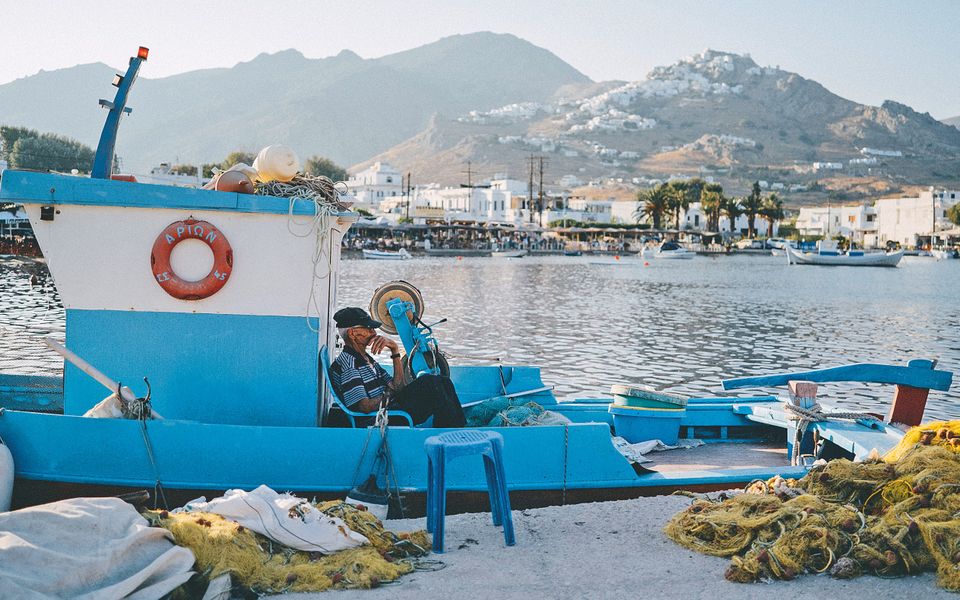
Tourism keeps growing in Greece. In 2019, the country received 34 million tourists who brought in €18 billion. The post-pandemic rebound was swift, with arrivals in 2024 exceeding 36 million and generating revenue in excess of €20 billion. Data for the current year show that the upward trend is continuing. Tourist growth is neither a temporary after-effect of the pandemic nor an exclusively Greek phenomenon. Portugal and Spain, to just cite two examples, exhibit highly parallel trends.
In fact, the growth of tourism is a global phenomenon driven by the seemingly relentless growth of global wealth. Roughly half of households worldwide now belong to the so-called “traveling class,” those with the financial ability to travel abroad. In rich countries, pensioners travel more because they live longer, are more active and have plenty of time and disposable income. As for the rising middle classes of the developing world, nothing spells having arrived more than travel to iconic destinations in Europe, including Greece. Air travel is becoming cheaper and the number of flights keeps going up: US connections to Greece have multiplied eightfold in the past few years and Greek carrier Aegean Airlines is now scheduling more direct flights to Asia, with India as its core priority.
The triumphalist reporting of record arrivals no longer elicits public approval outside the shrinking circle of those drawing substantial profits from it
Where does this leave us? On the one hand, tourism growth generates revenue, which is good for the economy. But is it as uniformly good as we think it is? Tourism is increasingly being seen as a destructive force with a negative impact on both the natural environment and local cultures. And how good can it be when locals are increasingly excluded from access to the most desirable destinations – unless, that is, they come as a source of cheap labor?
“Some places are simply beautiful,” wrote Greek poet and Nobel Laureate Odysseas Elytis. “Others are important because of a civilization that grew there. The Aegean Sea combines both. It is unique; where else can you find such a seamless interpenetration of land and sea, such purity?” The Aegean Sea came to define Greek national identity after Elytis’ verses were put into music by Mikis Theodorakis in the early 1960s. Its position in the Greek psyche was further enhanced by the life-shaping experience of generations of youth who, for over 40 years, enjoyed carefree and inexpensive summer vacations on beautiful empty beaches thanks to cheap ferry tickets and camping gear. Which is to say that there is a very deep emotional bond between Greeks and the summer – hence the “Greek summer.”
Public debate
Like elsewhere in the Mediterranean, the unrelenting growth of tourism has triggered a big public debate about the negative impacts of “overtourism.” “Tourism ideology,” the notion that tourism growth should be seen as an overarching national goal, has lost its hegemony. The triumphalist reporting of record arrivals no longer elicits public approval outside the shrinking circle of those drawing substantial profits from it. Indeed, the tourism-led economy is experiencing a momentous shift away from a business model featuring domestic, small and medium-sized family-owned businesses, and toward one dominated by foreign-owned, large-scale corporations. People employed in the tourism sector are now predominantly low-skilled and low-paid, and, increasingly, immigrant labor.
The public debate so far is limited to either rising complaints about the dark side of tourism, all the way to a total rejection or incremental thinking from a policy sector heavily influenced by the tourism industry. There is a lot of talk about improving the “carrying capacity” of tourist destinations, extending the tourist season and managing destinations. Essentially, the key idea is to invest in infrastructure to accommodate rising demand.
Clearly, the rising numbers of tourists have already placed existing infrastructure under massive strain. Greek islands, especially, are experiencing overcrowding, traffic jams, power cuts and water shortages, which are affecting the experience of locals and visitors alike; the high cost of living and limited housing also undermine the provision of basic public services such as health or education. And, as the state’s ability to regulate this business goes down, the benefits (and practice) of corruption go up.
Usually, this problem is approached from the perspective of “carrying capacity”: can a destination handle the visitors it receives? Can the ports, airports, roads, power and water networks, waste disposal and sewage systems, healthcare, etc, cope? If not, the expectation is that the state should invest in infrastructure to increase a place’s carrying capacity. Greece, the argument goes, can “fit” many more people, provided its infrastructure is upgraded. However, this approach suffers from a fatal flaw: Attracting more visitors inevitably will strain improved “carrying capacities;” investments in infrastructure might solve today’s problems only to exacerbate tomorrow’s. There is an additional issue as well: infrastructure investment in tourism amounts to a public subsidy of private business and profits. Given the decline in tourism ideology, it is doubtful whether taxpayers would be willing to support such a move.
The pressure on popular destinations has also led to proposals for extending the season and for managing destinations, so that presently, less popular destinations absorb the overflow from the more popular ones. Both are already happening organically. As employment becomes more flexible, more people avoid travel in peak season, which is both more expensive and less pleasant given rising temperatures. May and September have already become extremely popular, and April and October are getting into play. Athens, for example, no longer has a tourist season. The same is true with destinations: in recent years, many second-home owners have “escaped” from overcrowded and highly expensive Mykonos to Paros, but others are now leaving Paros for more “unspoiled” places like Sifnos or Amorgos. At the same time, however, real estate developers, hotel companies, etc, are moving alongside them. Again, both the extension of the season and destination management merely postpone the solution, while making the problem worse.
Begin from the beginning
What to do, then? In my view, this is a problem calling for radically new thinking. We must begin from first principles: exactly, what do we want tourism to do for us? The answer, I propose, boils down to three desiderata.
First, we are obviously looking for income. The Greek economy is increasingly dependent on tourism as a reliable source of income. There is a clear underlying risk, of course, as monocultures are always a very risky bet. But there is also a positive dimension, so far as Greece is concerned: it has a comparative advantage in tourism, and not just because of its sea, sun, natural beauty and unique antiquities, but also because hospitality suits the character of Greek people who are (still…) extrovert, hospitable and warm.
Second, we want the Greek coastline to be accessible to Greek citizens. It is just unacceptable, morally as well as politically, for Greeks to be excluded from the most beautiful parts of their own country. Lastly, we want a sustainable type of tourism with a light touch so that we can preserve the unique natural and human environment that is Greece.
This is where things get difficult, because the current tourism model is based on endless expansion. The Greek state is known for its limited capacity to establish and enforce zoning rules; at current rates, many Aegean islands will soon turn into fully built, suburbanized landscapes. Along with their natural landscape, their unique local culture will disappear, along with local communities themselves. On top of it and as a result, tourism is becoming an undifferentiated commodity. Santorini offers a striking example: it is, for all intents and purposes, a stage set, a theme park – and a disposable one at that: you rent a house with a private jacuzzi so that you can snap the famous cocktail-and-sunset photo, and leave for the next Instagrammable destination. In many places, once proud hosts have been replaced by sad-looking extras. Besides being a very real loss, turning a unique place into a commodity means sacrificing long-term value, becoming less competitive and much more vulnerable.
Possible solutions
Going back to our first principle’s way of thinking, we should be aiming instead for a business model that generates income yet enhances rather than destroys the natural and human environment, while allowing Greeks to have access to it. How feasible is this?
One way of reconciling income generation with environmental protection is to aim for a more upscale product targeting fewer, higher-income visitors – maximizing tourist income rather than tourist numbers. This is already happening in some destinations via the price mechanism. However, even when demand outstrips supply, prices may initially rise but so does supply, leading to overexploitation and eventual depreciation. A policy increasingly discussed globally is the reduction of tourist flows via a tax or entry fee. On a national scale, this has been implemented only in Bhutan. On a more localized scale, we are seeing it in places like Venice or on types of tourism like cruises. The fee is presently on the very low side, but it will go up as overcrowding will soon be unmanageable.
Yet, simply aiming for a more upscale product is hardly enough. Very wealthy tourists (a phenomenon that may be described as “VIP tourism”) often damage both the natural environment (via huge houses, yachts, private planes, etc) and the human environment (as they prize privacy and isolation from local communities). This model would also eliminate access for Greeks.
So, what to do? One policy solution is “filtering,” or “curating,” the clientele. Do we want visitors who will appreciate and even love the special place they happen to enjoy and who will wish to return, over those who will consume and discard it before moving on to the next destination? Do we prefer visitors interested in local culture, history and cuisine over partygoers coming for sushi, ceviche, ribeye and the latest international DJ? Such filtering and curating are already happening through a mix of pricing and branding: the island of Sifnos, for instance, attracts a very different crowd than the island of Rhodes, as different as Patmos from Kos. However, this is an unstable equilibrium and needs to be reinforced by public policies.
An additional policy idea relates to a system of subsidies that would allow Greeks to visit expensive destinations, funded by income generated by the entry fees. The synergies here are obvious: the presence of Greeks would make a destination much more attractive to visitors interested in local culture, enhancing both local access and the protection of the human environment. Similarly, one could imagine policies that subsidize other groups (e.g., young people from across the world), or even some form of lottery, as is already done in US national parks.
These are merely examples suggesting that once the first principles are established, one can craft appropriate policies. Clearly, the transition from today’s business model to a new model of tourism will not be seamless. But, I believe that it will be facilitated by the coming crisis of overtourism, which will force a stark dilemma on us: either we continue on the same path, leading to a combination of cheap commodity tourism in environmentally degraded and culturally dead tourist parks, along with exclusive spaces for the super-rich, or we radically change course.
Stathis N. Kalyvas is the chairman of the board of directors at the Stavros Niarchos Foundation Cultural Center (SNFCC) and Gladstone professor of government at the University of Oxford’s Department of Politics and International Relations.