This was created as part of the [Tidy Tuesday project](https://github.com/rfordatascience/tidytuesday) for last week (with apologies to any users who are tired of Billboard-related data vis submissions by now).
GOST_5284-84 on
how is the distinction between did not write the song and collaborated with non-performing songwriters made? like is there a criteria for contributions that make something a collaboration?
Expensive_Edge_6219 on
Wild how it went from “one dude with a guitar” to “an entire committee plus their neighbor’s dog” to write a hit song.
BrightLuchr on
The 1960s notably had many many hits by artists that also did not perform them on the records we know as classic songs. [The Wrecking Crew](https://en.wikipedia.org/wiki/The_Wrecking_Crew_(music)) is only one example of groups of studio performers on call. In the late 1980s, songwriting teams arose once again as it was much more profitable than performing. It has been argued, by people like Rick Beato, that performing artist writing credits on most of today’s hits are mere token/financial arrangements. So the graph is a bit misleading: the the dark green should be some shade of brown.
spaceporter on
I wonder how much of the blue is just granting the performer a song-writing credit. The way the market has developed, I’d imagine some performers are able to extort such a request out of songwriters.

![[OC] Changes in Billboard #1 hit songwriting credits over time](https://www.byteseu.com/wp-content/uploads/2025/09/yr7vqbu4hrmf1-1536x1084.png "[OC] Changes in Billboard #1 hit songwriting credits over time")
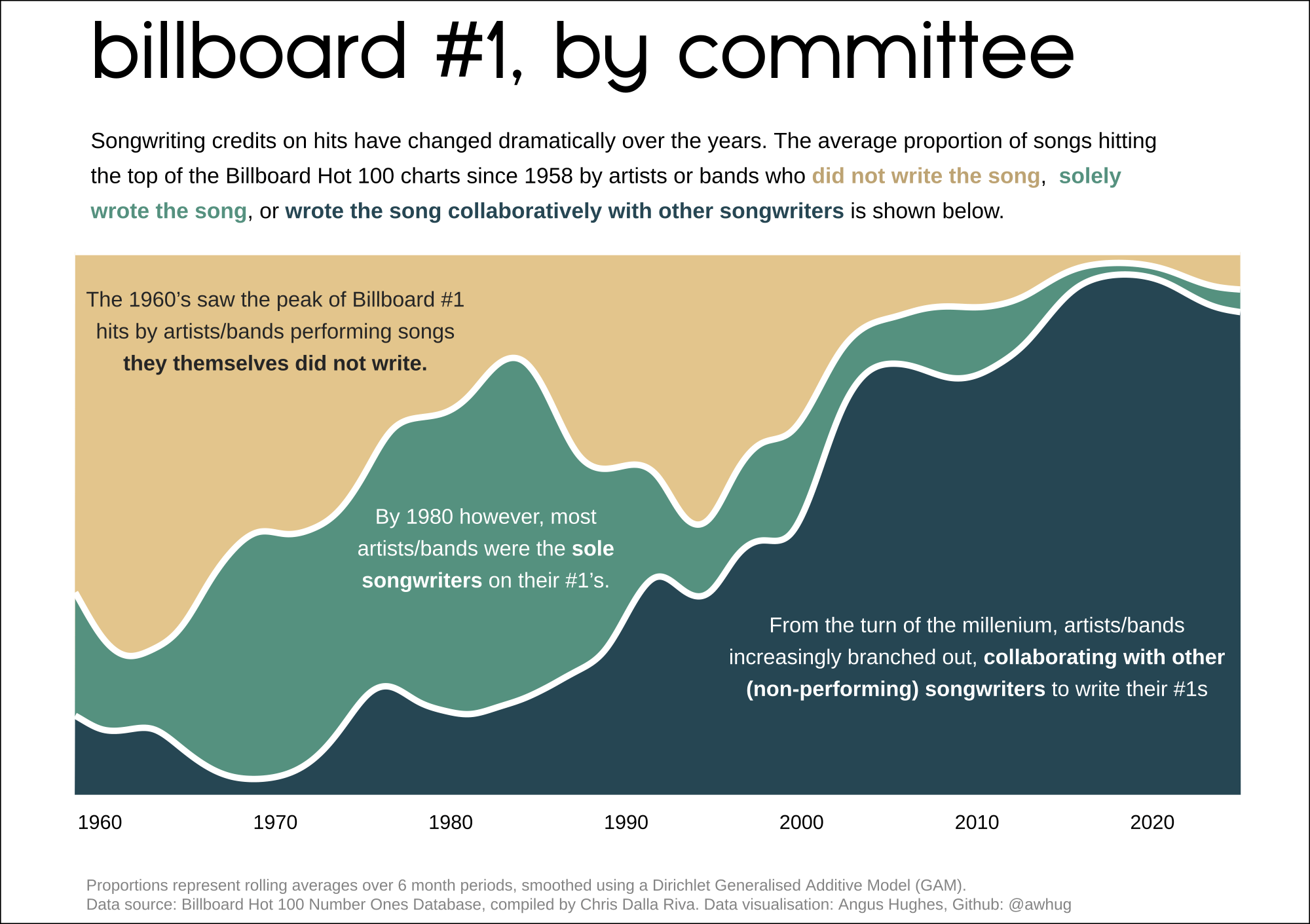
5 Comments
Data source: [Billboard Hot 100 Number Ones Database, compiled by Chris Dalla Riva](https://docs.google.com/spreadsheets/d/1j1AUgtMnjpFTz54UdXgCKZ1i4bNxFjf01ImJ-BqBEt0/edit?gid=1974823090#gid=1974823090)
Tools used: R, using packages runner (rolling averages), dplyr (data manipulation), VGAM (model-based smoothing), ggplot2 + ggtext (data visualisation).
Code: [Github](https://github.com/awhug/tidytuesday/blob/main/230826_billboard.R)
This was created as part of the [Tidy Tuesday project](https://github.com/rfordatascience/tidytuesday) for last week (with apologies to any users who are tired of Billboard-related data vis submissions by now).
how is the distinction between did not write the song and collaborated with non-performing songwriters made? like is there a criteria for contributions that make something a collaboration?
Wild how it went from “one dude with a guitar” to “an entire committee plus their neighbor’s dog” to write a hit song.
The 1960s notably had many many hits by artists that also did not perform them on the records we know as classic songs. [The Wrecking Crew](https://en.wikipedia.org/wiki/The_Wrecking_Crew_(music)) is only one example of groups of studio performers on call. In the late 1980s, songwriting teams arose once again as it was much more profitable than performing. It has been argued, by people like Rick Beato, that performing artist writing credits on most of today’s hits are mere token/financial arrangements. So the graph is a bit misleading: the the dark green should be some shade of brown.
I wonder how much of the blue is just granting the performer a song-writing credit. The way the market has developed, I’d imagine some performers are able to extort such a request out of songwriters.