This is what depopulation looks like: my home town stands as a warning to the West
https://www.telegraph.co.uk/news/2025/08/25/what-depopulation-looks-like-my-home-town-warning-west/

This is what depopulation looks like: my home town stands as a warning to the West
https://www.telegraph.co.uk/news/2025/08/25/what-depopulation-looks-like-my-home-town-warning-west/
11 Comments
# This is what depopulation looks like: my home town stands as a warning to the West
# Europe’s looming demographic crisis and the anxieties that come with it risk turbocharging uncontrollable populist forces
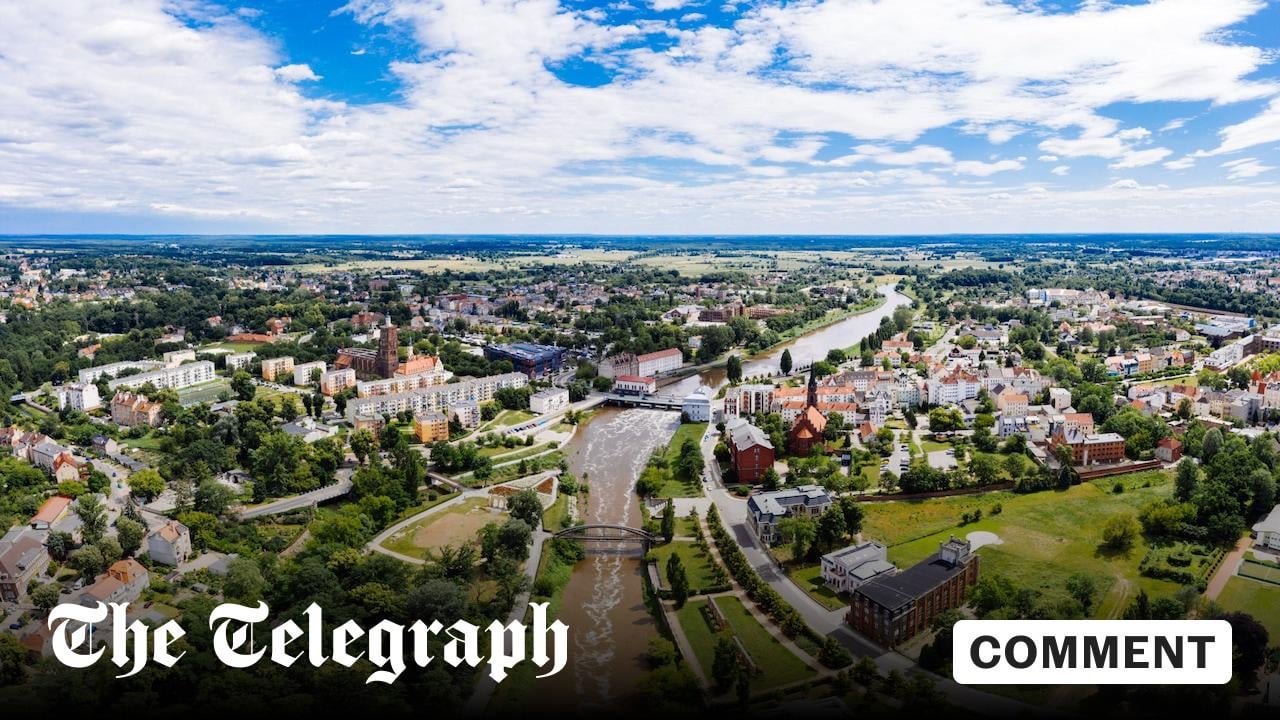
When I was born in Guben on the [German-Polish border](https://www.telegraph.co.uk/news/2025/08/18/the-forced-division-of-ukraine-will-haunt-europe/) in the 1980s, the town was a bustling, polluted hub of the East German chemical industry. Smog thickened the air, and extensive brown coal mining was turning the surrounding countryside into a barren moonscape.
When I recently returned to Guben, I found a clean and beautifully restored town, but also one that was less than half its former size and one where around 40 per cent of the [people voted for the Right-wing populist AfD](https://www.telegraph.co.uk/news/2025/07/05/european-democracy-in-peril-failing-elites-blame/). Demographic anxiety pervaded every aspect of life – a strangely underexplored factor in the growing disaffection with mainstream politics.
The fear that culture, traditions and institutions erode due to shrinking populations is often belittled by city-dwelling liberals. However, regional depopulation is a real phenomenon, and its scale is enormous across the areas that once lay east of the Iron Curtain. The Bulgarian political scientist Ivan Krastev has long tried to spell this out to Western observers, [identifying](https://shs.cairn.info/article/E_DEBA_204_0161?lang=en) a “largely unspoken preoccupation with demographic collapse” as a key factor behind the rise of populism. Since the fall of the Berlin Wall, Latvia lost 27 per cent of its population, Lithuania 22.5 per cent, Bulgaria 21 per cent and the [former East Germany nearly a quarter of its people](https://www.telegraph.co.uk/news/2024/09/02/germany-is-tearing-itself-apart/).
The vast majority of the emigrants were young, and they took their education, labour and future families with them when they moved West in search of a better future. In the case of East Germany, young women were overrepresented among the leavers. I’m a classic example of this. I finished school and university, and then I left, never to return. During a recent school reunion, I discovered that most of my classmates had followed a similar path, even though many long to return “home” when their financial circumstances allow.
The [impact of losing a generation](https://www.telegraph.co.uk/money/pensions/state-pensions/state-pension-betrayal-now-inevitable/) became apparent when I visited Guben recently. When I was born there in 1985, it had 35,000 inhabitants. Now only 16,000 people live there. Local politicians told me they hope they have now halted the demographic decline. The mayor of the nearby village of Schenkendöbern proudly showed me a recently renovated primary school, but it currently has just 23 children studying in Year 1. Guben’s town librarian told me that the primary school she attended had long shut down.
The [demographic decline](https://www.telegraph.co.uk/money/property/second-homes/rural-england-faces-bleak-future-without-second-home-owners/) defines Guben’s townscape. There is an elaborate Stalin-era cinema, featuring symmetrical columns that frame the entrance with murals and stucco decorating the interior. Today, it is empty and derelict, only occasionally used for events. Guben lacks both the population and the funds to maintain a venue built for a town twice its size.
The same is true for housing, once built on a grand scale for the workers of the chemical industry. After 1990, many of the flats stood empty and fell into disrepair. Shops boarded up. Eventually, the town decided to demolish buildings – an unavoidable step, but the result is a tumbleweed atmosphere of desolation
Social networks have broken down. Older people don’t see their grandchildren grow up. When someone retires, there is often nobody to take over an institution or a tradition, I was told by Sebastian Wehland, a pub landlord about my age, who recently returned after living in the former West Germany for years with his young family. His grandparents had run the village pub for decades, but eventually retired. Sebastian is a railway engineer and can’t open the pub every day. But he is desperately trying to keep it alive as a village institution. If it closes down, too, there won’t be a pub anywhere for miles.
The dearth of young people also makes it difficult for businesses to flourish, creating a vicious circle of limited opportunities. A local dairy farmer, the region’s largest employer, with a state-of-the-art business that produces milk as well as energy from cow manure, told me he is struggling to find and retain staff. He has now lowered his expectations, offering well-paid apprenticeships to young people with zero experience, but even so, there just aren’t enough people.
Politicians tell me the obvious answer is immigration, and that they can’t understand why a region with a need for young people would vote for the anti-immigration AfD in such high numbers. In Guben, this is a particularly pertinent question, since the town straddles the German-Polish border with the Neisse River separating German Guben from Polish Gubin since 1945. That border – a bridge at the end of the high street – is now subject to police controls since the new German government has adopted a stricter stance on immigration.
I asked a local AfD politician – and born Gubener – about this, and he told me what many locals had been saying too: people don’t have an issue with Polish workers. Their wages and expectations are now so high that they don’t adversely effect prospects on the German side. In fact, there is barely a business in the region that doesn’t employ them. However, people are worried about the uncontrolled immigration of recent years. Nearby Cottbus is cited as an example. The city has 100,000 inhabitants. In 2009, just 2,600 people had no German passport. By 2023, this number had risen to 11,500, with many newcomers requiring state-funded support. Overwhelmed, the Cottbus mayor declared in 2022: “We can’t do this any more”.
While most locals don’t appear to have a problem with targeted labour migration, most don’t regard mass immigration as a solution to the demographic crisis. On the contrary, they worry that it accelerates the erosion of their culture and language and that this feeling isn’t being taken seriously by mainstream politicians and the media. People often say that populism feeds on fear, but that fear is too often dismissed. Such derision opens opportunities for the AfD.
People are often mystified by why beautifully restored areas in eastern Germany, Poland, Hungary and much of central and eastern Europe, which have comparatively low immigration rates, have turned to populism. A big piece of the puzzle is depopulation. If politicians want to win back such regions, they need to start discussing demography in a way that goes beyond insisting on immigration as the only solution. If they don’t, they leave populist actors with a political monopoly on existential fears.
There is research showing a correlation between population decline in certain regions and rising supporting for populist/far right parties
[https://www.sciencedirect.com/science/article/pii/S0962629824002105](https://www.sciencedirect.com/science/article/pii/S0962629824002105)
[https://ejpr.onlinelibrary.wiley.com/doi/am-pdf/10.1111/1475-6765.12702](https://ejpr.onlinelibrary.wiley.com/doi/am-pdf/10.1111/1475-6765.12702)
I think this is quite important as ageing population, falling fertility rates and anti-immigration politics will further exacerbate population decline and could further increase support for such parties. This is a recipe for political instability. Not to mention that ageing population and a worsening dependency ratios weaken economies and worsen public finances, which of course is also linked to higher support of populist/far right parties.
Although I certainly sympathize with the towns described in the article, I think we have to be careful. The article refers to depopulation due to lost opportunities and bad governance. There is also the issue of lower birth rates in some countries. The two are completely different phenomena and will result in different outcomes.
If you look at the correlation between rural areas in the United States and right leaning political views, you’ll see the same thing. You don’t even need depopulation.
Here’s a thought, if the population in towns and rural areas is decreasing so much how come the housing market isn’t dropping accordingly?
We have a lot of people with WFH jobs, by all accounts this should incentivize families to relocate to a nice little town.
Maybe a big part of the problem is that the housing market if inflated to hell and corporations have seized too much and are artificially inflating the house prices and as a result people can’t afford to buy the house?
Capitalism plus sexism plus racism will slowly kill your society completely.
Anecdotal but the people in the article *want* to live where they came from. They just can’t afford to.
Young couples have pets instead of children because children are too expensive when so little of the burden is shouldered by the community or the state. Women can’t afford to live without working, and even if they could working is what gives people the precious little money and power they have. Should women just abandon their careers to have kids? It’s a huge setback, even if maternity leave is generous they have to work while pregnant, take time off to have the baby and recover, and then the whole time they’re away they definitely aren’t getting promoted. Either give people a lot more robust communities and free time, or make childcare free and you’ll see the population rebound.
Finally the band-aid. Immigration. At least this will prevent your community from dying completely. You can pass on traditions and language if you meet people with mutual respect. Or you can hate them and go extinct. Lots of people choosing the latter and I can’t say much of value was lost in that case. When the last person in Guben is an angry old racist man with a big pile of plastic and imaginary numbers, maybe the people who move into the ruins will put him in a nice retirement home.
Young intelligent women don’t want to return to (nor breed for) racist, far right, boomer hellholes, no matter how ‘clean’ the streets are.
More at 11
I have no clue what the point of the article is and what this post is trying to say. What’s being described is normal for literally thousands of years now
We can’t sustainably support the people we have so I don’t know what to tell you.
I think we sometimes forget that we do not, in any real way, know what we’re doing.
Everything we do on a macro scale is an experiment with no one in charge of what tests are run — and the tests that are conducted are often by the rich/powerful and they’re to the detriment of the masses.
People are like water and they will flow wherever it is easiest. I think we should be wary of both the situation OP has described, but also of the idea of controlling things to a different outcome.
There simply isn’t a solution to all of our problems, and government and business intervention will cause new problems just as often as they solve an existing one.
In a sense, all of what we do is both unnatural AND natural. We deal with issues that havent really occured throughout history, with different means of trying to resolve them that haven’t been tried throughout history.
Just to use an example, we have no a clue what AI is going to mean for us 20 years from now, but it seems likely new issues will arise for every issue it resolves, with no prior knowledge on how to fix them.
Humans are incredibly adaptable, but we are simply going through too much change, too quickly, to have a real idea of what’s happening to us.
Suppose that a city has a population of 20,000 and half the people leave. If those people are doing fine, then 10,000 are doing fine. Many of the remaining people are doing fine, so the majority of the people are doing fine even though the city’s population has been cut in half. This is different from a country with no emigration losing half its population. Population decline due to low birthrate is a gradual process and countries can adapt. Mayors may want a higher population because it gives them more power. One thing not mentioned in the article is religion. Maybe European censorship prevents that subject from being discussed.