
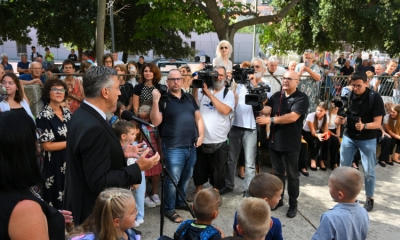
roatian Prime Minister Andrej Plenković underlined on Monday in Korčula that Croatia’s islands are not the country’s periphery, but a strategic national asset. Speaking at a session of the Island Council, he emphasized that the government has invested more than €4 billion in island development over recent mandates.
Plenković highlighted the vital role of the islands in Croatia’s tourism, noting that every fourth overnight stay in the country takes place on an island. “They contribute enormously to the growth of our GDP and are also of immense cultural and identity value,” he said.
With 128,000 residents living on 53 inhabited islands, the Prime Minister stressed that island life remains a government priority. “We are working on a better legal framework and increased funding to make life on the islands easier and more sustainable. A new Law on Islands and an updated Law on Regional Development are in the pipeline, alongside EU negotiations for the next multiannual financial framework 2028–2034,” he added.
He also announced the creation of a Council for Adriatic Croatia, modeled on the successful Council for Slavonia, which will unite all seven Adriatic counties.
Rising Economic Activity on the Islands
Minister of Regional Development and EU Funds Nataša Mikuš Žigman presented encouraging figures: compared with 2016, the number of active entrepreneurs on Croatian islands has grown by over 40 percent, employment has risen by 38 percent, and average net salaries have increased by almost 60 percent.
“The growth of economic activity is a precondition for people to stay and thrive on the islands,” said Mikuš Žigman. She also noted a rise in kindergarten enrollments by more than 5 percent, describing this as a sign of demographic revitalization. The upcoming Law on Islands, she explained, will introduce new measures focusing on digital transformation and improved healthcare access.
Focus on Sustainability
Discussions also covered sustainable housing, healthcare services, public water supply and sewage infrastructure, island mariculture, and the wider blue economy.
Ahead of the meeting, fifteen contracts and four decisions worth a total of €31 million were signed, relating to regional development, EU funds, environmental protection, and green transition projects.
Earlier in the day, Plenković visited the towns of Blato and attended ceremonies marking the start of the school year at Blato Elementary School and Ivo Padovan High School.