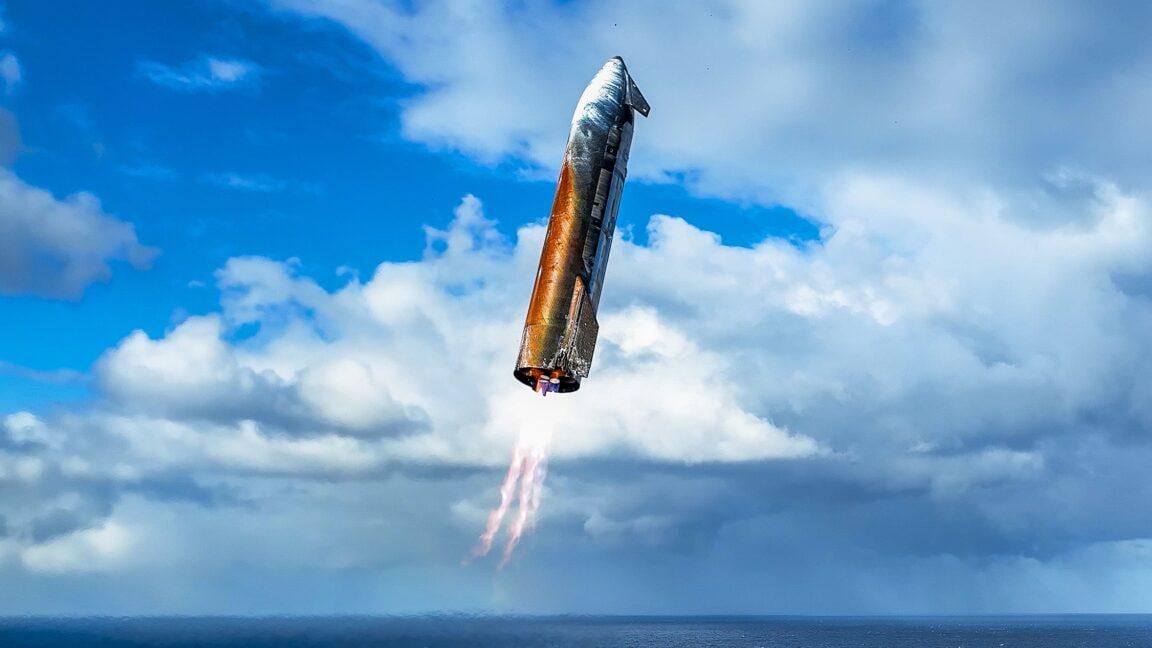
SpaceX’s lesson from last Starship flight? “We need to seal the tiles.”
https://arstechnica.com/space/2025/09/spacexs-lesson-from-last-starship-flight-we-need-to-seal-the-tiles/

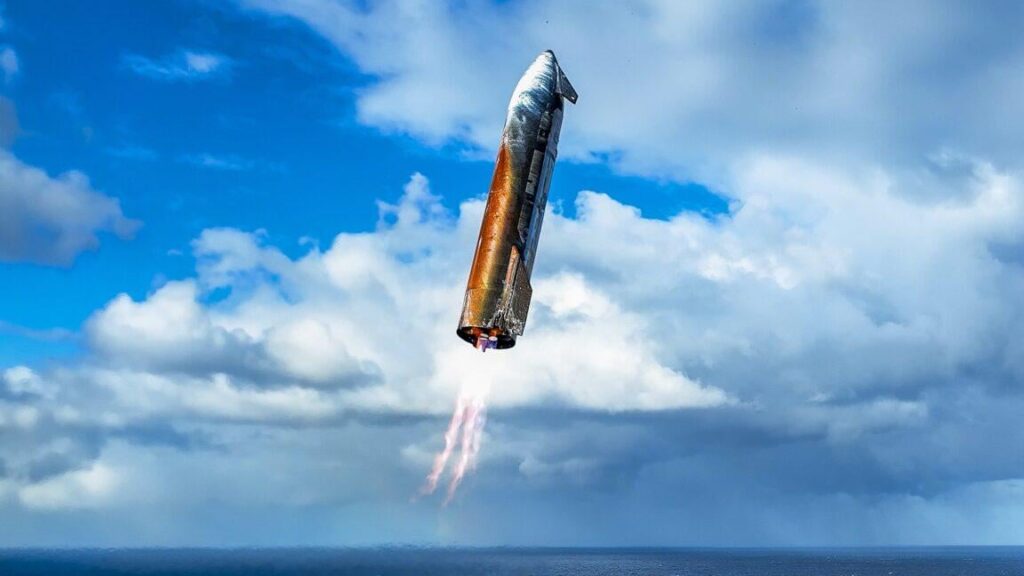
SpaceX’s lesson from last Starship flight? “We need to seal the tiles.”
https://arstechnica.com/space/2025/09/spacexs-lesson-from-last-starship-flight-we-need-to-seal-the-tiles/
19 Comments
Sounds like a “No shit, Sherlock.” moment for them.
Did they latch the screen door shut during liftoff? Having that banging around could be a problem, too.
>Gerstenmaier pointed to a patch of white near the top of Starship’s heat shield. This, he said, was caused by heat seeping between gaps in the tiles and eroding the underlying material, a thermal barrier derived from the heat shield on SpaceX’s Dragon spacecraft. Technicians also intentionally removed some tiles near Starship’s nose to test the vehicle’s response.
“It’s essentially a white material that sits on Dragon and it ablates away, and when it ablates, it creates this white residue,” Gerstenmaier said. “So, what that’s showing us is that we’re having heat essentially get into that region between the tiles, go underneath the tiles, and this ablative structure is then ablating underneath. So, we learned that we need to seal the tiles.”
They need to seal the gaps, not the tiles. I’m not sure why he puts it that way.
Ten more test explosion launches and you’ll get it right
I was there in person! I talked to him a bit about the tiles and all, and yea that was so cool.
I also just almost leaked smthn im not supposed to say lol
Do the tiles have a tongue and groove system on their edges? If not, why not?
Starship has a similar mass as the space shuttle while having twice the surface area. This is extremely ambitious project .
You know what rhymes with “seal the tiles”? Release the files!
Maybe they should talk to NASA about these things. They seem to have figured them out 40+ years ago.
Do they do testing on the ground, rather than an expensive launch? What would it take to simulate re-entry? Stick a boilerplate model at the flamey end of a raptor engine and shake it around on some hydraulics?
This one makes so much more sense since his “gestures” on stage.
https://xkcd.com/984/
> SpaceX engineers noticed the booster’s performance on descent in flight doesn’t match predictions from computer models or wind tunnel tests. In ground experiments, the booster encounters unstable buffeting as it slows below the speed of sound.
> Based on those results, “[we] should not be able to do what we do with our maneuver coming back with a booster, but we’ve been able to essentially show through flight that we have more stability than either CFD (Computational Fluid Dynamics) or the wind tunnels show that we have,” Gerstenmaier said.
It’s a scaling issue with the models. The booster is much larger than the Falcon 9 first stage. Something about the design, due to turbulence or inertia or the sheer size, means the vehicle is more stable than expected at those speeds.
They need to figure out a way to spray on some kind of heat shield material. Otherwise, it’ll take forever to repair after flights.
Acronyms, initialisms, abbreviations, contractions, and other phrases which expand to something larger, that I’ve seen in this thread:
|Fewer Letters|More Letters|
|——-|———|—|
|[CFD](/r/Space/comments/1ncs174/stub/ndbytgm “Last usage”)|Computational Fluid Dynamics|
|[ESA](/r/Space/comments/1ncs174/stub/ndc77k1 “Last usage”)|European Space Agency|
|[HLS](/r/Space/comments/1ncs174/stub/ndc87ao “Last usage”)|[Human Landing System](https://en.wikipedia.org/wiki/Artemis_program#Human_Landing_System) (Artemis)|
|[LEM](/r/Space/comments/1ncs174/stub/ndc87ao “Last usage”)|(Apollo) [Lunar Excursion Module](https://en.wikipedia.org/wiki/Apollo_Lunar_Module) (also Lunar Module)|
|[LEO](/r/Space/comments/1ncs174/stub/ndbuony “Last usage”)|Low Earth Orbit (180-2000km)|
| |Law Enforcement Officer (most often mentioned during transport operations)|
|[LOC](/r/Space/comments/1ncs174/stub/ndbxiz8 “Last usage”)|Loss of Crew|
|[SHLV](/r/Space/comments/1ncs174/stub/ndc8ro4 “Last usage”)|Super-Heavy Lift Launch Vehicle (over 50 tons to LEO)|
|[SLS](/r/Space/comments/1ncs174/stub/ndc9fcd “Last usage”)|Space Launch System heavy-lift|
|[TLI](/r/Space/comments/1ncs174/stub/ndc3cl8 “Last usage”)|Trans-Lunar Injection maneuver|
|[TPS](/r/Space/comments/1ncs174/stub/ndc52j4 “Last usage”)|Thermal Protection System for a spacecraft (on the Falcon 9 first stage, the engine “Dance floor”)|
|Jargon|Definition|
|——-|———|—|
|[ablative](/r/Space/comments/1ncs174/stub/ndc2i0k “Last usage”)|Material which is intentionally destroyed in use (for example, heatshields which burn away to dissipate heat)|
Decronym is now also available on Lemmy! Requests for support and new installations should be directed to the Contact address below.
—————-
^(11 acronyms in this thread; )[^(the most compressed thread commented on today)](/r/Space/comments/1lsabcb)^( has 39 acronyms.)
^([Thread #11661 for this sub, first seen 9th Sep 2025, 20:34])
^[[FAQ]](http://decronym.xyz/) [^([Full list])](http://decronym.xyz/acronyms/Space) [^[Contact]](https://hachyderm.io/@Two9A) [^([Source code])](https://gistdotgithubdotcom/Two9A/1d976f9b7441694162c8)
Were they not doing that already? Is this a new concept to these people? That sounds like something they could have figured out several failed launches ago.
Just a little red rtv silicone should do the trick
So spaceX is still failing at implementing lessons NASA, ESA and other space agencies have figured out decades ago? What a shock! All these promises they gave to get government contracts and they still can’t get a big rocket around the earth in one piece. What happened to having a permanent base on Mars by 2020?
im not engineer so i’m sure the brains have already thought about it. but i’ve often wondered why they dont use more carbon-carbon panels rather than tiles. like the entire flap assembly as one solid piece of carbon with stainless wire frame reinforcement all baked as one piece.
probably cost, but surely its more durable.
or just one massive blanket, or whole panels of the tile material.
or a pre cut blanket with the tiles attached, like when you buy small bathroom tiles at home and they’re attached to nets so you can lay them like carpet.
The lesson learned here should be to stop subsidizing private industry on a race to the bottom and to just fully fund NASA.