
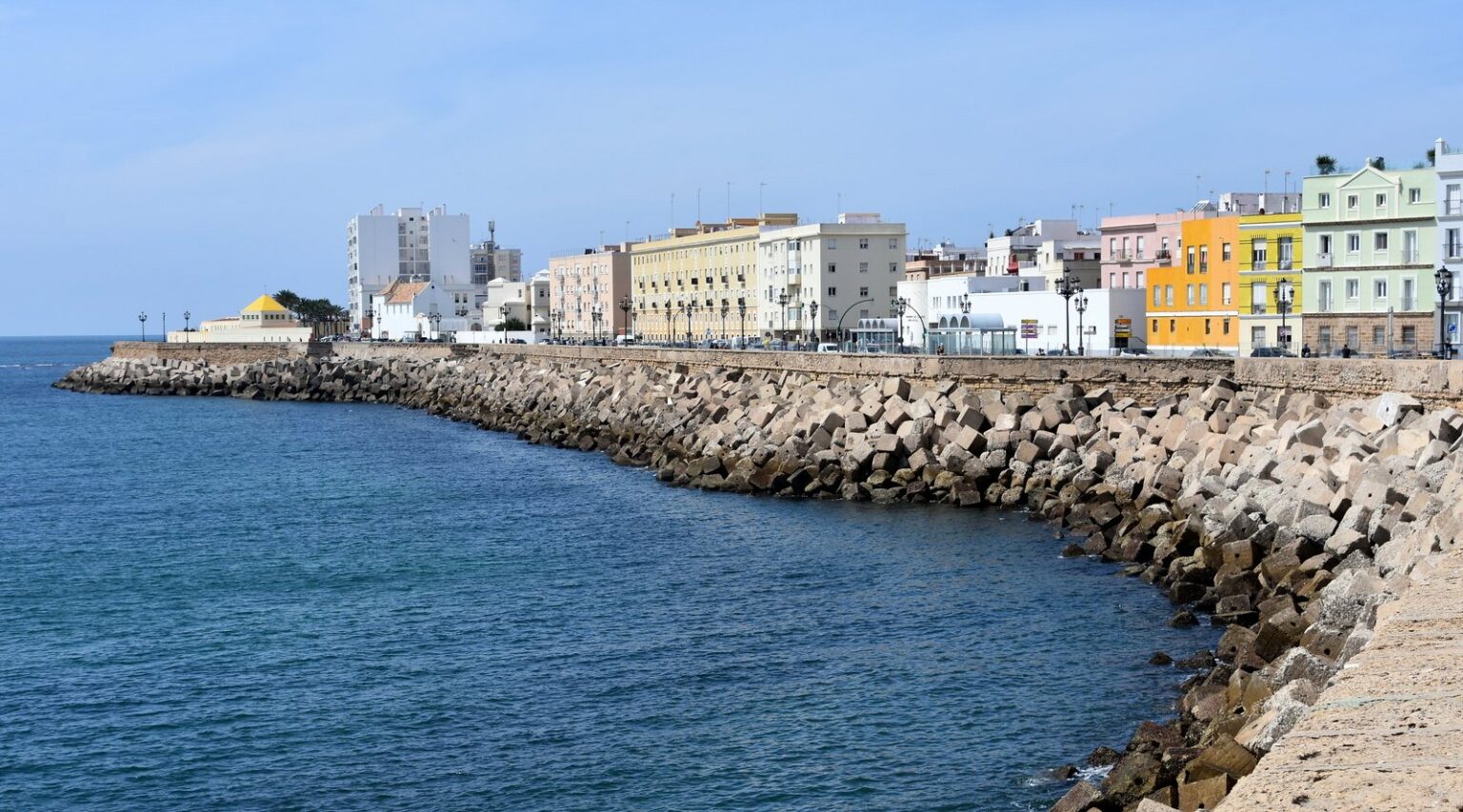
The coastline of Cádiz, Spain. Credit: James Stringer / Flickr / CC BY-NC 2.0
An archaeologist claims to have discovered the remains of the legendary lost city of Atlantis, described by the Greek philosopher Plato, in waters off the coast of southern Spain.
Discovery near Cádiz
Independent archaeologist Michael Donnellan has spent eight years studying submerged ruins near Cádiz, a city in Andalusia that has a historical connection to the ancient region of Gades. Using advanced sonar and satellite imaging, he believes the findings match Plato’s detailed accounts of the lost civilization.
Donnellan discussed his research in an interview highlighted on The Joe Rogan Experience, where independent researcher Ben van Kerkwyk introduced the claims. Rogan appeared stunned by the discussion and noted that Donnellan’s discoveries are being documented for wider release.
Plato’s descriptions of Atlantis
Plato’s dialogues Timaeus and Critias describe an advanced society with monumental temples, concentric circular walls, and fertile lands that supported year-round crops before the city was swallowed by the sea more than 11,000 years ago. Donnellan argues that the descriptions align closely with ruins and patterns detected on the seafloor near Cádiz.
🚨BREAKING NEWS: Could this be Atlantis?
Atlantis may have just surfaced—beneath the waters near Cádiz, Spain! Renowned archaeologist Michael Donnellan unveiled groundbreaking sonar scans today revealing ancient circular submerged structures eerily aligned with Plato’s… pic.twitter.com/JJoLrP8KMx
— History Content (@HistContent) July 3, 2025
“All those details align perfectly with the region we’re studying,” Donnellan said. “Our investigations reflect Plato’s texts with extraordinary precision, truly to a perfect degree.”
Findings from sonar scans
His team used high-resolution sonar to create 3D maps of the seabed, revealing long linear formations and massive concentric walls, each more than 20 feet tall. Donnellan said the outermost wall appeared damaged, as though struck by a tsunami, while two inner walls were “completely displaced” and split apart.
Alright, folks, what are we thinking about Atlantis in Spain?
Michael Donnellan and a group of divers and scientists have been mapping the south western shoreline of Spain for 6 years now. In his trailer to his new series coming out “Atlantica” there were some exciting images.… pic.twitter.com/YTqGLy0B3W
— Ripplestiltskin (@NewEinHara) September 3, 2025
The scans revealed carved canals between the walls. Donnellan identified a rectangular ruin at the center that he believes corresponds to Plato’s description of Poseidon’s temple, possibly marking the site of Atlantis’s capital.
“The team brings together a wide array of specialists and technologies, from the dive team to the scanning experts and the academics who have contributed to this project,” Donnellan said, adding that the findings suggest the structures are man-made.
Animals and trade in Plato’s account
Donnellan also pointed to Plato’s descriptions of animals that played a role in daily life, including horses, bulls, and elephants. He noted that the original horse from this region is considered one of the world’s oldest breeds, while the Andalusian fighting bull’s origins trace back thousands of years.
He said evidence of a prehistoric ivory trade suggests that three types of elephants once lived in the area, including Asian elephants, which would indicate long-distance commerce between Iberia and Asia.
Debate over the Younger Dryas event
The claims connect to a broader debate among researchers who believe a cataclysmic event destroyed an advanced civilization approximately 12,000 years ago. Proponents of the controversial Younger Dryas Impact Hypothesis argue that Earth collided with debris from a disintegrating comet, triggering floods, disrupting ocean currents, and plunging the planet into rapid cooling.
Mainstream scholars remain skeptical of both the hypothesis and the existence of Atlantis, widely regarded as a myth. Still, Donnellan maintains that his findings point to a civilization from that period, hidden beneath layers of sediment on the ocean floor.