

Published on
September 10, 2025
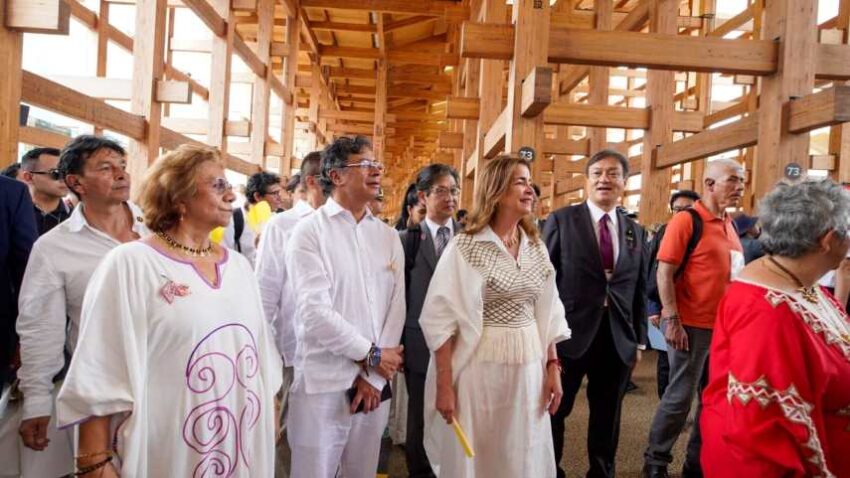
Osaka, Japan, had a big diplomatic and cultural moment when President Gustavo Petro of Colombia came to visit the Colombia Pavilion at the Expo 2025 Osaka, Kansai. This visit, which took place on the 5th and 6th of September 2025, was just another opportunity to display Colombia’s culture and to polish international cooperation and trade with Japan.
While at the pavilion, President Petro spoke with a few members of the media to explain to them his thoughts on Colombia as well as his vision of Colombia’s presence in the world, coupled with cultural diplomacy. One of the major highlights of the visit was the ceremonial planting of one of the ‘oaks of civilization’. This tree planting ceremony is aimed at promoting the Colombian legacy to the international community. This specific ceremony symbolizes the connection Colombian civilization has to the culture of the world in addition to the environmental aspect.
Colombian culture and its roots in magical realism are highlighted
President Petro spoke about the Colombia Pavilion’s theme and how it relates to Gabriel García Márquez’s One Hundred Years of Solitude. He discussed the impact of magical realism in Colombia and how it resonates with the rest of the world. He described the pavilion’s theme as a metaphorical link between Colombia and the rest of the world, embracing extraordinary richness in nature and human creativity in Colombia and Japan.
Exhibitions that enabled visitors to interact with Colombian indigenous groups were designed by the Pavilion of Colombia, which is sponsored by ProColombia, the country’s promotion arm. These cultural activities were aimed at providing participants with an inclusive understanding of Colombia’s treasured past, its rich traditions, and its innovative contemporary art. Colombia’s spirited culture, which is offered through the artistic disciplines of music, dance, and the visual arts, together with the educational information about the country’s culture, was on display during the performances and exhibitions.
Encouraging Trade and Investment Opportunities
President Petro took the trip to improve the decades-old Colombia-Japan relations. Also, the trip served as the base to talk about investment opportunities in Colombia and positioned the country as a strategic partner for innovation and tourism. Officials and traders from the country underscored the country’s commitment to a series of win-win relations in the international sphere and the role that cultural diplomacy will play in the world.
The Prodefensa Colombia organization led the effort. So the pavilion was about Colombia’s cultural and artistic prowess and geared toward Colombia’s economic prowess, too. With the pavilion, Colombia was promoting itself for investment in sustainable development, innovation, and tourism.
Interview and Vocational Focus
SENA is a Colombian government entity that corresponds to the second pillar. So there was the possibility to let experts visit the country’s efforts in education. Its collaboration in the pavilion featured the country’s workforce development component on SENA’s programs in the country, which aims to address the assumed deficit. With SENA’s participation, Colombia is again represented as a proactive, progressive country.
Adding these new educational aspects into the pavilion was intended to create a mixed cultural, economic, and educational experience from many different angles by the Colombian delegation. This way, the Colombian audiences could appreciate the culture and then see contemporary opportunities for partnerships.
Strengthening Community Engagement
The participation of President Petro during the pavilion activities was a sign of Colombia’s dedication to outreach and the cultivation of culture and community. The ‘Civilizations of the World’ naming ritual was a telling of the calling of Colombia to engender worldwide. The Colombian delegation intended to spell out the value of individual and collective memory for the nation’s image abroad by involving the local population and the press in these rituals.
The construction of the pavilion and the surrounding activities were aimed at a broad audience and made it easy for them to appreciate the artistic elements of the pavilion, intertwined with the elaborate stories told. The pavilion served as a pedagogical tool in the greater context of Expo 2025, inviting guests to understand the many different Colombian communities as well as the history and contemporary advancements.
President Petro’s Message on Global Collaboration
President Petro’s visit served to deliver a message of positivity and unity. It’s important to note that he strongly underscored that the use of cultural diplomacy assists in reinforcing relationships on the global scene as well as enables economic development. By taking part in the activities, Colombia wanted to showcase itself as a participant in the international dialogue on culture, innovation, and sustainable development.
In his remarks, the President pointed out the parallelism between Colombian and Japanese landscapes and traditions, noting how much appreciation of other cultures helps deepen understanding of one another. By integrating cultural displays, educational programs, and economic dialogues, the Colombia Pavilion became a remarkable case of how countries can connect audiences to their strategic interests while connecting audiences to their cultural heritage.
Looking Ahead
In the course of Expo 2025 Osaka, the Colombia Pavilion is anticipated to continue to be one of the key attractions for those who wish to learn more about Colombian culture, heritage, and economic potential. The Petro’s visit has reinforced the pavilion’s prominence and highlighted the importance of culture diplomacy in developing long-term diplomatic relations.
The visit, as in other cases, was a celebration point for the Colombian delegation and Japanese hosts, demonstrating their devotion to culture and education. The pavilion seems to continue to encourage visitors, allowing people to discover Colombia’s rich heritage and the natural surroundings, as well as advanced savings. Developed and developing countries are connected through the human-centered approach, the pavilion wraps, venturing people to the core of the country.
