
Although the President of the European Commission, Ursula von der Leyen, did not mention Serbia in her speech on the EU today, only briefly touching on the Western Balkans as a whole, the fact is that our country has been under the scrutiny of European public opinion in recent days. First, European Commissioner for Enlargement Marta Kos stated that “we have a problem in Belgrade”, then the situation in Serbia was debated during the visit of opposition politicians from Belgrade to the European Parliament (EP), where a session on our country was held on Tuesday, during which sharp assessments and criticisms of the Serbian regime were voiced.
To this must be added that the President of the European People’s Party (EPP), Manfred Weber, said that the future of the SNS in that largest group in the EP, where it holds the status of associate member, would be the subject of debate in the coming days.
After everything that has happened in just the last few days, it is hard for anyone to continue claiming that the EU is turning a blind eye to developments in Serbia, as we had been hearing for months. The fact is that the EU knows very well what is happening in Serbia, but it is also true that all this does not yet mean Brussels will make a major shift in its approach towards official Belgrade.
For now, it is only clear that the EU acknowledges it has a problem in Belgrade, but everything else – the “intensity” and “severity” of Brussels’ reaction, a possible change of stance, the instruments the EU can use and so forth – remains uncertain, open to debate and subject to change.
“The EU must hear citizens as well as the authorities”
The Secretary General of the European Movement in Serbia, Dragana Đurica, told NIN that the EU, apart from some of its individual officials, has not yet clearly connected cause and effect.
“Official Brussels must clearly recognise that in a country where institutions have been emptied of meaning, where violence against citizens and the media is being carried out, protests are not the cause of the crisis, but its symptom. Of course, no form of violence or intimidation should be justified or glorified, but the EU must recognise the context and not equate systemic repression with the frustration of disenfranchised citizens. There can be no ‘balance’ between regime violence and citizens’ anger.
At the same time, however difficult this may be to understand in such a distorted political reality, it is important to emphasise that citizens can seek support and protection from the EU, whatever its flaws. But they must also understand the broader context and the challenges the Union faces. The EU reacts slowly, and it is currently burdened by its own crises – the war in Ukraine, divisions within member states, and declining global influence.
On top of this, enlargement has for years been caught between unfulfilled hopes and propaganda, from broken promises of ‘imminent membership’ to government spin about ‘blackmail’. Citizens are trapped in a vicious circle of expectations and disappointment, while the EU repeatedly misses the chance to have them as partners,” Đurica said.
According to her, if it wants to maintain its credibility, the EU must hear citizens as well as the authorities. But citizens too, if they want EU support to be genuine and visible, must position themselves clearly towards Europe rather than away from it.
“The clearer citizens show that they belong to Europe as their natural geographical, economic, cultural, and historical environment, the harder it will be for the EU to ignore them. And this is already beginning to happen: the biggest European media openly speak of the regime’s brutality, of the abuse of citizens, of the climate of fear in which they live. The European Parliament is once again debating Serbia. The European People’s Party, which for years has provided a political umbrella for the regime, has announced it will reconsider the membership of Serbia’s ruling party. And if such a statement is made publicly, it means the matter has already been seriously raised within the EPP itself.
This could have consequences for both Belgrade and Brussels. For if the EPP really does abandon its member, the question arises how much political room will remain for Commission President Ursula von der Leyen, who comes from that very party and is already facing pressure and divisions on all fronts. In that case, Serbia will no longer be just a ‘problem in the Balkans’, but a litmus test for the consistency of European policy and its officials,” Đurica argued.
What did we hear in the European Parliament?
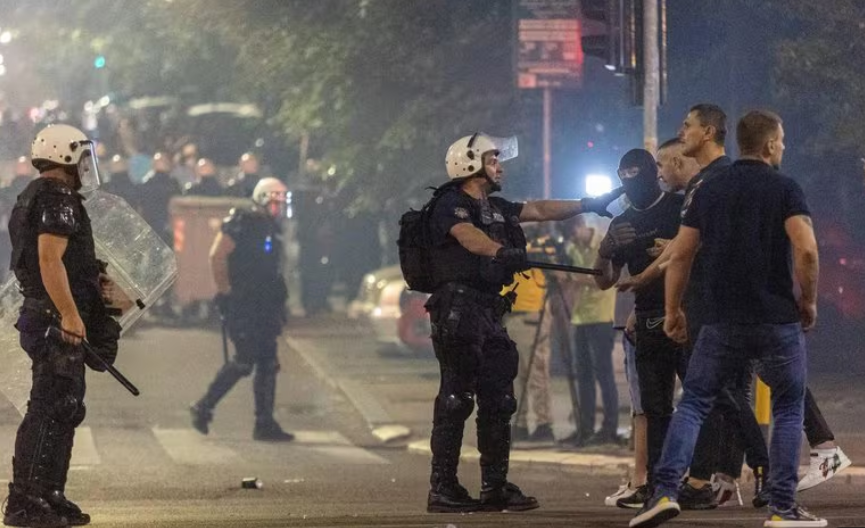
During Tuesday’s debate in the European Parliament, under the title “Wave of violence and continued use of force against demonstrators in Serbia”, MEPs took turns voicing a series of criticisms. They noted, among other things, that the country has in the past ten months reached a new level of repression, violence, and polarisation, and that President Aleksandar Vučić has established authoritarian rule in the country, which has no place in the EU.
Addressing the EP, Commissioner Marta Kos said that it is expected that policing and police action should be proportionate and that fundamental rights must be respected.
“We condemn all acts of hatred, vandalism and violence and continue to call on all sides to de-escalate tensions. Respect for fundamental rights and values, including freedom of peaceful assembly, media freedom and academic freedom, are key elements of European integration and must be respected everywhere and by all sides. This also means avoiding any form of violence against government representatives and their families, as well as refraining from attacks on political party premises,” Kos said, also condemning “violence or threats against representatives of the judiciary.”
She also referred to Vučić’s visits to Beijing and Moscow, as well as to his insults aimed at Members of the European Parliament who visited Serbia a few days ago.
“We want Serbia to be truly democratic and to become part of the EU. I am committed to that as Commissioner for Enlargement. We will continue to be constructive and do everything to help Serbia move forward on its path to joining Europe, but for that to happen, concrete steps are needed in terms of reforms and democratic principles. The participation of President Vučić in military parades in Moscow and Beijing, alongside critical statements against the EU and respected Members of Parliament, most recently aimed at the delegation of the European Greens, is simply not what is expected from a candidate country,” said Kos.
The European Parliament’s rapporteur for Serbia, Tonino Picula, stated that “Brussels must not offer Vučić carrots so that he can hand out sticks to his citizens,” adding that “it is paradoxical to impose sanctions on the Russian regime, while remaining silent towards a candidate country whose leader publicly refuses to introduce them against the aggressor regime.”
Austrian MEP from the EPP, Reinhold Lopatka, said that Serbia is a key EU partner in the Western Balkans and “we see its future in the Union,” but that the path to membership must be based on democracy, and “Serbia is currently not on it.” Vladimir Prebilič of the Greens said that Serbia is “crying for help” and stressed that the EPP must stop supporting Vučić. Belgian MEP Van Brempt also spoke about democracy in Serbia, stating that the EU must insist on its restoration.
“Serbia is a candidate country for EU membership. It is time to take concrete measures, and negotiations should be used to see change on the ground. It is very important that we clearly stand for democracy,” said Van Brempt, adding that on one side are Vučić’s relations with the presidents of China and Russia, Xi Jinping and Vladimir Putin, and on the other are “peaceful protests controlled by the authorities with force.”
Earlier on the same day in Strasbourg, a panel discussion titled “Serbia: Democracy at the Crossroads” was held, organised by three political groups in the European Parliament – Socialists and Democrats, the Greens, and Renew Europe. Serbian opposition representatives also took part – Borko Stefanović (Party of Freedom and Justice), Biljana Đorđević (Green-Left Front), Zdravko Ponoš (Serbia Centre), Pavle Grbović (Movement of Free Citizens) and Ana Jakovljević (People’s Movement of Serbia). Some representatives of these five Serbian opposition parties called on that occasion for the introduction of sanctions against President Aleksandar Vučić and other senior state officials.
A paradoxical relationship
The director of the Institute for European Affairs, Naim Leo Beširi, told NIN that the EU has for years been caught in a paradoxical relationship with Serbia, burdened by the need to adopt decisions by consensus at the level of the Council of Ministers.
“While Brussels increasingly acknowledges the collapse of democracy, the stifling of the media and the lack of reforms, the reactions have been mild and often delayed. It is especially important to recall that in the last 13 years not a single essential reform has been implemented, neither in the judiciary nor in the fight against corruption. Five years ago Aleksandar Vučić effectively abandoned the European path, despite the fact that he built his political legitimacy precisely on the promise that he would bring Serbia into the EU by 2018. Those lies, together with elections marked by bags full of questionable ballots, have enabled him to win ever since the time when his party leader Tomislav Nikolić defeated Boris Tadić,” Beširi said.
He believes that the fact that in Ursula von der Leyen’s speech today on the Western Balkans neither Serbia nor Vučić was mentioned represents a political message, but also reflects the ambiguous stance of the Commission itself.
“Her ignoring of Serbia today looks more like washing her hands of ‘Dear Aleksandar’ than a genuine change of course. Unlike the Commission, the European Parliament has in recent days shown readiness to speak openly about the situation in Serbia. The debate dedicated to the political crisis and the opportunity for the opposition to speak directly before European institutions shows that Serbia has not been forgotten. However, as long as member states continue to balance between values and short-term interests, Vučić will go on using the EU as a backdrop for his own rule, with no intention of changing anything in the country,” Beširi added.
He underlined that the EU’s message must be clear: “Without real reforms, free elections and the rule of law, there is no European path for Serbia, and when citizens’ rights are threatened, we will be ready to impose sanctions on those responsible.”
“If the EU does not convey that message unambiguously, it risks losing not only Serbia but also its own credibility in the region,” he said.
Today’s speech by European Commission President Ursula von der Leyen was also criticised by some European politicians. The Secretary-General of the European Democratic Party, Sandro Gozi, said he was certain that Ursula von der Leyen was familiar with the situation in Serbia and that she did not rely on letters from President Vučić for information. Still, he stressed that her speech today was not favourable for the citizens of Serbia.
“For you, it was not a very favourable speech because it completely ignored the situation in Serbia and what is happening there. That does not work in your favour. From the EU’s perspective, of course, it is not heading in the right direction, but also in view of Serbia’s ambitions… I think you should be disappointed,” he said in an interview for N1.
Accusations against European politicians
Since the start of mass protests in Serbia ten months ago, harsh words have increasingly been directed by the country’s top officials at European representatives who criticise the regime in Belgrade. Thus, a few days ago, President Vučić called the Green MEPs who visited Serbia “scum”. A few days later he slightly backtracked, saying that he had made a mistake by calling them scum, but added that he thought even worse of them than he had said.
“They say I insulted them because I said they were ‘scum’. To be completely honest, I think much worse of them. But did I make a mistake by calling them that? Probably yes, the president of a state should not use that word in public discourse. Otherwise, I think much worse than that. And what am I to think of people who did not come to an election rally? They did not come to support some policy? I would not have had anything against that,” Vučić said.
Dragana Đurica of the European Movement in Serbia, speaking about the increasingly frequent attacks by government representatives on EU officials, said that this was “part of a performance for the domestic audience and their electorate.”
“When they ‘thunder’ against the EU, they do not risk much, because they know very well that they can afford the luxury of speaking about the ‘humiliation of Serbia by the EU’, or the ‘orchestration of protests and destabilisation of Serbia by European countries’, or insulting EU officials, while at the same time using European funds, trade benefits and the political legitimacy of the negotiating process. It is a paradoxical policy, where the EU is used both as a punching bag and as a cash machine. The problem is that Brussels has stubbornly tolerated this until now, while citizens are left with a taste of bitterness and frustration, because in the end they are the ones who pay the price,” concluded NIN’s interlocutor.
(NIN, 10.09.2025)
https://www.nin.rs/politika/vesti/88677/srbija-tema-evropskih-institucija