
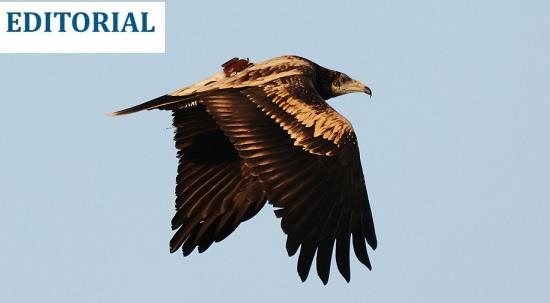

Malta recently witnessed what has been described as a conservation “success story”. A rare Egyptian Vulture, named Hugo, crossed the islands safely on its way to Africa – escaping the all-too-common fate of being shot by hunters. BirdLife Malta and the Environmental Protection Unit, together with international conservationists, monitored Hugo’s every movement, provided food when he was weakened by headwinds, and essentially safeguarded his survival until he resumed his journey.
This is, on the face of it, good news. Yet the very fact that we are celebrating Hugo’s safe departure should make us pause. If ensuring that a single bird is not gunned down requires round-the-clock monitoring, international cooperation, and the deployment of police, then Malta does not have a conservation success story – it has a conservation crisis.
The Egyptian Vulture (Neophron percnopterus) is not just another migratory bird. It is one of Europe’s rarest raptors, listed as endangered by the International Union for Conservation of Nature (IUCN). With barely ten breeding pairs left in Italy, every chick raised in captivity represents years of expertise, immense financial cost, and a fragile hope of reversing population decline. Hugo was one of only two chicks hatched at CERM’s captive-breeding centre in Tuscany this year. That such an effort is required to produce a single bird speaks volumes about how close the species is to vanishing from Europe altogether.
And yet, when birds like Hugo make their way to Malta, their greatest threat is not nature’s unpredictability, but the barrel of a gun. Past cases illustrate this all too painfully. Isabel, another vulture, vanished near Dingli Cliffs in 2021 and was believed to have been shot. Tommy was killed in 2022, his transmitter later washing ashore at Ġnejna Bay.
That is why the fanfare around Hugo’s survival feels bittersweet. Yes, he survived. But should we truly be in the business of celebrating when an endangered species manages to leave Malta alive? Shouldn’t that be the minimum expectation? The fact that the bird’s safety was not guaranteed, and that volunteers had to scramble in response to nearby gunfire, reveals the depth of Malta’s problem with illegal hunting.
Hunters and their defenders often argue that the majority abide by the law, and that illegal killings are rare exceptions. But if every passage of a rare raptor sparks fear, emergency monitoring, and international concern, then the exceptions are far too many. The shadow of illegal hunting is so entrenched in Malta’s countryside that each bird of prey becomes a potential victim rather than a symbol of natural beauty.
It is worth remembering that Malta lies on a crucial migratory route. What happens here resonates far beyond our shores. For species on the brink of extinction, the islands can be either a safe passage or a deadly bottleneck. The international effort poured into raising and releasing birds like Hugo risks being squandered if Malta cannot guarantee even the most basic protection from criminal gunfire.
The irony is painful: it takes thousands of euros, years of expertise, and the dedication of conservationists across Europe to rear a single Egyptian Vulture chick. Yet it takes only one illegal shot in Malta to erase all that work in an instant. When that imbalance defines our wildlife landscape, applause for “success” rings hollow.
We should not be celebrating Hugo’s survival as if it were an extraordinary achievement. We should be demanding that it becomes the norm. Malta must move past the stage where every bird of prey needs a police escort to avoid a poacher’s bullet. The true measure of conservation success will come not when we cheer because one vulture has survived, but when their survival ceases to be in question.
Until then, Malta’s “success stories” will remain reminders of just how far we still have to go.