
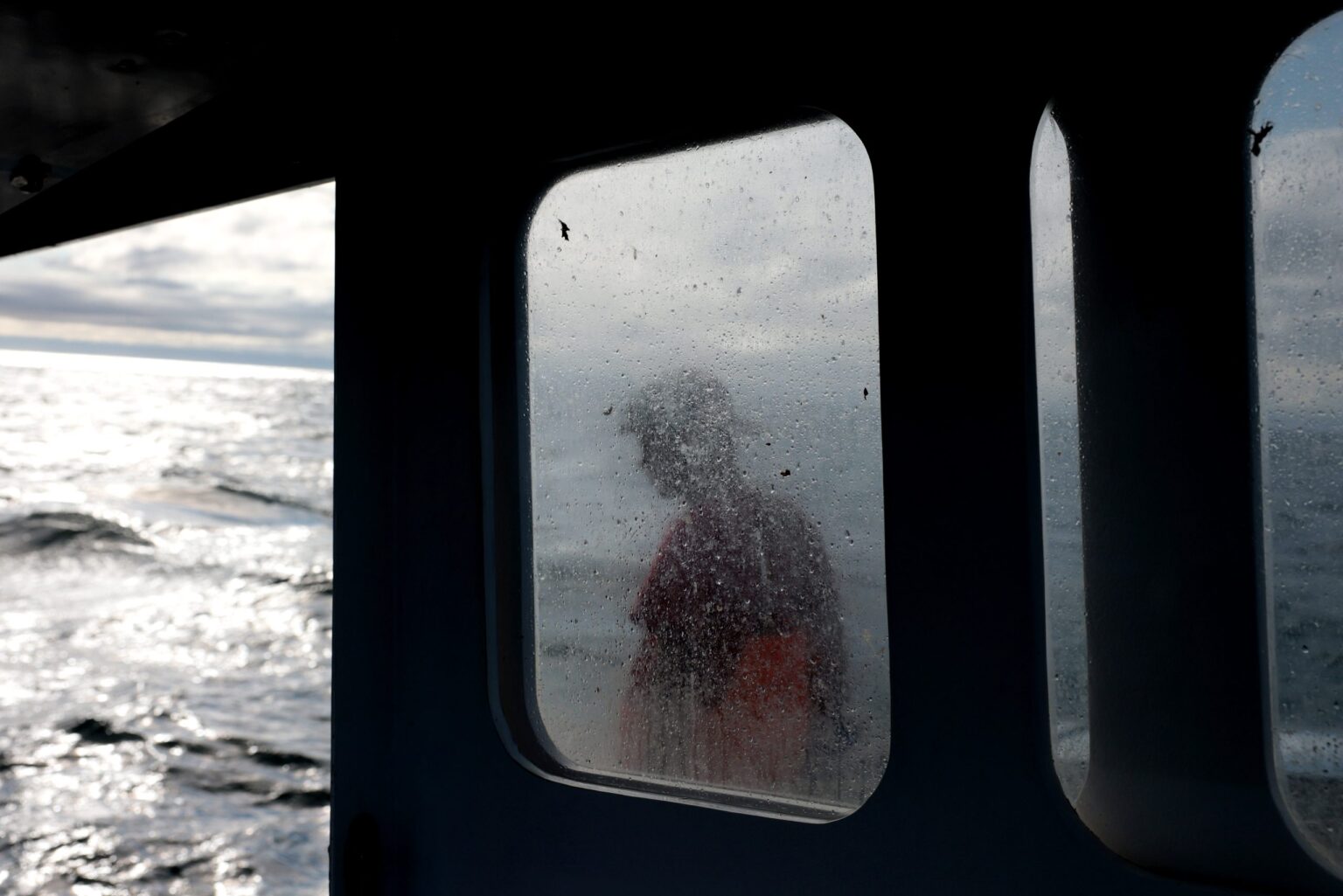
A footballer turned fisher in the Pacific and a stubborn daughter with a small boat in Barcelona – they have little in common but a love for fishing, a sector on the brink of a demographic crisis.
“Good morning, good afternoon, or whatever it is over there,” Unai Ruiz-Zeberio Almandoz, aged 25, says in a voice note dispatched from a fishing boat in the middle of the Pacific Ocean. When asked about his precise location in a response, he hesitates. “I can’t tell exactly because we never take the same route. We always follow the fish. If the fish go north, we go north.”
Back in his home town, Donostia-San Sebastián in Spain, Unai is known as the former goalkeeper who recently hung up his boots and swapped playing in the country’s second division for tuna fishing.
The combination of a knee injury – a nightmare for any player – and disillusionment with the world of football forced him to quit. “My case is not very common. I have always loved fishing, since I was a child (…) but I started playing football, and I was good at it.”
He is now spending four months at sea to get his licence as a captain in deep-sea fishing. After going back home for a while, he’ll sail again for four more to close out his training.
“I embarked in Ecuador, and now we’re heading west, off French Polynesia, south of Hawaii, to an island-country called Kiribati. It’s right in the middle, between Australia and Latin America”.
The number of people in their 20s willing to sign up to fish in oceans around the world is dwindling in a profession growing older every year. EU data shows that around 70% of fishers in countries such as Italy and Greece are over 40 years old.
Faced with an ageing and also shrinking fishing workforce, Brussels promised a “generational renewal strategy” for 2027.
Unai says that life on board could be worse.
“We each have our own cabin, a chef cooks for us, we have our clothes cleaned, and we can shower every day,” he says in another voice note, adding that the downside is missing his loved ones. When the crew is not fishing for tuna, Unai takes care of safety in the boat and keeps watch at night – he says that the interview helped him “kill time” during the dull hours.
“It’s a decent job, like any other, and the wage is good”.
Still, Unai knows that it can be difficult to get youngsters aboard in the industry, especially in smaller, inshore fishing, where he says the conditions are tougher and the likelihood of future generations taking over is slimmer.
“In inshore fishing, you can be awake for 20 hours. In deep-sea fishing, you spend much more time away from home. But then, in my case, I take more rest,” Unai says.
We are what we eat
Alba Aguilera Olivencia, aged 24, knows the reality of small-scale fishing too well.
“We set the nets before the sun goes down, and raise them when the sun has set. So we sleep on the boat. We haul in the nets, catch the fish, sell it at the market, set the nets again… and so on,” she told Euractiv.
And all of that for an uncertain – and usually small – pay.
“After working all day, you can make 50, 100, 200 euros, or nothing. You don’t know. It’s like a roulette; you don’t know where the ball will land. The sea gives you whatever it wants to give you”.
The fourth generation of fishers in her family, Alba’s passion for the sea dates back as far as she can remember.
“My mother was a truck driver at the port of Barcelona, the only female. My father was a fisher. I was their first child, and it was difficult for them because they both worked nights. Sometimes, I would wake up before him and go out on the boat to learn the ropes”.
But her father did not want her to become a fisher, telling her it was “too precarious”. After working in a nightclub – which she says took her down wrong paths – and then on passenger ships, she finally took up the family tradition.
Alba now claims to be the youngest shipowner in Spain’s Catalonia region. “Whatever port I go, I am the youngest, both among men and women, so generational renewal where? (…) I am the last one”.
Her friends still don’t get it. “Girl, that’s disgusting, you’re a masochist,” they tell her.
Alba gets upset when questioned about how to keep small-scale, artisanal fisheries afloat. She accuses Madrid and Brussels of treating boats like hers as industrial-scale fishing and choking them with restrictions.
And she regrets that, around her beloved Mediterranean, consumers opt for fish caught thousands of kilometres away.
“We’re all going to end up eating salmon. And I swear I’ll die without trying it”.
Asked about this bold claim, she treats it as common sense.
“In the Mediterranean, if you have a refined palate, you can enjoy sand eel, solenette, parrotfish, turbot, European lobster, spiny lobster, and red prawn. And for a simpler palate, there is forkbeard, my favourite, monkfish, sardine, and blue whiting…” and the list goes on.
“Do you really think I’m going to eat salmon?” she laughs.
(adm, jp)