
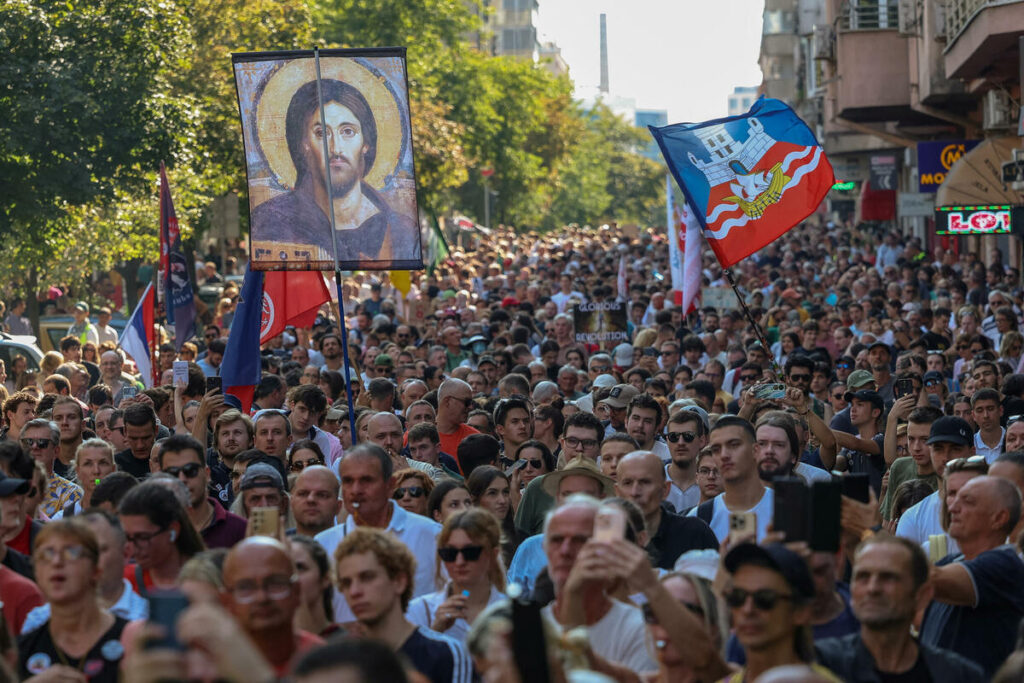
Serbian President Aleksandar Vučić is stepping up his crackdown on protests that have shaken his populist rule in recent months, the Associated Press (AP) agency reported today, adding that what began as a small student-led anti-corruption campaign “has grown into the most turbulent protest waves in the Balkan country in a quarter of a century.”
As reported by the AP, human rights groups and Vučić’s political opponents have warned of increasingly brutal tactics aimed at silencing the movement that has become the biggest challenge to his more than 10-year hold on power.
Last week, the agency writes, tanks rolled through the capital Belgrade in preparation for a military parade on September 20, and protesters fear that the army could remain on the streets “if riots break out during the parade.”
The agency provides an overview of Vučić’s political career, noting that he has ruled Serbia for more than a decade, reshaping its politics amid accusations of corruption and authoritarianism.
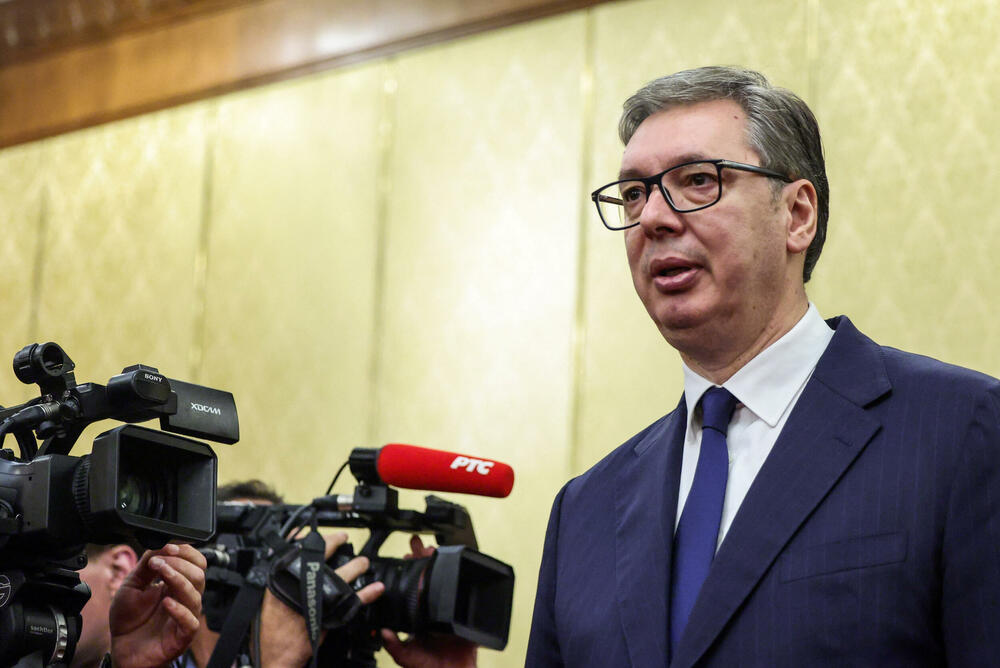
photo: Reuters
He began his political career in the 1990s as a hard-line nationalist in the Serbian Radical Party, the agency points out, recalling that he became Minister of Information under then-Serbian strongman Slobodan Milosevic and became notorious for his calls to punish independent media, and for his war rhetoric against Serbia’s neighbors, which, as the AP adds, he maintains to this day.
Serbia was defeated in the Balkan Wars, Milošević was overthrown in a wave of protests in October 2000, and Vučić transformed himself into a pro-European reformer, co-founder of the Serbian Progressive Party that promised modernization and integration, but consolidated his power through populism, control of the media, and a firm grip on state institutions, the agency writes.
AP recalls the collapse of a canopy on November 1, 2024, at the Novi Sad train station, when 16 people died, and that the tragedy was linked to a Chinese-backed renovation project fueled by alleged state corruption and negligence.
Describing how the protests developed, the agency said that students first began the protests, blocking traffic every Friday for 15 minutes in memory of those who died, but anger over corruption quickly spread beyond campuses and attracted masses of ordinary citizens frustrated by the rising cost of living and a sense of impunity among the ruling elite.
Protesters are now demanding accountability, transparency and early elections, writes the AP.
The demonstrations were initially peaceful marches and protests, the agency said, adding that tensions rose when authorities deployed riot police, plainclothes police and even shadowy paramilitary units led by football hooligans loyal to Vučić to disperse the gatherings with batons, sticks and torches.
Protesters reported being beaten, arbitrary arrests, and the use of tear gas, stun grenades, and sonar devices, tactics that human rights groups have condemned as excessive and brutal.
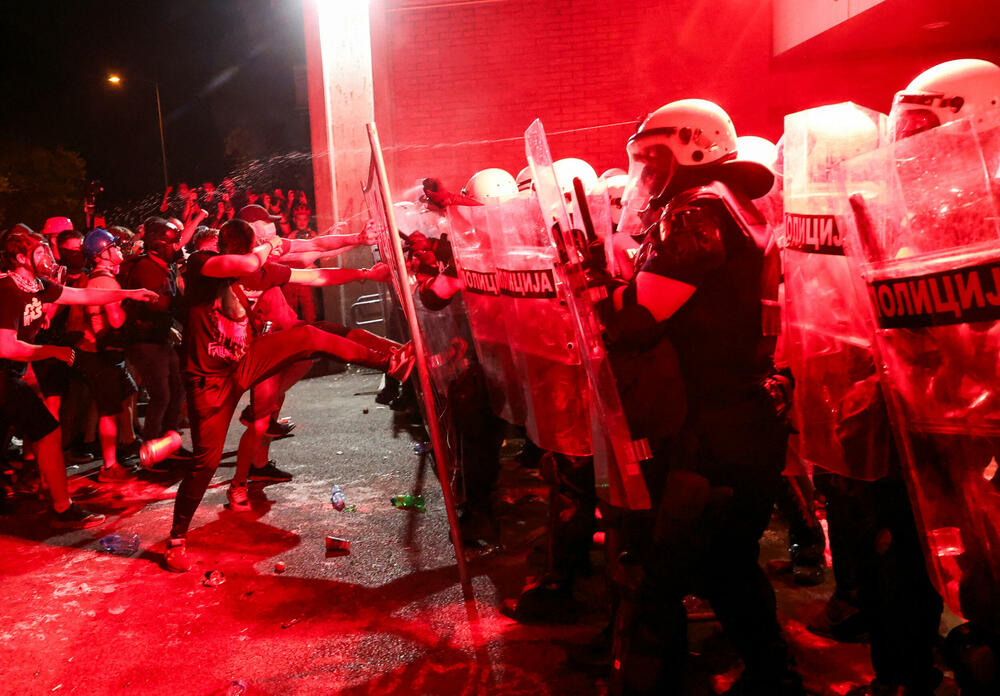
photo: Reuters
The government’s harsh response has fueled defiance, the AP said, adding that students have escalated their actions by blocking major intersections, occupying university buildings and staging protests in front of state institutions. Each new crackdown on protests has brought more people onto the streets, creating a cycle of confrontation.
While previous waves of protests slowly subsided over a controversial real estate project, allegations of stolen elections, and two mass murders (“Ribnikar” and Orašje), this time the protests grew over time and, most crucially, they spread beyond Belgrade to dozens of cities and small towns across the country.
Vučić has repeatedly called student protesters “terrorists” who are working together with Western powers to remove him from power, without providing evidence, the agency writes.
Although he called for dialogue with students, he refused to call early elections and warned of an even harsher response to the protests.
The students rejected his offer of negotiations before early elections. In response to the students’ demands, the authorities fired more than 100 teachers, professors, and deans and replaced them with Vučić loyalists.
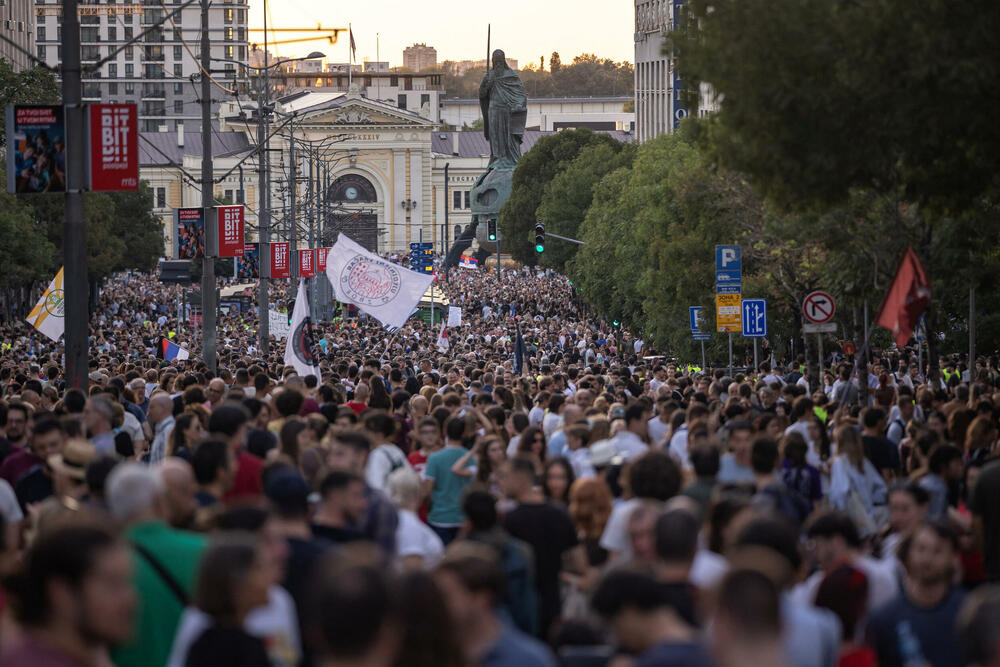
photo: Reuters
While some schools have opened with new staff, others have remained closed, especially some colleges.
While under intense domestic pressure, Vučić continues to present Serbian foreign diplomacy as balanced, managing complex relations with the European Union and its authoritarian allies, such as Russia, the agency writes.
He recalls that on September 1, Vučić attended a summit of leaders from China, Russia, North Korea and Iran where, as he said, he received their support in handling the protests at home. He also refused to join international sanctions against Russia for its invasion of Ukraine.
However, he did not try to block Serbian arms exports to Ukraine, and earlier this year he visited Kiev for the first time, indicating a willingness to connect with Western-oriented countries, writes AP.
The agency recalls that Serbia has been a candidate for EU membership since 2012, but that it has made slow progress.
Vučić’s rule has been marked by centralization of power, repression, and tight control of the media, which has prompted scrutiny from human rights organizations, the AP adds.
He has openly advocated for the closure of the last independent television channels, N1 and Nova, or for a purge of reporters and management. He has called them liars for reporting on the protests, even though they mostly broadcast the protests live, with minimal intervention from editors or commentators, the AP reports.
Analysts and opposition groups believe that Europe must increase pressure on Serbia to prevent its further democratic erosion.
European Union officials have warned Vučić that progress towards EU membership depends on meeting certain standards including judicial reform, media freedom and the fight against corruption.
At a time when Europe is grappling with the consequences of Russia’s war in Ukraine, the EU has so far shown little willingness to confront Vučić and his government, the AP points out.
The Serbian opposition and some EU lawmakers believe the Union’s response was too mild because officials believe Vučić is the only one who can preserve peace in a region still reeling from the consequences of a series of wars in the 1990s, in which more than 100.000 people died and millions were left homeless.
The anti-corruption protests have become more than just a fight against corruption – they are now a direct challenge to Vučić’s strong-arm rule, with protesters demanding free elections, an independent judiciary and accountability for police violence, the agency writes.
With neither side showing signs of relenting, Serbia faces a deepening political crisis and the risk of further unrest and even bloodshed, the AP concludes.

News