
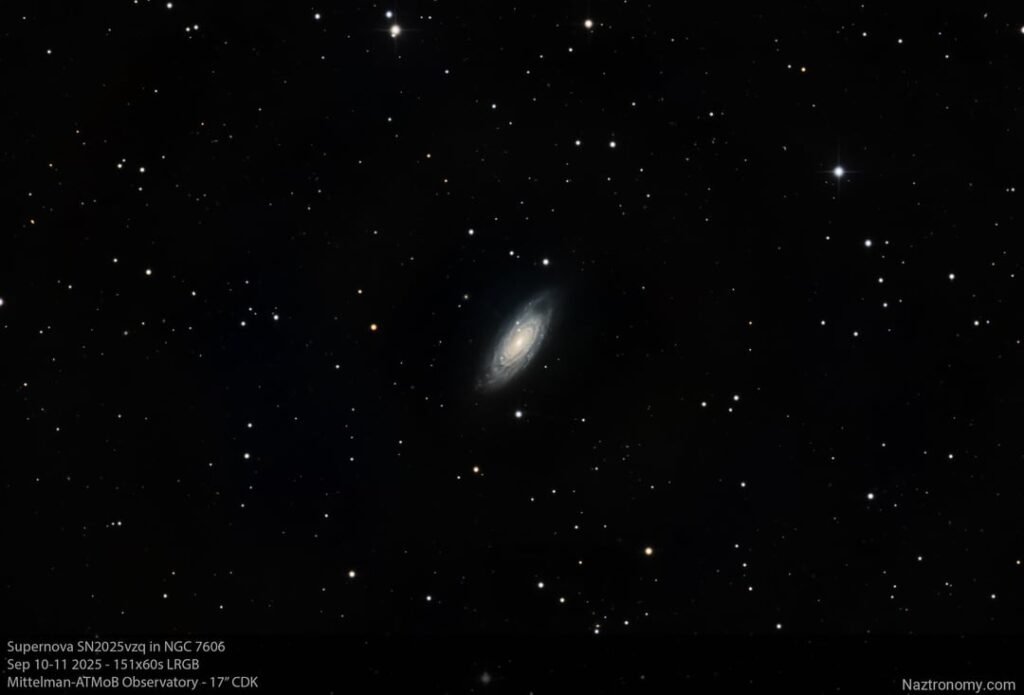
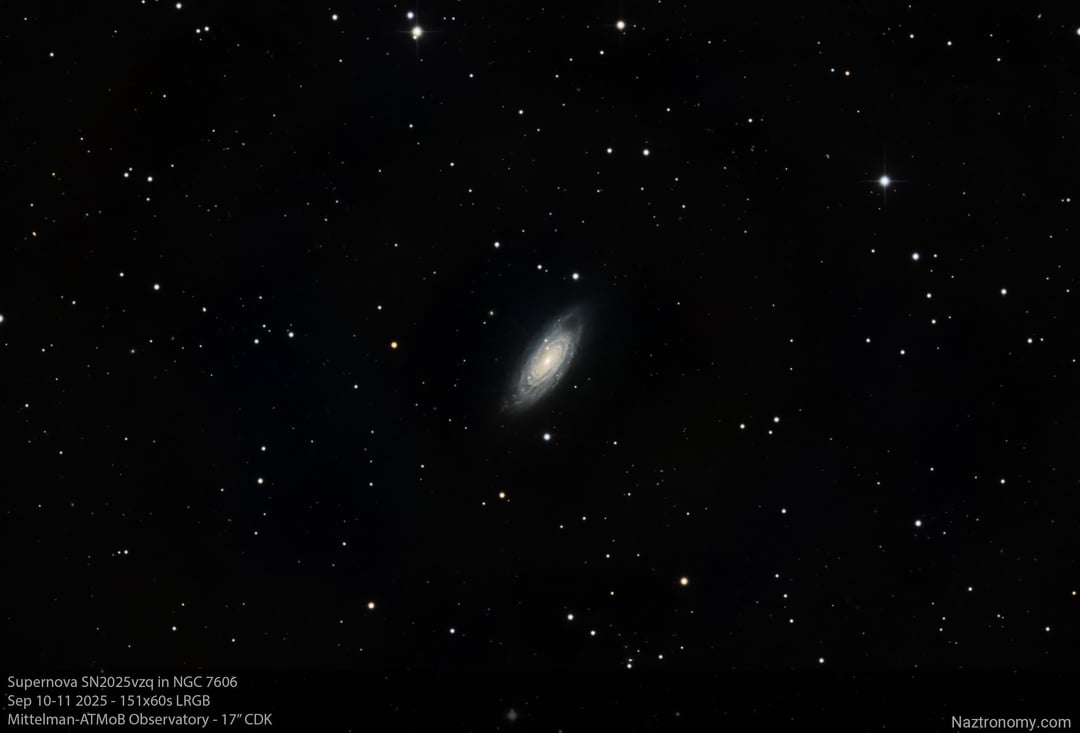
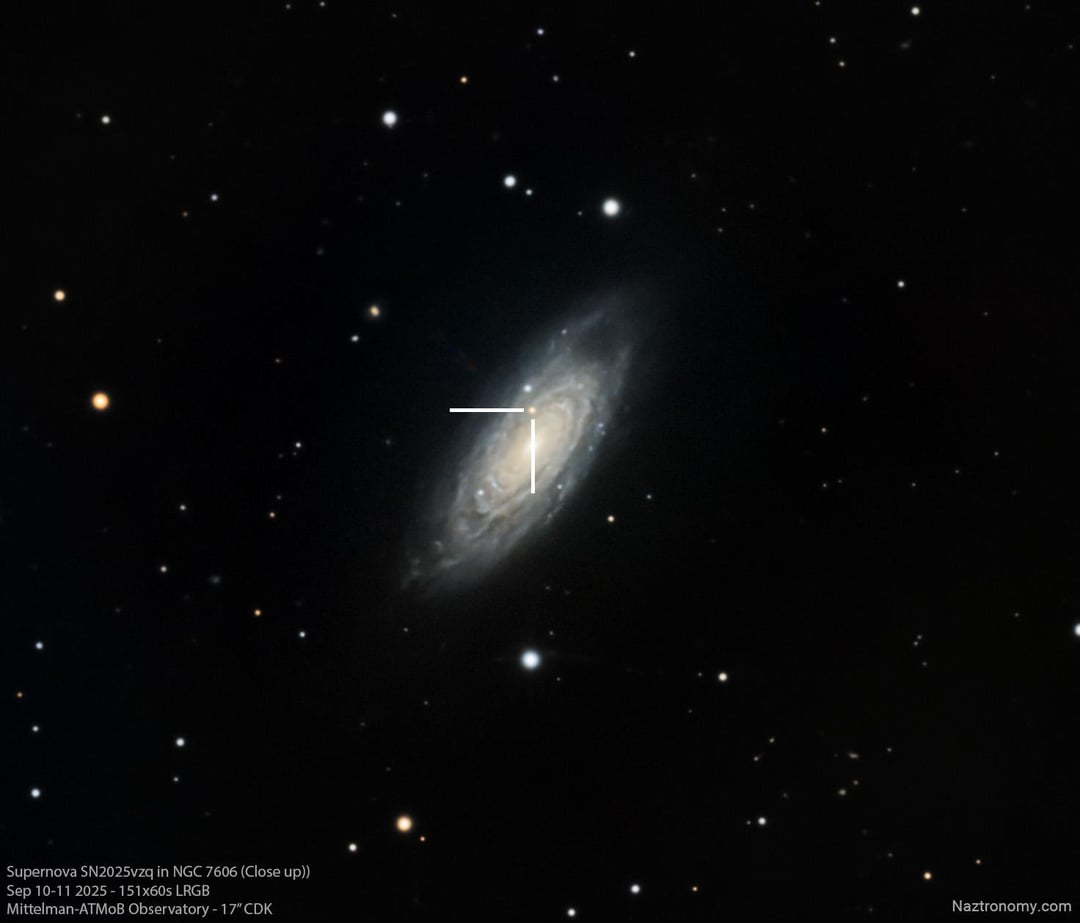
Supernova SN2025vzq was discovered in galaxy NGC 7606 on August 28th. I pointed our observatory's Planewave 17" CDK telescope and QHY600M Full frame astrocam for 151 minutes to get this shot. The observatory is named MAO – Mittelman-ATMoB Observatory as part of the Amateur Telescope Makers of Boston Astronomy club.
The full image is cropped in a bit since it's still a tiny galaxy. The close up shot has indicator lines to show where the supernova is.
Will be posting a quick video about it on my Youtube shortly: https://www.youtube.com/Naztronomy
Integration per filter:
- Lum/Clear: 1h 26m (86 × 60")
- Photometric B: 16m (16 × 60")
- Photometric V: 24m (24 × 60")
- Photometric R: 25m (25 × 60")
Equipment:
- Telescope: Planewave CDK17
- Camera: QHYCCD QHY600 Pro M
- Filters: Astrodon Clear 65×65 mm, Astrodon Sloan Gen2 r' 50×50 mm, Baader Bessel-B 65×65 mm, Baader Bessel-V 65×65 mm
- Software: Pleiades Astrophoto PixInsight, Siril Team Siril
For more information, visit AstroBin: https://app.astrobin.com/i/valznz
https://www.reddit.com/gallery/1ngye0k
5 Comments
So the entire bright area isn’t the supernova, it’s a spot inside it?
Is it the color that makes it a supernova? Or are there 6-7 supernovae in there?
It’s wild to me to know that we are looking into the past with deep space photography.
Just looked it up, apparently supernovas occur once every 50-100 years in a galaxy like the Milky Way. I thought it’d happen more, but that just showcases how long stars are around for. Regardless, what you captured must’ve been blindingly bright for anyone nearby it in that galaxy.
I had to check my notes — this galaxy was very dim but detectable in my 8″. If I get a clear night next week I should take out my 16″ and see if I can spot the SN.