Company Logo
The Data Center Solutions Market offers key opportunities through modular designs, AI-driven management, and a focus on operational agility and energy efficiency. Organizations can leverage flexible infrastructure, intelligent platforms, and region-specific strategies to enhance resilience, tap into advanced cooling systems, and support diverse technological workloads.
Data Center Solutions Market
Data Center Solutions Market
Dublin, Sept. 15, 2025 (GLOBE NEWSWIRE) — The “Data Center Solutions Market – Global Forecast 2025-2030” report has been added to ResearchAndMarkets.com’s offering.
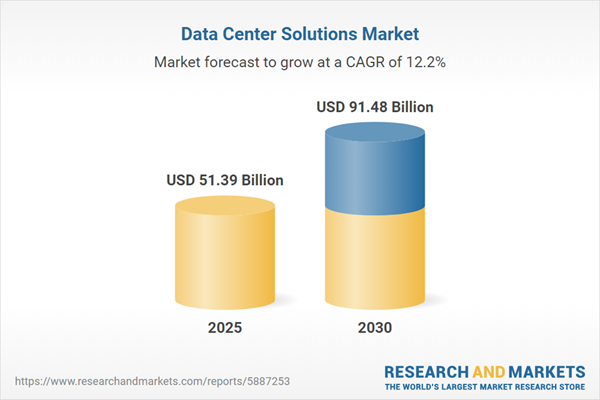
The Data Center Solutions Market grew from USD 45.89 billion in 2024 to USD 51.39 billion in 2025. It is expected to continue expanding at a CAGR of 12.18%, reaching USD 91.48 billion by 2030.
The Data Center Solutions Market is undergoing rapid transformation as enterprises accelerate digital initiatives, adapt to evolving operational demands, and prioritize sustainable infrastructure. Senior decision-makers face a complex landscape where modernization, efficiency, and resilience drive both short- and long-term strategies.
Market expansion is propelled by accelerating adoption of modular designs, AI-driven management platforms, and a heightened focus on operational agility and energy efficiency. Organizations seek flexible infrastructure that accommodates varied technological workloads and aligns with evolving sustainability mandates.
This research delivers a comprehensive, actionable analysis of the Data Center Solutions Market, providing strategic guidance for organizations seeking to enhance resilience, accelerate innovation, and capture growth in a dynamic global landscape.
Key Takeaways: Strategic Insights for Decision-Makers
-
Transition to modular, prefabricated, and scalable data center solutions is reshaping operational efficiency and accelerating project timelines.
-
Adoption of advanced liquid cooling and energy-efficient systems addresses both environmental imperatives and the escalating hardware demands of AI, edge, and cloud workloads.
-
The integration of software-defined architectures and automation empowers real-time optimization of resources, delivering improved resilience and lower total cost of ownership.
-
Regional differences in regulatory environments and market maturity drive tailored approaches to infrastructure deployment, partnership models, and technology adoption.
-
Investment in workforce skills, particularly in digital operations and sustainability, is becoming a core enabler for managing increasingly complex environments.
-
Intelligent management platforms and data-driven strategy foster predictive maintenance, risk mitigation, and agile response to evolving operational requirements.
Key Attributes:
|
Report Attribute
|
Details
|
|
No. of Pages
|
186
|
|
Forecast Period
|
2025 – 2030
|
|
Estimated Market Value (USD) in 2025
|
$51.39 Billion
|
|
Forecasted Market Value (USD) by 2030
|
$91.48 Billion
|
|
Compound Annual Growth Rate
|
12.1%
|
|
Regions Covered
|
Global
|
Market Dynamics
-
Adoption of liquid immersion cooling solutions for high-density AI workloads
-
Deployment of edge micro data centers to support low-latency 5G applications
-
Integration of modular prefabricated data halls for rapid scalability and deployment
-
Implementation of renewable energy microgrids to achieve carbon-neutral data center operations
-
Adoption of software-defined data center architectures for enhanced automation and agility
-
Deployment of AI-driven predictive maintenance platforms to reduce unplanned downtime
-
Integration of multi-cloud networking fabric for secure hybrid enterprise data environments
-
Adoption of advanced biometric and AI-enabled security protocols for data center access
-
Implementation of quantum-resistant encryption to future-proof data center cybersecurity posture
-
Utilization of digital twin simulations for real-time data center capacity planning and optimization
Market Insights
Competitive Landscape
-
Market Share Analysis, 2024
-
FPNV Positioning Matrix, 2024
Competitive Analysis
-
Microsoft Corporation
-
Broadcom Inc.
-
Blackbox Corp.
-
Alcatel-Lucent S.A. by Nokia Corp.
-
CBRE, Inc.
-
Cisco Systems, Inc.
-
CommScope, Inc.
-
Delta Electronics, Inc.
-
Digital Realty Trust Inc.
-
Hitachi Ltd.
-
Intel Corporation
-
Johnson Controls International PLC
-
Juniper Networks, Inc.
-
Legrand Group
-
Microchip Technology Inc.
-
ABB Ltd.
-
NVIDIA Corporation
-
SAP SE
-
Schneider Electric SE
-
Siemens AG
-
Sify Technologies
-
STL Tech
-
Sumitomo Electric Industries, Ltd.
-
Tata Consultancy Services
-
Vertiv Group Corp.
-
Hewlett Packard Enterprise LP
-
Google LLC by Alphabet Inc.
-
Amazon Web Services, Inc.
-
Salesforce Inc.
-
Oracle Corporation
-
NEC Corporation
-
International Business Machines Corporation
Scope & Segmentation
-
Solutions: Electrical (Cabling Infrastructure, Power Backup, Power Distribution & Measurement), Mechanical (Air-Conditioning, Chillers, Cooling Towers, Economizers, Management Systems, Server Cooling), Security (Logical Security, Physical Security), and Services (Consulting Service, Professional Services, System Integration Services).
-
Tier: Tier I, Tier II, Tier III, Tier IV reflecting redundancy and resilience gradations.
-
Deployment Type: Colocation, On-Cloud, On-Premise, serving distinct business continuity and scalability needs.
-
User Type: Enterprise Data Centres, Large Data Centres, Mid-Size Data Centres supporting different operational profiles.
-
Vertical: Banking Financial Services & Insurance, Energy, Government, Healthcare, Telecom & IT, each presenting unique compliance and growth drivers.
For more information about this report visit https://www.researchandmarkets.com/r/t1dd9o
About ResearchAndMarkets.com
ResearchAndMarkets.com is the world’s leading source for international market research reports and market data. We provide you with the latest data on international and regional markets, key industries, the top companies, new products and the latest trends.
Attachment
CONTACT: CONTACT: ResearchAndMarkets.com Laura Wood,Senior Press Manager press@researchandmarkets.com For E.S.T Office Hours Call 1-917-300-0470 For U.S./ CAN Toll Free Call 1-800-526-8630 For GMT Office Hours Call +353-1-416-8900