

There is a fast and stark realisation that Malta’s birth rate is one of the country’s most serious and significant challenges for the future.
During the presentation of the government’s pre-budget document, Finance Minister Clyde Caruana sounded the alarm on Malta’s declining birth rate, with statistics showing that more than 60% of Maltese families have only one child.
“If there is something unsustainable, it is this. The time will come when elections will no longer even be interesting, because the Maltese population will be too small,” he warned.
He stressed that while the effects may only be felt decades from now, action is needed immediately to address Malta’s declining birth rate. Caruana appealed to all politicians to start discussing this matter more openly.
Archbishop Charles Scicluna meanwhile has also used homilies to comment on this situation, saying on victory day that Malta’s low birth rate coupled with the country’s size means that we risk the “extinction of our ethnicity”.
“What our enemies did not manage to do, we are doing with our own hands,” Scicluna said.
It is clear that Malta has a serious problem when it comes to its birth rate. The key stakeholders all agree that it exists and that it must be tackled – but we need to understand the root cause as to why this problem exists in the first place, and ask a very simple question: is today’s Malta one which allows families to have children, and one which families would want their children to grow up in?
Young people wishing to start a family have a multitude of issues to face today. Housing prices are through the roof, with couples having to pool together two full-time salaries in order to be able to afford a hole in the wall apartment. The cost of living, meanwhile, is not getting any cheaper.
Whereas in the past, the economic situation was such that a couple could afford to have one parent working and one tending to the household and children, in today’s economy that it is an unattainable reality.
Instead, children are fobbed off to childcares or to their grandparents for the majority of the day, to then be picked up by their parents after a day at work – in a working environment where hours are getting longer, and stress levels are getting higher.
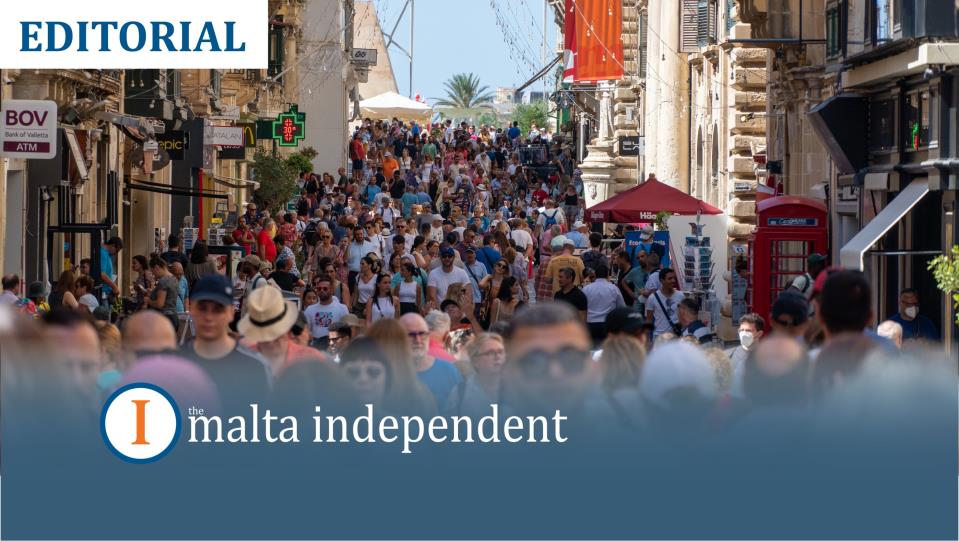
This is not to mention the second part of the aforementioned question. Malta’s environment is not getting any better. Construction continues to reign supreme; noise pollution, light pollution, and overcrowding is effectively everywhere. There is little peace to be had anywhere.
Is the current Malta really a Malta that a couple would want to bring children into? Many, one could wager, will argue that it is not.
So the biggest problem with Malta’s birth rate is not simply deciding on how to tackle it, but undoing its root causes – and those root causes are so systemic within the fabric of how the Maltese economy and society has developed, that it’s a task which, at best, will be no easy feat.