
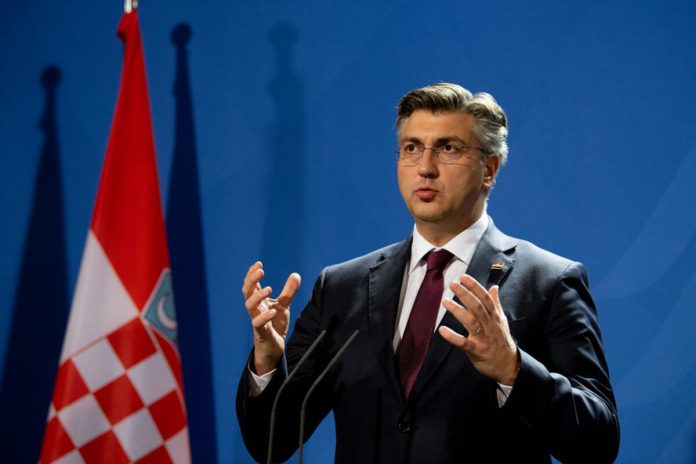
Plenkovic explains why Croatia will not recognize Palestine

Express newspaper
16/09/2025 8:00
Recognition of the Palestinian state will not lead to the end of war operations in the Israeli-Palestinian conflict, Croatian Prime Minister Andrej Plenkovic said on Monday, despite previous recognitions and announcements by several countries to that effect.
So far, 147 countries have recognized Palestine, and several countries have announced that they will do so in September at the UN General Assembly session in late September, Hina reports.
In light of the Israeli war in Gaza, the Palestinian state has been recognized by, among others, Ireland, Norway, Spain and Slovenia.
“I say this so that we have no illusions that the recognition of our state or any other state will lead to the end of war operations. This is what we all need to clearly understand: it will not,” said Plenkovic, who presented a report on the European Council meetings held in the Croatian Parliament.
Before that, he recalled the visit of Palestinian Foreign Minister Varsen Agabekyan, who presented the positions of the Palestinian authorities in Zagreb last month and supported the recognition of Palestine.
“We are very willing to help alleviate the suffering of civilians, women and children, who are in a difficult situation in Palestine, especially in the Gaza Strip. Croatia has also provided four million euros in humanitarian aid to Gaza so far,” Plenkovic said.
He also referred to last week’s visit by Israeli Foreign Minister Gideon Saar to Zagreb and reiterated that he had been conveyed Croatia’s position, which opposes any action that leads to further civilian casualties, supports the release of all hostages and the swift and serious continuation of the peace process that would lead to a two-state solution.
“To fully understand the position of both sides, that’s why we spoke with both ministers, and in addition, Minister Gordan Grlic Radman visited Jordan and Syria. So, in the region, so that, after talks and dialogue with a number of countries in the Middle East, we could fully understand the situation and anticipate steps in the coming months,” Plenkovic said.
“We see the coming months as crucial for a comprehensive peace solution to be achieved, which of course we all want at the EU level, but also globally,” he added.
Regarding Ukraine, Plenkovic stressed that it is about the security of all of Europe, “our freedom, respect for international law and also a major impact on the security architecture,” but he also mentioned again the EU country that often did not support the position of everyone else in any sense, obviously referring to Hungary, although he did not name it.
In the context of security, he mentioned “drones that flew over Poland, where Poland, as an ally, requested consultations based on Article 4 of the Washington Treaty, that is, the agreement that established NATO.”
He added that support for Ukraine at the European Union level, as well as in Croatia, is growing.
“We also help. I remind you of 14 military aid packages with a total value of 317 million euros. Every year, since the beginning of the Russian aggression, we have had an international conference dedicated to Ukraine,” Plenkovic said.
This referred to the Crimean Platform parliamentary summit, the donors’ conference for international humanitarian demining, the meeting of leaders of Southeast Europe and Ukraine, and the conference on the transfer of Croatia’s experiences in the rehabilitation and recovery of war invalids.
“Considering the number of victims and the number of wounded, which is really large, Croatia also has very fresh experience and useful knowledge on how to try to help them. Not only by accepting some of the wounded in Croatia in our institutions, including the newly built veterans’ centers, but also in the whole process of rehabilitation and solving a number of difficulties they face,” Plenkovic said.