
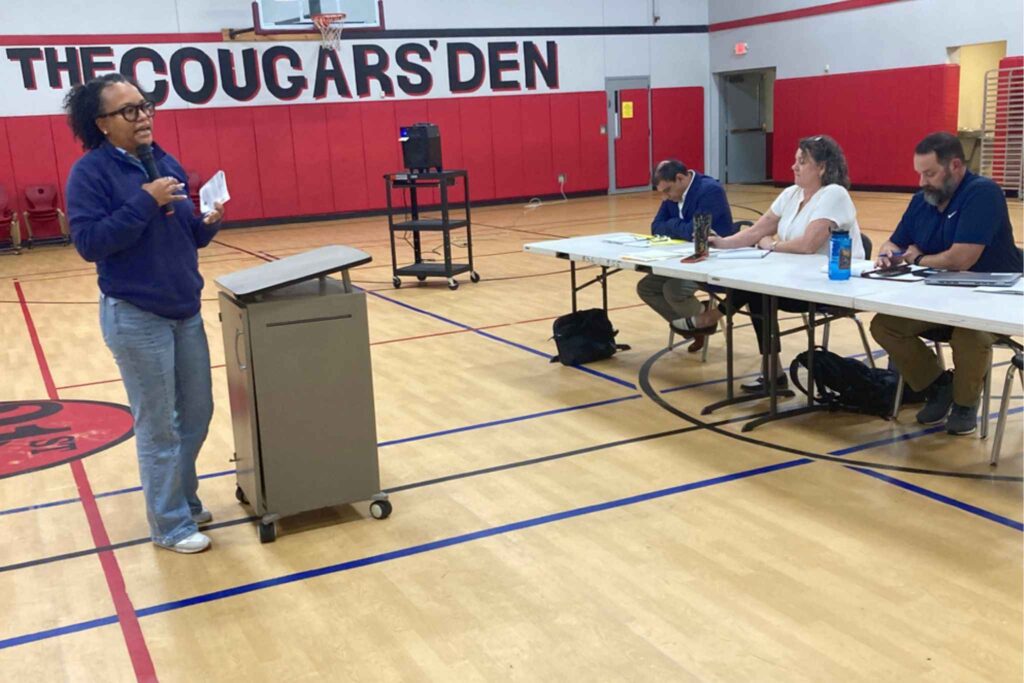
Lori Latham, Gary’s city council president said she has to answer her constituents’ complaints about the pollution coming from the Gary steel mills with “it’s legal, it’s permitted.”
That was part of her testimony at the recent meeting, held Wednesday, September 3, with a panel from the Indiana Dept. of Environmental Management, in Gary to discuss a modification US Steel has requested for its Gary Works air permit.
The air permit is the legal authorization Latham was referring to and allows US Steel to operate the Gary plant. It also stipulates the amount of hazardous materials and gases, like soot and carbon dioxide, that can be emitted into the air during the steelmaking process.
Gary Works air permit was renewed in May by IDEM for 5 more years; afterwards the company asked for a modification to its pig iron caster.
Latham is also a founding member of GARD (Gary Advocates for Responsible Development), a community organization dedicated to helping Gary residents participate in environmental decision-making at all levels of government.
In July, GARD was among a group of environmental activists that petitioned the EPA, requesting it object to IDEM’s renewal of the air permit for Gary Works.
The public and GARD members grilled IDEM officials Jenny Acker, chief of the Air Permit Branch and Brian Williams, its section chief on the air permit and the permit modification.
According to IDEM, the proposed permit contains all standards established by the U.S. Environmental Protection Agency and the Indiana Environmental Rules Board that will limit the emissions from the facility to the very lowest level allowed by law.
“The proposed permit modification uses variables rather than actual numbers in its compliance equation to estimate PM (particulate matter) emissions in the pig caster buildings and to determine compliance with emissions limits,” argued Elise Zaniker, Associate Attorney for the Environmental Law and Policy Center, in her comments to the IDEM panel.
Particulate matter emissions are harmful to human health, recognized as contributing factors to respiratory and heart diseases. When PM emissions are high, they can severely complicate breathing for people with asthma, sometimes sending them to hospital emergency rooms.
“The Clean Air Act requires compliance equations to be written with clear and enforceable terms so that IDEM, EPA, and the public can evaluate whether USS is complying with its air permit,” Zaniker said.
The ELPC is an advisor and supporter of GARD, providing knowledge about engineering processes and environmental regulations.
Zaniker further explained the current compliance equation “completely fails to account for emissions that escape from the pig caster building and its baghouse filter, known as fugitive emissions.” The baghouse filter is the primary pollution control device in the casting process.
Acker said Zaniker was correct about the equation not accounting for fugitive emissions.
The steel company’s permit application stated a 95% baghouse capture efficiency and 70% building capture efficiency.
“At the very least, IDEM should require USS to explain the engineering analysis behind these high capture efficiency estimates,” Zaniker said. “The only required parameter in the permit is pressure drop, which will show that the baghouse is functioning, but pressure drop does not translate into specific PM emission rates that are necessary to determine compliance with the PM limits in the permit.”
Compared to the climate at meetings held in Gary by its city council and its school board, the IDEM meeting was much friendlier. The public comment portion allotted 3 minutes to each speaker who signed up and the speaker got a response from the IDEM panel.
The panel gave speakers second turns and next held an open forum to answer questions from the audience members who hadn’t signed up to speak. At Gary council and school board meetings, there are no 2nd turns, no responses from the panelists and questions are not allowed from the audience.
“That’s why we asked for a public meeting instead of a hearing where there is no back and forth,” said GARD’s president Dorreen Carey.
“These permit applications are the only way we can find out what is happening at US Steel and talk to them. We want them to understand people don’t want to breathe air filled with pollution,” Carey said. “They say they are cleaning the air; so, why is our air not clean? The mill has to do better.”
 Gary city councilman Darren Washington.
Allen Haileen, a physician on GARD’s Green Steel Committee and medical spokesperson was concerned about the multiple health consequences coming from the steel mills.
Haileen recounted an environmental justice study stating that 514 premature deaths occur in northwest Indiana every year because of pollution from mills in East Chicago, Gary, and Burns Harbor. He asked the panel, “Do you have any concern that the current levels for the smallest particulate matter are safe?”
“I cannot weigh in on that; I’m not a physician,” Acker replied. “We follow the guidelines set by the Clean Air Act.”
The smallest particulate matter is measured as PM2.5. Its small size allows the particles to bypass nose and throat filters and travel deep into the lungs and enter the bloodstream.
GARD member Jennifer Rudderham asked, “Why is testing of pollution controls happening only every 5 years and couldn’t it be done annually?”
Acker said 5 years is the standard. “They do monitoring in between; they monitor pressure drop; they may or may not monitor fan averages. They look at parameters of the stack test results; they do numerous bag tests.”
Brian Williams said the stack test verifies emissions and makes sure the baghouse is working. In a response to another question about the 5-year testing cycle, Acker said IDEM does have the option to require additional testing if there is a problem.
Gary city councilman Darren Washington was also concerned with testing of the pollution control devices. “My president Lori Latham is here and we’re going to sponsor a resolution asking IDEM specific details. We want to see annual compliance, not every 5 years.”
“We as a community need to talk to our legislators. If IDEM is not going to watch out for us, we need to file specific legislation this year, before the session starts in 2026, to make sure they adhere to benchmarks set for every year,” Washington said.
Acker replied, “Councilman, I want to thank you. He is spot on. If you don’t like the rules and regulations, get a hold of your representatives. Let them know what you want changed. All IDEM can do is enforce, write the permit; we are bound to follow the rules and regulations.”