
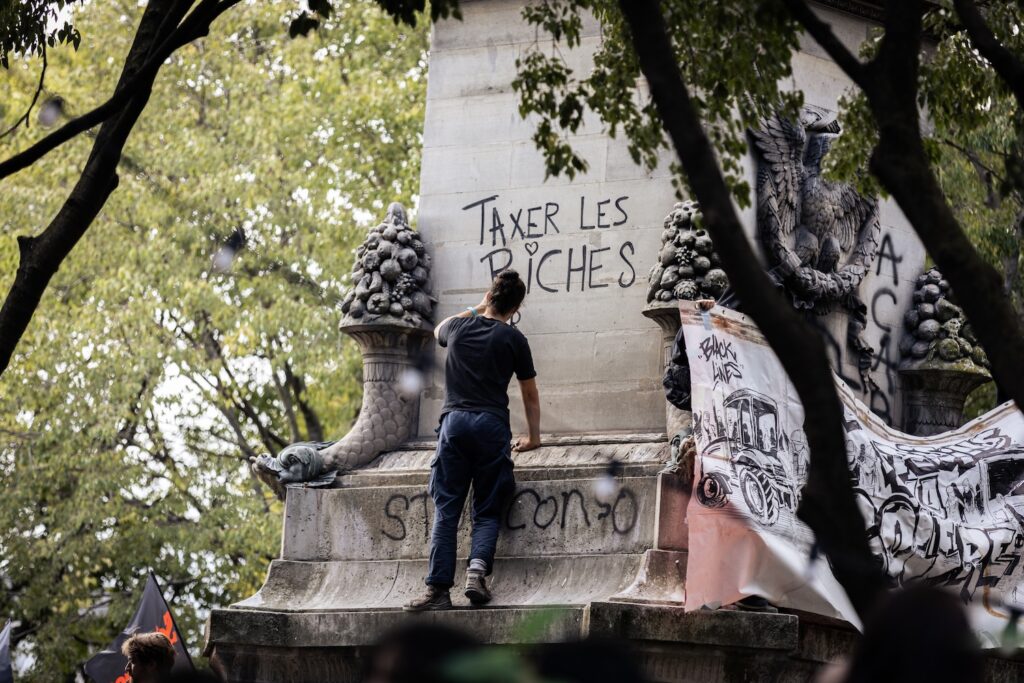
PARIS – French economist Gabriel Zucman is the man behind the controversial tax, now deciding whether France will get a sixth prime minister, or finally agree on a new budget.
Talks open today between the Socialist Party (PS) and Prime Minister Sébastien Lecornu to find a compromise on the 2026 budget, just over a week after the French government collapsed. This time, the left is pushing Zucman’s signature idea: a levy on the wealthiest households.
At 38, Zucman is the rising star of French economics and the man of the moment. A professor at the University of Berkeley in the US, and director of the European Tax Observatory in Paris, his big plan to refill the state coffers is a 2% tax on households whose wealth exceeds €100 million.
With French debt surpassing €330 billion, this new tax is at the heart of Wednesday’s negotiations. Socialist leaders have embraced the French economist’s proposals and are pushing for an increase in revenues by making large fortunes and major corporations contribute.
“What I do not want is for the French middle and working classes to end up tomorrow paying the bill for a debt for which they are not responsible,” explained the socialist leader, Olivier Faure.
What is the Zucman tax?
Zucman argues that billionaires pay, proportionally, “half as much tax” as the rest of the population, by using regulations to their advantage. In 1996, the 500 largest professional fortunes in France – that is, the value of the shares they hold – represented the equivalent of 6% of GDP. They now account for 42%.
His plan sets a minimum threshold: All taxes paid by the richest households (income tax, social charges, etc.) must equal at least 2% of their assets. If their contribution falls short, they pay the difference.
According to the economist’s estimates, this tax would concern only 1,800 households – 0.01% of taxpayers – and could bring in €20 billion per year for the state.
The French parliament adopted the proposal last spring on a Green initiative, but it was later blocked by the right-dominated Senate, France’s upper house.
“I don’t know why in France we dislike the wealthiest,” said Christophe Gomart, MP for the right-wing Les Républicains (LR), which is currently backing Lecornu. “We need to stop targeting those who work, who produce, who invest.”
Big business discontent
The Zucman tax is, of course, far from popular among the heads of France’s leading companies. For Michel-Édouard Leclerc, president of the retail group of the same name, the levy is a “scarecrow” that “does nothing to move the economy forward” and “offers no solution for growth”.
A similar concern was voiced by Patrick Martin, president of the powerful employers’ organisation MEDEF (Mouvement des entreprises de France), who this weekend brandished the threat of a “major employers’ mobilisation” should taxes rise further in 2026.
The Zucman tax is “a terrible brake on investment and risk-taking for businesses”, he argued, since it “includes business assets in the calculation of wealth”. In the case of certain companies that are not yet profitable, Martin said that “introducing this tax would in fact amount to a form of expropriation and would condemn them to being sold off”.
Meanwhile, 74% of the French population supports higher taxation of top incomes.
The far right caught in the middle
The tax is backed by the left and opposed by the right, but it divides the far right. National Rally (RN) President Jordan Bardella never misses an opportunity to court business leaders, recently promising them in a letter a “massive reduction in production taxes”.
Party leader Marine Le Pen, however, has said she is open to “considering asking for contributions from those who earn the most”. In 2024, the RN supported the Zucman tax during its examination in the French parliament, before abstaining in the final vote.
Now, with a meeting scheduled with Lecornu today just hours after the socialists, the RN will have to decide where it stands. For the prime minister, meanwhile, the bigger picture is clear: His centrist bloc, comprising centrist and right-wing movements, cannot pass the 2026 budget without socialist support.
(mm, vc)