
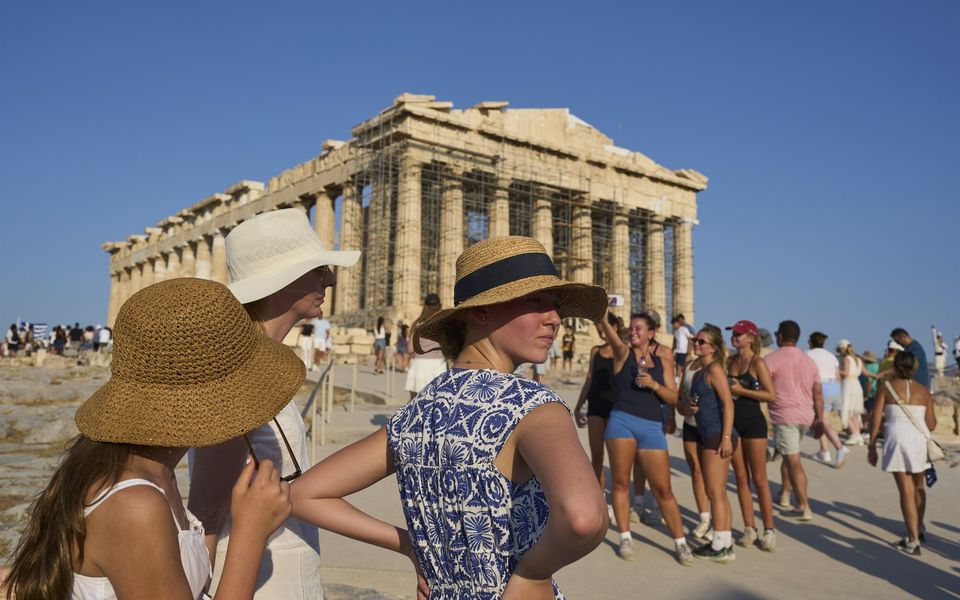
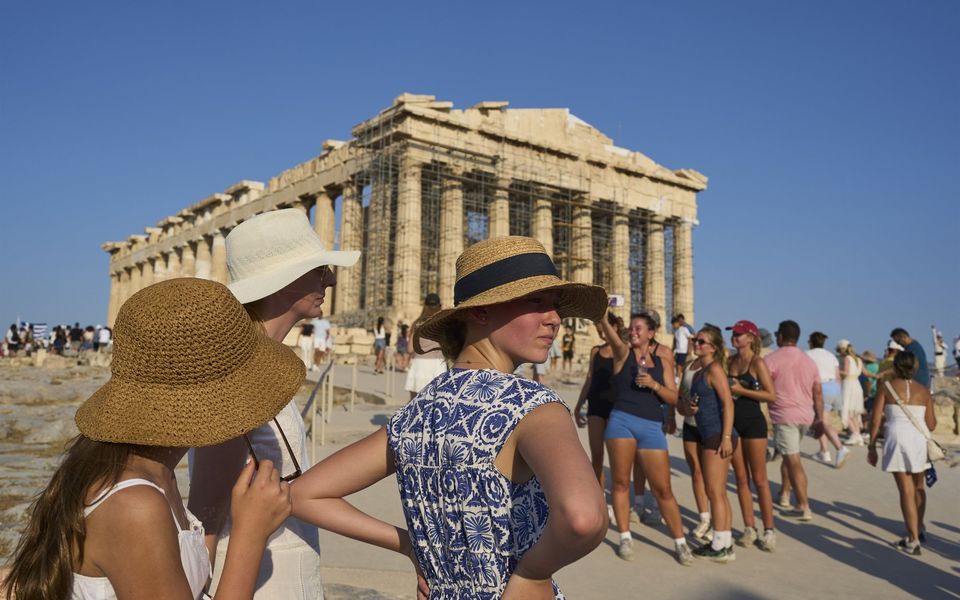
Young tourists stand in front of the 5th century BC Parthenon temple on the Acropolis hill this summer. ‘Greece is becoming an elite playground, its soul increasingly only available to the highest bidder,’ the author says. [AP]
We just celebrated 20 years as an American university study abroad program in Greece. Moved by the cosmopolitanism I saw volunteering at the Athens 2004 Olympic and Paralympic Games, I organized the first edition in 2005 to inspire my students.
Several hundred students and a few million dollars pumped into the local economy later, we still come, survivors of earthquakes, wildfires, drunk students leaving one in a coma, the economic crisis, near war with Turkey, Covid, even a physical assault by a student.
The program remains intact, but Greece changes. Over 15 million tourists came in 2005, last year it was 36 million (some claim 41). We’re still welcomed, but philoxenia has been politicized. “Greece is for Greeks!” a woman once berated me and my students while we waited at a fast-food eatery.
We pay six times the original costs for our Athens accommodations. After Covid, some restaurant prices doubled. Popular islands now lie beyond our students’ budgets. Greece is becoming an elite playground, its soul increasingly only available to the highest bidder. Back home, we face increasing competition for students who prefer cheaper alternatives in the Czech Republic, Bolivia, Morocco, or Spain.
Like Greeks, we must choose affordable destinations like Patra, Kavala or Hania. Athens no longer welcomes us, despite our loyalty to the city during the financial meltdown when political chaos and street riots suggested staying away. The city forgets such kindness. It’s on a different trajectory now.
We can’t imagine not spending our summers in Greece with 20-plus students in tow.
Ending the Greece program would deprive them the experience of a true gem of a culture and its profound history. Even more, to imbibe its simple but gloriously human-friendly life: the little corner taverna with the owner-server working, the neighbors we know and love, the quiet, laidback lifestyle of inner peace rather than technological domination.
But we also contribute to an overtouristed Greece and the strain on her precious resources even as we are priced out of it. We must either stop coming or choose another country for our program. There’s always Bolivia.
Dr Taso G. Lagos lectures at the University of Washington, Seattle and is currently co-director of the Greece study abroad program. He has led or co-led 26 programs to Greece.