

Visiting Albania, and/or North Macedonia, was never on my bucket list. But when the Israeli Association of Periodical Press offered its members an 8 day tour of the two countries, I decided to leave the madness and our evil government behind for a little while, and take the plunge.
All I knew about Albania was that during the heart of the Cold War it was considered the darkest, most closed country, led by Communist anti-Nazi partisan turned vicious dictator Enver Hoxa. On our last day in the country, we actually visited one of the approximately 200,000 bunkers he ordered built to withstand the possibility of a nuclear war. Shades of Stanley Kubrick’s “Dr. Strangelove.”
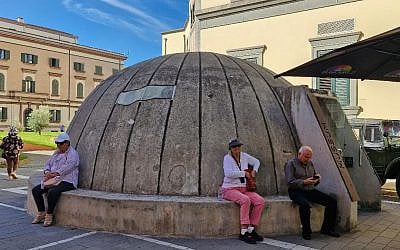 Enver Hoxa’s main underground bunker in Tirana (Photo: Author)
But above ground, the country was a delightful temporary escape from the horrors of the “forever war” that Netanyahu refuses to end. A mixture of beautiful nature, endless green forests, roads cut through the mountains, small villages built into the country side, ancient castles mosques and churches, many of them on UNESCO’s World Heritage site list, an old Roman amphitheater, the city of 1,000 windows and Lake Ohrid, one of the oldest and biggest tectonic lakes, more than two times the size of the Sea of Galilee according to our Israeli guide Carmela, the beautiful black Ohrid pearls, a boat ride on the lake, and much more.
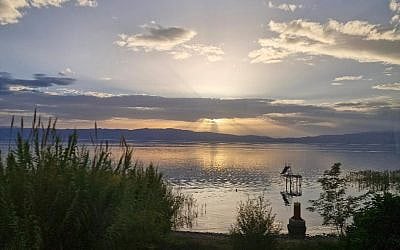 Sunset over Lake Ohrid (Photo: Author)
Turns out that in the pre-war period they actually had a guy named Zog whose name reminded me of a character from Star Trek or some other sci-fi film or series, who managed to serve as Prime Minister (1922-4), President (1925-28) and finally King (1928-1930), a trick that Trump, Putin and Netanyahu can only dream about (I think). I discovered that he formed an alliance with Mussolini’s fascist Italy, so maybe they should read up on how he did it.
Albania is now on the tourist map
Moving back to Hoxa, after he passed away in 1985 and particularly after the collapse of the Soviet bloc in 1989-90, Albania began to open up. Fortunately today it has a social-democratic government led by Prime Minister Edi Rama, and Albania is a member of NATO and a candidate for membership in the European Union.
Our first local guide, Tony, lives in the midst of the historic castle in Berat, an area which has been inhabited for 2,400 years. Climbing up the steep cobblestone road to the top was quite an effort given the state of my knees, but with some help from my friend,s as Ringo Starr once sang, I made it, well worth it. The castle is filled with ancient Christian religious icons, Mary and child on the left, adult Jesus on the right, while about 50% of the population is Muslim. Turns out that Tony’s father is Muslim and his mother is Christian, and the Christians and Muslims go to school together, no problems.
The country is now on the world tourism map, and 26% of its GDP comes from tourism. Israeli tourist companies have also discovered it, and as we walked along the shores of Lake Ohrid, we suddenly encountered a TV team from…Israeli Channel 12 news! Along with taking shots of the lake, our group and the TV crew came upon a drink vendor who told us he likes…Arik Einstein and popular Mediterranean-style Mizrachi singer Omer Adam, who pressed his Spotify button and began to sing and shout…in Hebrew, along with the singers. Shades of the Jordanian Bedouins at Petra soon after the Israeli-Jordanian peace treaty in 1994 who already knew some Hebrew to sell their wares.
A particularly moving moment followed when we discovered that the grandfather of another man selling us cold water sheltered local Jews during the WW II and had been killed by the Nazis because of it.
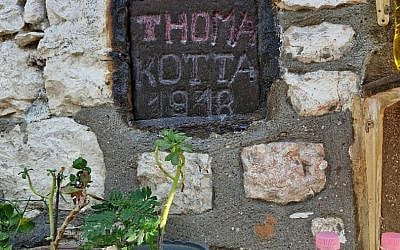
Thoma Kotta sheltered Jews and was killed by the Nazis (Photo: Author)
Skanderbeg, the national hero
Our second Albanian guide, Kaydi, also lives in a historic World Heritage site, the mountain town of Kruje, where the national hero known as Skanderbeg lived in the 15th century and defended Albania against the Ottoman armies. His real name was Konstantin Kastrioti, which explained the signs all over the place that said Kastrioti, which did not stand for castration, as one of our group wondered.
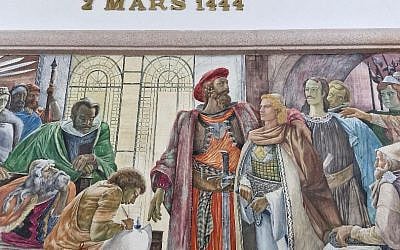 Skanderbeg, who was 2 meters tall preparing his men for battle in 1444 (Photo: Author)
Back in the capital of Tirana there’s a striking statue of Scanderbeg overlooking the main city square, wearing his goat-shaped hat, a symbol of the fact that he once led a group of goats to fight the Ottomans who thought they were a vast army of soldiers.
Taking us to Scanderbeg’s castle, another challenging climb, he explained how Greece and Bulgaria gobbled up parts of relatively weak Albanian land. He also talked about what he called the Greek genocide against Albanians during WW II that he learned in school, though historians question whether that’s a legitimate term for what happened. The ancient colorful bazaar is at a lower level, oh those steep steps once again, and I bought a beautiful multi-colored rug to place near my bed as a memento.
Memories of former Yugoslavia
Crossing over into North Macedonia we were greeted by Alexander, a very articulate and knowledgeable guide. In addition to describing the incredibly beautiful surroundings he noted the fact that natural sparkling water flowed down one of the mountain sides and we were told that the green bottles in the stores carry it, while the colorless bottles carry regular spring water. Or is it the other way around.
He also went into a very detailed and informative explanation about the rise and fall of former Yugoslavia. Like Hoxa in Albania, Josip Broz Tito was a Communist partisan leading the struggle against the Nazis in WW II. However unlike Hoxa’s dark path, he led post-war Yugoslavia on a very different, social-democratic liberal, more open path, breaking with the harshness of Stalin’s Soviet Union. When he died, his successors couldn’t hold the country together, as nationalism reared its ugly head, and the country split into 7 different countries: Bosnia and Herzegovina, North Macedonia, Montenegro, Serbia, and Kosovo. I had the feeling that Alexander himself was a socialist, and nostalgic about the Yugoslavia period. One of the things I learned from him is that one of the main reasons that Tito was able to keep Yugoslavia together was that he was an atheist leader who was able to enable the different religions and nationalities to go beyond their differences. That might be a lesson for anyone dreaming of a one-state solution for Israel-Palestine based on our common Abrahamic heritage. Can you imagine Hamas-type Palestinians and messianic Smotrich-Ben-Gvir type and Haredim/ultra Orthodox type Jews finding a common bond to live in one democratic state based on equal rights? And in today’s reality, can you imagine a secular, atheist leader emerging able to unify them?
Many of the women in the group thought Alexander was very sexy, and they arranged for a group photo of just the women together with him.
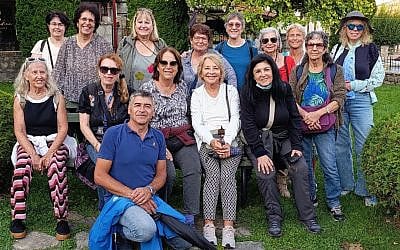 Alexander and the ladies (Photo: Moshe Venturi)
Seeing the sights in Skopje
In Skopje, the capital city, our other Macedonian guide, Suzana, took us to see a well-
preserved caravanserai, one of three surviving fortified roadside inns for travelers from
the Middle Ages to protect them from robbers. Then we visited the beautiful “Painted
Mosque” in Tetovo, originally financed and built by two sisters in 1438, with walls covered
with colorful floral and geometric paintings on both the inside and outside. Of
course we took our shoes off before entering.
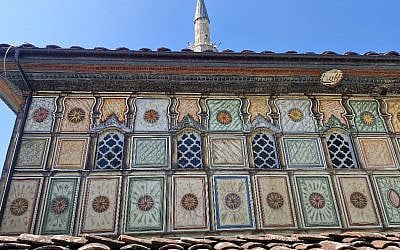 The “Painted Mosque” (Photo: Author)
She also took us to meet the nearby very inspiring spiritual dervish Abudlmutalib Bakri, who is taking care of his abode in Tetovo by himself, cooking, cleaning, washing, an all-
around handyman. His wife and children periodically visit but don’t live with him.
She then took us to the striking Holocaust memorial in the old Jewish Quarter with 7,144 glass beads hanging from the ceiling representing the number of victims. The museum also had photos of many of them since the Nazis photographed them when they were taken to the tobacco center before being sent to their death in Treblinka.
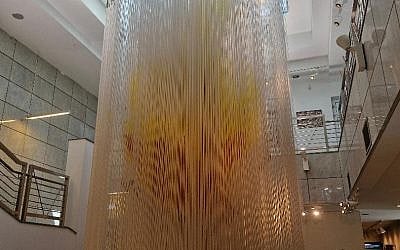 Memorial with 7,144 glass beads in honor of the victims of the Holocaust (Photo: Author)
Skopje also has the largest bazaar in the country, with a huge Carmel Market-like covered over area for fruits and vegetables, meat and of course Turkish delights (lokum). The main square in the city features an impressive statue of King Phillip the 2nd, and also a statue of Alexander the Great, known in Hebrew as Alexander the Macedonian. We also learned that Mother Teresa, the Nobel Peace Prize winner, was born in Skopje, and has a square named after her. Crossing over the bridge between the old and the new city at night, we encountered Roma (Gypsies) trying to raise funds by having a small child lie on the ground in the middle of the bridge while his family played music and danced nearby.
Our guide Suzana said she was an English teacher but didn’t make enough money from teaching, so she had to also become a guide to supplement her income. In both Albania and North Macedonia many young people are seeking greener pastures in Western Europe to earn a living.
As for why the name North Macedonia, the Greeks claim that Macedonia is in Greece, and refused to allow them to use that name. After a long dispute and negotiations it was agreed in a 2019 treaty that the country would officially be called North Macedonia to distinguish it from the Greek Macedonia.
Speaking Hebrew in public?
Before heading off on the trip we were advised not to speak Hebrew in public, given the attitude towards Israelis due to the images coming out of Gaza that everyone sees. However, it turned out that this didn’t really seem to apply to Albania and North Macedonia, and soon everyone was speaking Hebrew in the streets. We did encounter one little ten-year-old girl who asked us where we were from, and when someone said Israel, she shouted “Free Palestine!”
In the hotel rooms, anyone who turned on the TV could see on CNN, BBC, Al Jazeera, the local channels and even a Japanese news channel in English (!) the horrific images coming out of Gaza of war crimes that are being committed that we don’t see on Israeli TV. A Japanese analyst also seemed worried about the summit meeting between Putin, Xi and Kim, and the fear that Trump would “throw them under the bus.” So the Middle East is not the only world trouble spot.
Of course, the tour group had its own WhatsApp group to keep informed and place photos. And through the magic of an international cellphone package I was able to maintain contact via WhatsApp with my Palestinian colleague Ziad AbuZayyad as we dealt with the final details of the new issue of Palestine-Israel Journal (www.pij.org) that we co-edit prepared to coincide with the UN General Assembly meeting in New York where France, the UK, Australia, Canada, Belgium and other countries will be recognizing a Palestinian state alongside the State of Israel.
Dreaming about a “Wind of Change”
Back in November, 2024, when I flew to Sacramento State University to participate in the 6th International Conference on Genocide for a panel devoted to the future of Israeli-Palestinian relations, a woman at the United Airlines stand at the airport said to me “You have a famous name.” I said “really, why?” And she responded “because of Rudolph and Michael Schenker.” I knew who they were, and told her that she is the first person who ever said that to me. They are of course the founders of the German rock band “The Scorpions”. Well, on our last night in Tirana, the capital of Albania, before heading home the next day, there was excitement in the air, since “The Scorpions” were appearing on a makeshift stadium platform in Skanderbeg Square next to our hotel, with the statue of Albanian hero Skanderbeg standing guard over them. And alongside all of the loud heavy metal rock songs they sang, they naturally performed their very lyrical big hit “Wind of Change” which was sung at the Brandenburg Gate when the Berlin Wall fell. I sat on a rock near the gate to hear them, while Carni said she grew up with their music.
Take me to the magic of the moment
On a glory night
Where the children of tomorrow share their dreams
With you and me.
Take me, on a glory night
Where the children of tomorrow dream away
In the wind of change
I left Tel Aviv on September 8th, and discovered that according to Netanyahu I had
returned to “Super Sparta,” a comment he quickly regretted and tried to walk back on when he saw the reaction of the stock market.
We really need a “Wind of Change” in Israel as well.