
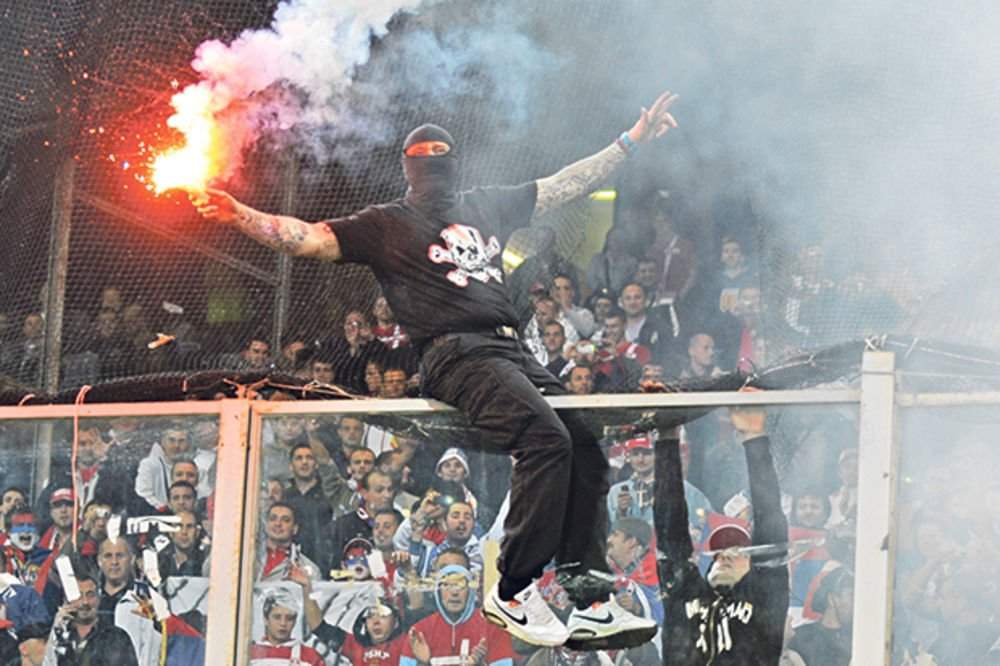
It will soon be a full decade since the then Prime Minister, Aleksandar Vučić, declared that Serbia needed stricter laws and a stronger fight against violence in stadiums, promising that the participation of hooligans in organised groups threatening public safety would not be tolerated.
Not only has the current President failed to keep that promise, but ten years later he is using those very same supporter groups for his own political purposes, to “discipline” political opponents – if he cannot “re-educate” them, then at least to silence them.
For that reason, the authorities even sent a group of “supporters” to Riga, the capital of Latvia, to calm down the real fans, who had been hyping up Serbia’s national basketball team from the stands before its elimination from the European Championship. Thanks to those fake supporters, allegedly paid to prevent the cheering, the situation escalated into physical confrontations in the stands.
Among those tasked with disciplining the “disobedient” fans were Bojan Vujošević (a.k.a. Mrvica) and Aleksandar Janković (a.k.a. Aca Hari). Mrvica had been a member of the Partizan sub-group of supporters known as the Vandal Boys, formed back in 2001 and disbanded last September. At their final gathering, the founding members of the group set fire to the flag and all insignia of the Vandals, leaving behind the message: “If our name is no longer synonymous with courage, it will not be synonymous with dishonour either.”
Shouts and blows
It is clear that the original members of the group did not consider it either “courageous” or “honourable” that Bojan Vujošević, posing as a student, attended the gathering of “students who want to learn” at the Sava Centre on 25 December 2024, or that, wearing a cap with the logo of the private security company T\&M -Group, he attacked citizens outside the Belgrade Assembly on 6 March this year. That day, five people were arrested, four of whom belonged to the initiative Most ostaje, danas Beograd ostaje.
Alongside Mrvica in Riga was also Aleksandar Janković, Aca Hari, previously noted for guarding a banner featuring a painted middle finger on one of Belgrade’s overpasses on 21 January this year. The short-lived campaign of painting that red symbol on banners was the government’s response to the so-called “coloured revolution” and the bloodied handprints drawn on walls, a message from the people to the authorities that they would not give up protesting until those responsible for the deaths of 16 innocent people – killed by the collapse of the Novi Sad railway station canopy on 1 November last year – were found and punished.
The “guards” of the middle finger attacked two activists on that overpass, destroying one of their phones. Yet the activists still managed to remove several banners, clearly commissioned by the SNS, and placed one of them in front of the Presidency building on Andrićev Venac.
According to activists from the initiative Beograd ostaje, Aleksandar Janković is nothing more than a “thug in the service of the SNS.” To back up their claim, they cite his private correspondence, in which he wrote about the students: “Tramps, I beat them up today.”
Whether, as sources told Radar, the price for beating people with a telescopic baton in the front lines is worth €1,100, or whether €50 is enough for showing up at a “literary evening” in Pionirski Park, is something that should be determined by the competent authorities. But the chances of that happening any time soon are slim. Until then, citizens will continue witnessing scenes that shouldn’t even be shown on television before 9 p.m., let alone watched by anyone under the age of 18.
Under the command of Milan Radoičić
The main actors in one such scene were recently, as Radar reveals, Zlatko Jovanović, Vuk Savić and, apparently the leading member of that group, Miloš Lukovac from Podgorica, who threw objects at citizens in Bajina Bašta, and with his group was also present last week at the Rajko Mitić stadium during the Serbia–England football match. And they were not the only ones with a clear assignment that evening.
According to well-informed sources cited by Radar, they were joined by people close to the former vice-president of Srpska Lista, the sister party of the SNS in northern Kosovo, Milan Radoičić – Danilo Ilić, Danijel Đukić, Marjan Radojević, Stefan Radojković and Stefan Jovanović from Kosovska Mitrovica and Zvečan. All of them were under Radoičić’s direct command during the armed clash in Banjska, for which Radoičić himself publicly took responsibility, although that investigation has yet to be completed.
Even that, it seems, was not enough, so “someone” also sent a crew from Leskovac to the stadium, which was confirmed for Radar by local opposition representatives, who recognised Aleksandar Đorđević, an MMA fighter, and Miloš Stojković from the village of Grajevce. Sources claim that both are members of the martial arts club Animal Team and the kickboxing club Haler from Leskovac, and that they have been seen in the company of Danilo Vučić, the son of the Serbian president. They were with him at the 2022 FIFA World Cup in Qatar, held from 20 November to 18 December.
Most of those named, apart from Bojan Vujošević and Aleksandar Janković, were also seen at the Rajko Mitić stadium on 10 September, when they went into “action” because chants of “pump it” and insulting messages directed at the president and informal SNS leader were echoing from the stands.
Mirko Poledica, president of the Independence Footballers’ Union and a member of the Serbian Football Association Assembly, is certain that political interests are always at the forefront. “When it comes to sporting events, we’ve reached the point where the government is afraid of the crowd chanting its opinion, which threatens no one. And when you see people trained to beat up those who think differently, you cannot help but suspect that it’s staged,” Poledica told Radar. He also reminded that Serbia’s national team plays Albania next in October, and memories of the match between the two sides ten years ago are still fresh. For this reason, he suspects that the riots in the stands last week were “staged, so that Serbia would be punished by having to play against Albania without spectators, in front of empty stands.”
Fan rebellion marked the beginning of Milošević’s downfall
Poledica also said he had never experienced greater humiliation and disappointment than at the match against England, when “tattooed men, dressed in black, beat their own people for holding different opinions.” Such scenes had never before been recorded in Serbian stadiums, and he believes they will be remembered as a historic disgrace.
He does not expect any reaction from either the Football Association or the Basketball Association of Serbia, not even after the scandalous graffiti in front of the entrance to the building where former basketball national team player Nikola Kalinić lives, when government supporters quickly branded him a “Ustaša” (Croatian collaborators of Nazis in WWII).
“These organisations are controlled by politics, which runs Serbian sport, because no law on the privatisation of sports clubs has been passed, so even their ownership structures are unclear, despite the state spending large sums of money on them,” Poledica points out, concluding that the entire climate of Serbian society is reflected in the players, even though some criticise them for not being socially engaged enough.
Marko Vujić, lecturer at the Faculty of Political Sciences and director of the National Institute for Sport and Ecology, also points out that the reflection of social conditions in the stands is particularly visible in countries with lower living standards and is usually intensified in times of social instability and political division.
“We don’t need to go as far as the Santiago stadium, which under Pinochet’s rule served as a kind of torture chamber for dissidents and later became a place of resistance against the Chilean dictator. Instead, we can look at the former Yugoslavia, where during the matches of Hajduk and Partizan, as well as Dinamo and Zvezda, the bloody war storm that followed just a year later was already foreshadowed. The state’s ideological and political shift from communism to nationalism was clearly visible on the stands of our two biggest clubs. On that wave, thousands of volunteers were recruited directly from the stadiums during the war. The late 1990s brought the downfall of Slobodan Milošević’s regime, which could already be sensed in the stadiums, with the clear turning of Zvezda’s North Stand and Partizan’s South against the then authorities, culminating in their active participation in the events of 5 October 2000. In this clear intertwining of fans and politics, the question arises whether the stands are merely a reflection of the existing state or also an infallible harbinger of all future changes,” Vujić told Radar.
Although Aleksandar Vučić has obviously drawn some lessons from Slobodan Milošević’s experience, who, after the wars in the second half of the 1990s, neglected the significance of the stands, a quarter of a century later he is making a similar mistake.
“We are witnessing that even the Red Star stadium or arena is difficult to control, while Partizan’s matches have long been public manifestations of rebellion against the president’s regime. The last national team match against England shows that even neutrals, who could be seen more as sympathisers than hardcore fans, are also using the stands to express their dissatisfaction with the current government. The government’s last attempts to control this are crude and violent, using thugs from Riga to Rajko Mitić, but this is merely an attempt to plug the many holes of a rapidly sinking ship. All this, along with turning down the volume during matches when chants against the president can be heard, shows the inability of the authorities to deal meaningfully with this rising force,” explains Marko Vujić.
The role of former government secretary General Novak Nedić
Everything that has been happening in recent weeks is in many ways the harvest of what the authorities sowed long ago, having courted hooligans for years, to the point that some analysts even regard them as the hooligans’ “political wing.” One of the first to cement that connection on behalf of the authorities was Novak Nedić, until recently the longest-serving Secretary General of the Government of Serbia, who held that post from May 2014, when Aleksandar Vučić replaced Ivica Dačić as Prime Minister, until April this year.
No one at the top of government seemed to think of removing Nedić even when he was seen at the funeral of murdered Partizan supporter Aleksandar Stanković, known as Sale Mutavi. Nor when, before that, he had been at the centre of accusations by the then interim leadership of Partizan, which in 2016 identified him as the man who, on 16 April that year, ordered the egg attack on the club’s management in the west stand of the JNA stadium.
Less than two weeks after that stand-off, outside the stadium, under the watchful eye of security cameras and without masks to cover their faces, Aleksandar Stanković and the then little-known Veljko Belivuk, together with Darko Ristić, attacked FK Partizan president Miloš Vazura and his associates. Confident, as if knowing they were protected by someone very powerful, after the incident they raised their middle fingers to the cameras, making no effort to hide their identity.
That clash further deepened the rift not only between the management and the “supporters” but also between certain fan groups. It was only five years later that the authorities uncovered the “bunkers” beneath the Partizan stadium stands, where police found drugs and weapons. In that operation, Veljko Belivuk – Velja Nevolja – was arrested, the then leader of the supporters’ group Principi, which had grown out of the earlier group Janjičari. President Vučić and the then Interior Minister Aleksandar Vulin denied claims made during questioning that government officials had sought favours from the clan led by Belivuk and Marko Miljković.
It is an open secret that politics in Serbia has always held sway over sport, and that Partizan is not the only club whose supporters have dealings with those in power. In that group certainly belongs Đorđe Prelić (a.k.a. Prela), convicted for the 2009 killing of French supporter Brice Taton in Belgrade. Since his release from prison, Prelić has begun appearing at SNS political rallies, and was recently spotted in the front row of SNS sympathisers gathered outside the Serbian Parliament, the so-called Ćacilend.
The same applies to Nenad Vučković (a.k.a. Vučko), a senior member of Serbia’s Gendarmerie. According to the investigative portal KRIK, he was head of a “hooligan-criminal structure” linked first to Aleksandar Stanković (ak.a. Sale Mutavi) and later to the Veljko Belivuk group, allegedly “holding the police in his pocket” and controlling some criminal activities through police channels.
A safe house for the President
On the rival side, a high-ranking figure in the hierarchy is Marko Vučković, nicknamed Komandant, leader of the Ultra Boys supporters’ group. For a time, until October 2016, he was co-owner of the company Ultra Kop, which often received contracts for state projects. He was also seen at protests and demonstrations among the assembled fans, and was a member of the assembly of the Red Star football club.
According to observers, the authorities assigned Partizan-linked hooligans the role of hammer in clashes with political opponents, while they had other plans for the leaders of supporters controlling the north stand of the stadium in Ljutice Bogdana. This is confirmed by Vladimir Vuletić, professor at the Faculty of Law in Belgrade and former vice-president of FK Partizan, who told Radar that the situation on the terraces is nothing new.
“It seems that neither Ćacilend, nor SNS party premises, nor even the Presidency of Serbia, are as much of a safe house for the president as the Rajko Mitić stadium. For the builders of what used to be corridor projects and are now Expo Ultra Kop projects, only the red-and-white crane matters. The opposing black-and-white stand is still paralysed with fear, so its admittedly stronger attempts to resist the regime in recent years resemble Radičević’s epitaph: ‘Much he wanted, much he started, suddenly death swept him away!’ Meanwhile, in Riga and Belgrade, they beat together arm in arm, still serving only the red-and-black colours, as if forgetting that the stick always has two ends,” Vuletić said.
To the tune of Mozart, it was once sung to Milošević, and later even to Boris Tadić, “save Serbia and kill yourself…” To Vučić, no songs are sung. The government clearly counts on the fact that no one will feel like singing if even cries of “pump it, pump it” can earn you a sound beating. Their problem is that the student protests have helped many previously restrained people change their tune, heralding a new era, with new songs arriving along with it. Perhaps one of them will soon echo from sports stadiums across Serbia.
(Radar, 18.09.2025)
https://radar.nova.rs/drustvo/navijaci-pretorijanska-garda-sns/