
Published on
September 19, 2025

A poignant excavation undertaken in Egypt has unveiled a longstanding submerged port which is believed to have belonged to one of the last rulers of Egypt, Cleopatra VII. The recently identified location, which exists near the submerged Taposiris Magna temple, was made possible because of Clampin’s focus on Cleopatra’s rule in Egypt, emphasizing her power in on par with Rome.
The so-called Cleopatra’s Lost Port has been identified in the most recent communications with the Taposiris Magna archeological site, confirmed by the archeological site’s head, Kathy Martinez. Martinez, alongside the same Titanics famed archaeologist Bob Ballard, has been instrumental in port excavations throughout the Mediterranean. Presumed dated from the 1st century BC, this port is thought to have catered as one of the most crucial waterways of the era used in the Mediterranean and neighboring waterways and seas.
Accompanied alongside a National Geographic documentary in the making ‘Cleopatra’s Final Secret’, this recent port excavation, along with her Egyptian archaeological endeavours, attempts to understand Egypt’s wide arterial port and trade network in her reign, letting on to Rome and its interests.
A Sunken Maritime Hub: What Was Found Underwater
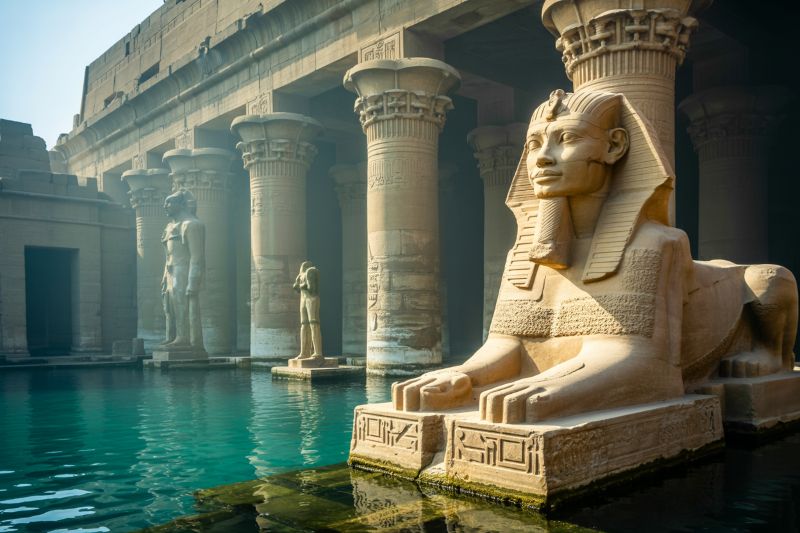
The submerged port, located in the Bidasoa River near Alexandria, was discovered with several significant structures, including amphorae (ancient vessels used for storage), multiple anchors, and large columns. These items strongly suggest that the site was a bustling port used for maritime trade and travel during the time of Cleopatra. The discovery of polished floors and cemented blocks also hints at the port’s importance as a well-maintained hub for Egyptian commerce.
Archaeologists have uncovered large stone structures arranged in rows, towering over 20 feet in height. The team believes these structures, along with other materials found on site, suggest the port was actively used as a trading post, connecting Egypt to other Mediterranean and international locations. With the port being active during Cleopatra’s reign, it holds the potential to deepen our understanding of the political and economic networks that shaped her era.
The Link to Cleopatra’s Legacy: Taposiris Magna Temple and Maritime Connections
The discovery of this port builds upon earlier findings at the nearby Taposiris Magna temple, which has long been linked to Cleopatra’s reign. The temple, located just west of Alexandria, was believed to be a significant religious and cultural center during Cleopatra’s time. However, recent excavations have revealed that Taposiris Magna was also a maritime trading hub, far more expansive than previously understood.
In 2022, a 4,265-foot underground tunnel was discovered at Taposiris Magna, stretching towards the Mediterranean. This tunnel, partly submerged and about 40 feet underground, contained artifacts from Cleopatra’s reign, including ceramic jars and pottery from the Ptolemaic period. The recent discovery of the submerged port near the temple further solidifies the idea that Taposiris Magna was not just a religious site but also a vital center for international trade.
The Search for Cleopatra’s Tomb: A Step Closer to the Truth
Kathleen Martínez, a criminal lawyer-turned-archaeologist, has spent nearly two decades searching for the final resting place of Cleopatra and Mark Antony, her Roman lover and political ally. Many archaeologists believe that Cleopatra was buried near the royal palace in Alexandria, which sank into the sea during an earthquake and tsunami in A.D. 365. However, Martínez’s research has led her to focus on Taposiris Magna as a potential site for Cleopatra’s tomb.
Martínez’s work, in collaboration with Bob Ballard and his team, has helped uncover new insights into Cleopatra’s maritime and political influence. The discovery of the sunken port and the ongoing excavation of the Taposiris Magna temple complex suggest that the site could hold more than just religious artifacts—possibly even clues to Cleopatra’s burial place.
The Role of Technology in Underwater Archaeology
The discovery of this ancient port is a testament to the power of modern archaeological methods, particularly the use of sonar surveys and 3D mapping technology. Ballard and his team worked alongside the Egyptian Navy to conduct a sonar survey of the seafloor, identifying structures like “Salam 5”, a group of rectangular stone constructions. These structures are believed to resemble broken statues found in the Taposiris Magna temple, further tying the underwater port to the temple complex.
Ballard’s team also used cutting-edge mapping techniques to chart nearly 6 miles of underwater terrain, creating detailed models of the site. This data will be used for further excavations in the coming months, as researchers focus on uncovering more about the Salam 5 structures and their potential connection to Cleopatra’s royal court.
The Impact on Egypt’s Tourism Industry
This discovery is expected to have a significant impact on Egypt’s tourism industry, drawing attention from both archaeologists and travelers interested in ancient history. The unveiling of Cleopatra’s maritime legacy offers an exciting new chapter for Egypt’s rich cultural heritage, making it an even more attractive destination for tourists.
The new findings, coupled with the upcoming National Geographic documentary, will likely attract more international visitors to the Alexandria region, as tourists flock to see the Taposiris Magna temple, explore the underwater port, and learn about Cleopatra’s complex and fascinating reign.
A Glimpse Into Ancient Egypt’s Global Influence
The discovery of this sunken port off the coast of Egypt underscores the global reach of Cleopatra’s Egypt during the Ptolemaic period. It highlights how Egypt was not only a political power but also a maritime force, with thriving trade routes that connected the Mediterranean to other regions. The underwater site offers a rare and well-preserved glimpse into the ancient Egyptian economy, revealing its significance as a maritime hub and its connection to Cleopatra’s legacy.
Unveiling Cleopatra’s Hidden Legacy
The finding made while diving near Alexandria is the most intriguing of recent times. Its significance goes beyond the boundaries of Egypt. Its relevance extends to Cleopatra’s times, probably adding to the maritime narrative of her glorious reign. The more they research the site, the more they unveil. The more they unveil, the more the world realizes how Egypt influenced international relations and its enduring legacy far beyond its borders. Tourists and historians alike will be fascinated by what Egypt has to offer. Egypt unveils a new mysterious port which reportedly served Egypt’s former glory and historians plan uncover more of its submerged secrets.
The port will add to the country’s historical prestige and will influence future research about Egypt. In addition, the site is expected to increase the region’s allure for visitors. Especially those keen on Egypt’s fascinating maritime history. Cleopatra’s submerged port promises future excavations to be equally thrilling.
