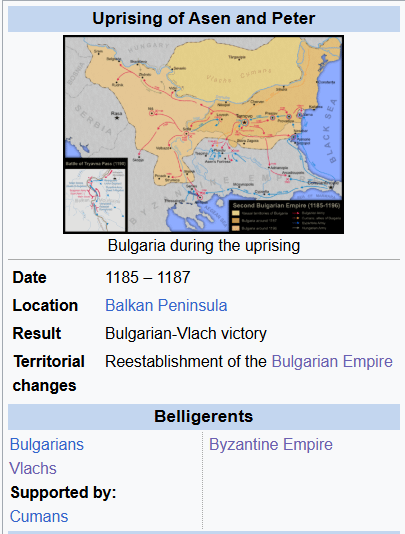
The only time Romanians and Bulgarians collaborated
https://i.redd.it/7p2wm4r7djqf1.png
Posted by BabaRomanianBoss

The only time Romanians and Bulgarians collaborated
https://i.redd.it/7p2wm4r7djqf1.png
Posted by BabaRomanianBoss
14 Comments
What are you talking about? Romania / Walachia / Moldavia did not even exist 1185-7.
Mate, Romanians didnt exsist in the 12 century as a country/nation or whatsoever what about wording. Nothing personal, I like the country and so, but in the middle centuries the vlachs was simply a region where ethic bulgarians were living ( often mixed up with cumans )
Изтрий си акаунта.
I think it’s true because the Cumans which were the political factor back then had Vlachs in their service though I’m not sure if there was a specific Vlach political entity at that time as a leading force.
In school, they teach us it is entirely a BG thing, so you won’t get much support here.
Also during WWII
The r-word ppl really think that 100% multi ethnic empires were only with their preferred ethnicity only….if this sub Reddit could research for shit, they would find Romanian Wikipedia and read about the Valacho Bulgarian empire ….. Asenu and Petru lol or even Ioanica Caloian. Ppl here would explode I’m pretty sure
Not the only collaboration especially in the middle ages but yeah the history of the second bulgarian empire is pretty entangled with the vlachs and cumans.
Asen and Petar were undoubtedly local Търново nobles. However, the modern concept of a “nation” didn’t exist in their time. It was not unusual for local nobility to have origins from entirely different ethnic groups. The Asen dynasty was most likely of Cuman descent, but this does not change the fact that the state they founded was Bulgarian.
Over time, some modern Romanian narratives consider the Cumans “Romanians” because they lived on what became Romanian territory, but this is a territorial, not ethnic claim. Also it is another modern misconception that projects present-day national identities onto a period when such concepts did not exist.
Bro, what about Tsar Kaloyan? What about parts of WW2? Lol
The Cumans are ignored here and they shouldn’t be. It is Bulgaro-Cuman victory if anything.
Nonsense
Firstly, a small correction on the terminology: the Romanian state is from 1859. Wallachia’s history as a state (one of the principalities that will create Romania and the closest to Bulgaria geographically) starts around the late 13th century. Yes, these lands were inhabited by Vlachs (and also Cumans and probably some Bulgarian minority), which is the term that should be used at that age. And yes, Peter and Asen were of mixed origin (either Cuman or Vlach and Bulgarian but knowing how messy i the history of Northern Bulgaria is in that age, combination of all three are possible).
Second, while the Vlachs and Bulgarians being two distinct ethnic groups, people on the both sides of Danube closely collaborated and influenced one another. The Bulgarian language has influenced the Romanian one (the Romanian language is the only romance language where “yes” is the same as the Slavic one), the Romanian language used Cyrillic until the 17th century. Many Bulgarian scholars fled into Wallachia after the fall of the Bulgarian state in 1396. Wallachia and the Second Bulgarian Empire were often on the same side in their wars (against Hungary, for example).
Third, the opposite is also true. During the Ottoman rule, the principality of Wallachia was a safe haven for the disgruntled Bulgarians and refugees. Romania (yes, because it is after 1861) participated in the liberation of Bulgaria in 1877-1878. Furthermore, most of the Romanians were unhappy to get Northern Dobruja and give up Moldavian lands to Russia. It was only later when their interests clashed for Southern Dobruja (partly because at the time, Romania’s only way for expansion was south, being squeezed between two empires) but the dispute for Dobruja has been settled in 1940 in today’s borders and populations have been exchanged.
Furthermore, Bulgaria and Romania were allies in the Second World War (willingly or unwillingly) and were in Eastern Block and ascended together in the European Union.
As a summary, I would go on and claim that more often than not, the Bulgarians and Romanians have been on the same side.
Up until 200 years ago Vlachs and Bulgarian still spoke old-bulgarian. After the split romanians and Bulgarian split into 2 etnic groups. If you want evidence listen or read romanian church prayers.They are still in old-bulgarian. Romanian as in the language was made from a combination of Balkan Romance , French and Italian 200 years ago.
The only time? What about Costi and Andrea?