
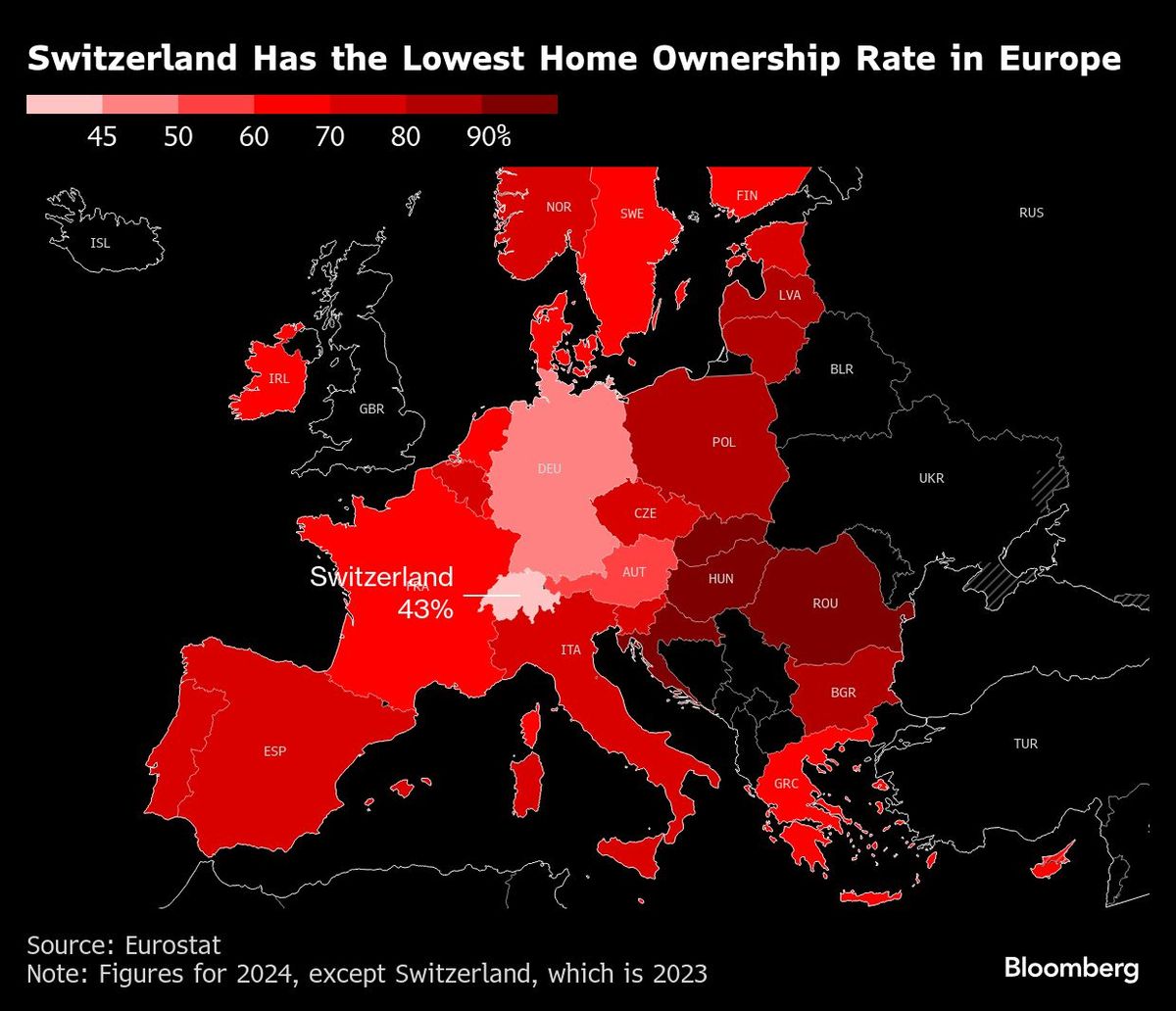
(Sept 22): The country with the lowest home ownership in Europe is about to decide whether to hand the lucky few with property a CHF1.7 billion (RM8.98 billion) tax gift.
Ahead of a national ballot next week, polls show Switzerland’s voters are split about 50-50 on a proposal to overhaul a longstanding system of how homes are taxed. Approval would mean those who have property are better off. It could also fuel additional demand and push up already elevated home prices.
If the vote passes, homeowners’ property tax burden could drop by as much as 22%, depending on the taxpayer’s situation, according to estimates by Raiffeisen Switzerland. Only four in ten Swiss own their own homes, compared with 70% in the neighbouring European Union. That means a minority benefits from the tax cut, while the cost is borne by all because of its impact on federal and cantonal budgets.
Unsurprisingly, support for the proposal is sharply split along the line of home ownership. But the complicated way of calculating the tax, which dates back a century, also means there’s a perception of unfairness. which is resonating beyond just homeowners. It’s levied on the theoretical rent that homeowners could earn for their property on the market, the so-called imputed rental value.
“Perceptions of fairness are a key driver of Swiss plebiscites, especially when it comes to taxes,” said Michael Hermann, a political scientist at the University of Zurich. “And the imputed rental value has been seen as unfair for decades.”
Scrapping the tax at the Sept 28 ballot would cost around CHF1.7 billion a year, according to government estimates.
The move could push up home values, according to Fredy Hasenmaile, chief economist of Raiffeisen Switzerland. He estimates it would add 1-2 points to real estate price growth over the next 12 months, bringing increases to 5-7%. A UBS Index suggests there’s already a “moderate bubble risk” in Swiss housing, while the central bank has repeatedly warned of “vulnerabilities” in the market.
“It’s already cheaper to own than to rent,” Hasenmaile said. “With this tax cut, home ownership is getting even more attractive. That increases demand while supply is limited — so prices will rise”.
Debt levels
The imputed rental value is just one part of the proposed overhaul. Approval by voters will also end tax deductions related to mortgage interest and home improvements. In addition, cantons — the Swiss states — will get the power to put their own levy on second properties. That’s a response to concern that the tax change would create budget shortfalls, particularly in Alpine and rural locations, where there are many vacation properties and home ownership is higher.
Supporters of the change say it will simplify tax returns and encourage people to reduce debt. Currently, many people don’t fully pay off mortgages because of the tax advantage. Swiss household debt levels are around 125% of GDP, by far the highest in Europe, according to IMF data.
Among homeowners, polling by Tamedia/20 Minuten shows 66% in favour of the proposals, with 33% against. Among renters, the numbers are almost the mirror opposite. For all voters, there’s a narrow margin in favour.
“Who will foot the bill?” Social Democrat lawmaker Jacqueline Badran asked voters in a campaign email. “Everyone who doesn’t own their home.”
It needs a “resounding NO” to the “unfair” proposal, she added.
Those on the other side also cite fairness, though their reasoning is the complicated way in which the levy works.
“It’s a ghost tax,” said Marcel Dobler of the pro-business party FDP. “You pay tax on an income that doesn’t exist.”
The question is whether voters will let feelings of unfairness override economic realities, such as the risk that other taxes may have to rise to offset the loss of state income.
“The less affluent unite with the affluent against the government,” said Hermann. “Through a higher sales tax or larger pay cheque deductions, the majority may well pay for this in the end. But it’s unclear if people realise that.”