
The student-led protests were triggered by the deaths of 16 people when an outdoor canopy at a newly renovated railway station in northern Serbia collapsed in November 2014.
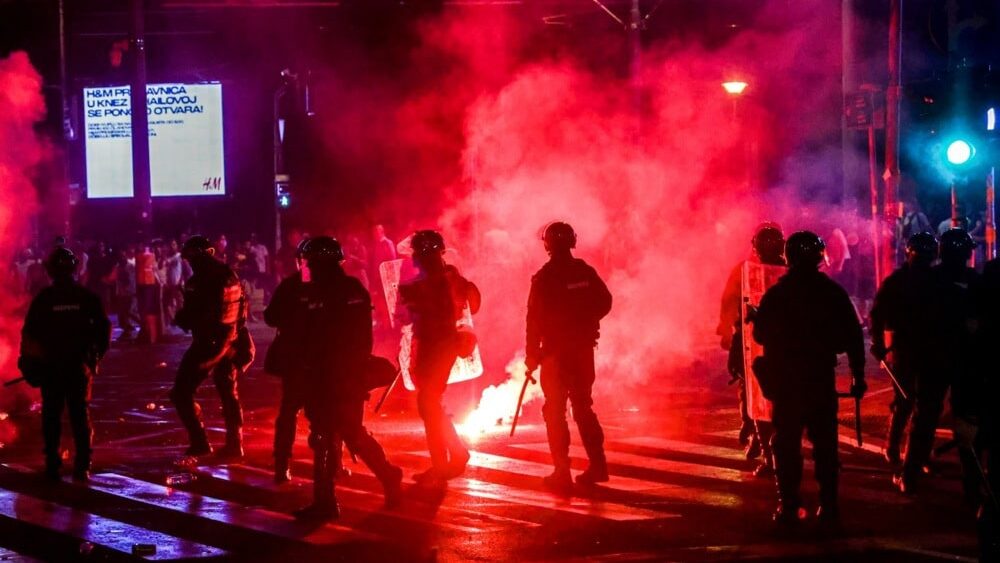
The protesters are demanding accountability and respect for the rule of law, blaming the deaths on the corruption, corner-cutting and nepotism that critics say has come to characterise Vucic’s rule. At first, the president said they were free to protest, but as the days turned into weeks, weeks into months, the gloves came off.
Over the summer, there were repeated reports of excessive police force in towns and cities across the country. Amnesty and CRD were already calling on Serbian authorities to investigate the alleged violence by early July.
Serbia’s interior ministry has dismissed the claims; in the case of Kricak and the government garage, the ministry issued a press release within a couple of hours of the accusations, saying the unit had acted in line with the law. Kricak’s unit, however, is tasked purely with protecting high-profile state officials and state buildings, such as the government HQ; it rarely makes arrests.
Vucic, who should, according to Serbia’s constitution, have only ceremonial powers and no formal say over policing, said the interior ministry’s internal affairs unit would investigate the claims of the female detainee, Nikolina Sindjelic, who alleged Kricak had threatened her with rape.
Lawyers for the students said they had little faith in the internal affairs unit given it reports to the minister, Ivica Dacic, who had already absolved the unit and Kricak personally of any wrongdoing.
There has been no word since on the internal investigation, if it exists. The ministry did not respond to a request for comment. BIRN also submitted questions to Kricak via the police press office but received no reply.
The statements given to prosecutors by four of the detainees, who were the first to be detained but did not know each other personally, differ very little.
They all described being kicked, slapped, insulted and spat on, and mentioned a “commander” who would ask them questions and then hit them.
One male student told prosecutors he was threatened with “rape” and “mutilation”. They were restrained and either lying down or sitting when they were abused, unable to offer much resistance. All of them described being sprayed in the face with pepper spray or something similar.
“We were sitting with our backs against the wall, and then they sprayed some kind of pepper spray into the faces of all four of us,” said one of the students. “I received blows to the shin, the biceps, the head.”
Several said the ‘commander’ warned them not to tell anyone about what had happened to them in the garage, or he would “destroy” them.
Another said: “After some time, another group of detainees arrived. They were treated the same way as us, and among them was a girl, whom the main policeman cursed and insulted, calling her a whore and insolent, striking her in the face with a piece of cloth and breaking her phone.”
Based on their testimony, the First Basic Public Prosecutor’s Office initiated the collection of information regarding the conduct of the JZO officers.
Two of those detained have been charged with obstructing an official in the course of their duties and two with assaulting a police officer.
Sindjelic and another student, 21-year-old Dusan Cvetkovic, who are not among those charged, also filed a criminal complaint against unidentified members of the JZO as well as Kricak by name.
Sesar, from Amnesty, said that any use of police force must be “proportionate to the seriousness of the offence and the legitimate objective to be achieved”.
“Once a suspect is safely apprehended, no further force is permissible. Force must never be used against individuals who are passively resisting or those who are already restrained.”
‘Whom should I call?’