
I wanted to share the result of my personal research on the history of the Risorgimento with you.
Carboneria was one of the protagonists of the early stages of the Risorgimento. His name has become synonymous with conspiracy, but what was this secret society really?
https://www.itermentis.it/upload/2020-12-19_Carboneria_Iter_Mentis_%284%29.jpg
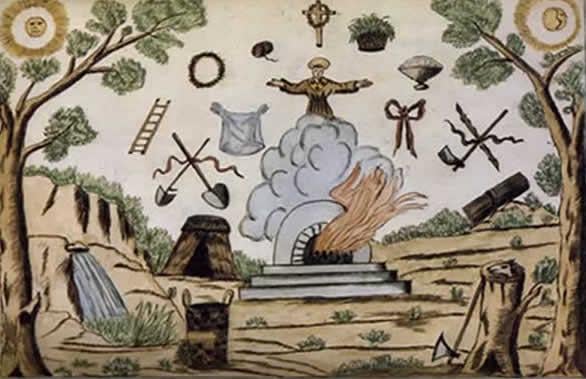
The origins of the Carboneria remain in part dark. The first “sales” appear in the South of Italy at the beginning of the nineteenth century, in opposition to Gioacchino Murat. According to some historians, they derive from dissident Masonic lodges, not aligned to Napoleonism. Others reconnect them to Coal French, a secret Jacobin -inspired society that French soldiers would bring to Italy. There is also those who hypothesize an English intervention, interested in destabilizing Napoleonic Italy. In those same years other similar societies flourished – such as the Adelfi and Philadelphs – but the Carboneria ended up early to prevail and eclipse the others. The carboneria took its symbols from the profession of charcoali, once widespread in Italy. Official patron was San Teobaldo, and the hierarchy included various degrees: apprentice, master and grand master (who will then become nine). The local nuclei were the “shacks”, gathered in “sales” and organized in territorial “orders”. The members were called among them “good cousins”, while the non -affiliated were called “pagans”. Code language was an integral part of the carbonara life: the "forest" indicated Italy, i "wolves" They were the oppressors, “playing at full orchestra” meant starting an insurrection. There was even a replacement figure. The initiation rite was solemn and theatrical: the aspiring, blindfolded, faced symbolic evidence, eventually lent oath and was surrounded by confreres armed with accepted. The warning that was addressed to him was: “If you betray, they accept you will hit you. But if you need, with them we will run to your help”. Born with a liberal and Christian imprint, Carboneria collected adhesions especially between small bourgeois, bass clergy and army. Initially he organized antinapoleonic movements in the kingdom of Naples (also portrayed by Giovanni Verga ne "The carbonari of the mountain"). After the restoration, the hopes of a Constitution vanished and the action turned against the Bourbons. In 1818 Filippo Buonarroti entered the scene, veteran of the conspiracy of the equal in France. With him the Carboneria took on a more radical face: next to the democratic-republican ideal, social instances appeared, from the agricultural reform to socialist tendencies.
https://www.questionecivile.it/wp-content/uploads/2020/04/bandiera-della-Carbonaria.jpg
The occasion came in 1820, inspired by the Spanish revolution. On the night between 1 and 2 July, the Departments of Nola were mutated by Carbonari officers such as Michele Morelli and Giuseppe Silvati, flanked by the priest Luigi Minichini and then by Guglielmo Pepe. The rebels waved the secret carbonara flag – a horizontal celestial, black and red tricolor – symbol of burning embers under coal and ash. King Ferdinand I of Bourbone was forced to grant the Constitution, but the joy lasted little: in 1821 the Austrians invaded the kingdom of the two Sicilies, the king revoked the paper and had Morelli and Silvati hanged. Meanwhile, the church condemned the secret companies hard: with the bubble Church by Jesus (1821), Pope Pius VII excommunicated the carbonari accusing them of religious indifferentism and of parodic the sacraments. The following years were marked by failures and repression. In Milan (1820), Silvio Pellico and Piero Maroncelli were arrested and locked up for ten years at Spielberg. In France (1822), the famous four sergeants of La Rochelle were guillotine. In Rome (1825), Angelo Targhini and Leonida Montanari were beheaded in Piazza del Popolo. A female carboneria, the “Gardener Society”, was also born, which saw women such as Teresa Casati Confalonieri and Cristina Trivulzio from Belgiojoso.
The motions of 1830-31 marked the sunset. The failure of the conspiracy of Ciro Menotti in Modena and the Austrian repression weakened the carboneria. In 1831, the Foundation of the Giovine Italia by Giuseppe Mazzini offered a new conspiracy model: less esoteric, more political and open to all. The defeats of 1834 in Lyon, the death of Buonarroti (1837) and the repression followed to the motions of 1848 brought the carboneria in the background.
https://visitcittasantangelo.it/wp-content/uploads/2018/11/interno-vendita.png
Yet Carboneria did not disappear. Recent searches, in particular those of Gian Mario Cazzaniga, based on ritual texts, police reports, images of then (ritual objects) e diploma (certificates of the degree covered) showed that the secret society survived for a long time, especially in Rome, which became its main center. It becomes the most intransigent wing of the republican movement. At the end of the nineteenth century he mobilized in favor of the movements of National Liberation of Serbia, Crete and Cuba (as already in 1821 the Carbonari undertook in favor of the independence of Greece), as well as of course Trento and Trieste, promoting events and collecting volunteers. The Carboneria then participates in the irredentist movement, in the anti -fascist one, and then military in the resistance (in Rome there will be two brigades of the "Italian carboneria"the Mazzini brigade and the Mameli brigade or black band). The sources show us that the Carboneria continues to operate as a popular organization of the Pri, and then disappear towards the 70s. However, his legend and the imprint remained on the Risorgimento and on Italian and European political culture.
Carboneria also echoed abroad. In Portugal it was re -founded at the end of the nineteenth century with a clear republican imprint. In 1908 he was suspected of the assassination of King Carlo and Prince Luigi Filippo. Two years later, in October 1910, the Portuguese Republicans including the Carbonari led by António Machado Santos took Lisbon and proclaimed the Republic: the red-green flag adopted they became the official one of the new Portugal.
Breve Storia della Carboneria Italiana
byu/zgido_syldg initaly
Posted by zgido_syldg
2 Comments
Avevo letto Carbonara
siamo sicuri che al giorno d’oggi non ci sia più?