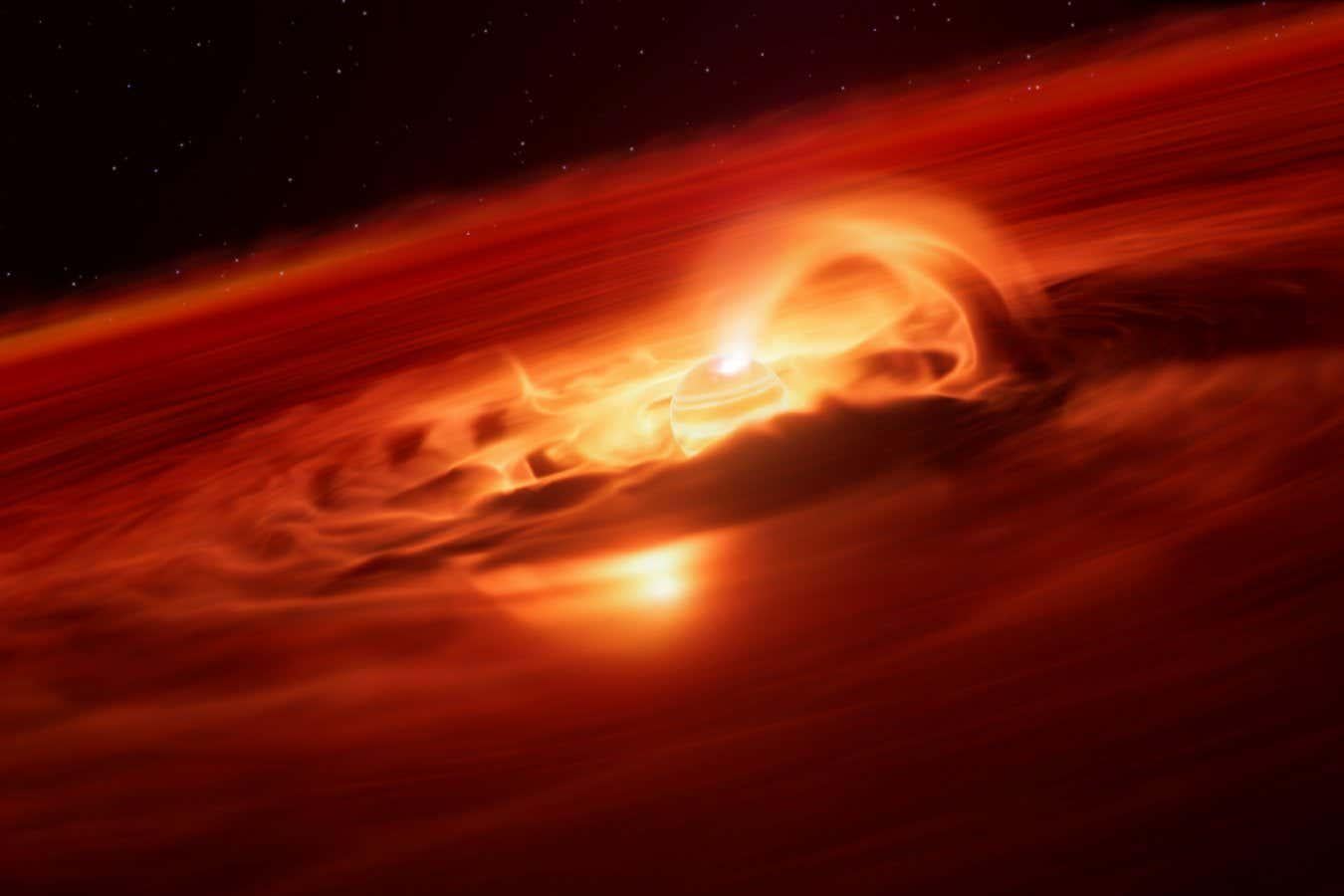
A rogue planet has been caught eating 6 billion tonnes of gas and dust per second
https://www.newscientist.com/article/2498489-rogue-planet-gains-6-billion-tonnes-per-second-in-record-growth-spurt/

A rogue planet has been caught eating 6 billion tonnes of gas and dust per second
https://www.newscientist.com/article/2498489-rogue-planet-gains-6-billion-tonnes-per-second-in-record-growth-spurt/
9 Comments
Sounds just like me at 2 o’clock at the fridge
Articles that anthropomorphise objects always make me smile.
It’s not just a planet, it’s a naughty rogue planet!
They didn’t observe it, they caught it in the act like a criminal!
Curious – thanks to paywall, can someone explain how it is even possible? Lone planet, wandering thru space, minding it’s own business, consuming whatever is around? What if it collides with some system? Star? Or somehow it managed to avoid it?
Is a tonne a unit of mass or weight? Is a tonne of gas on earth the same as a tonne of gas in space the same as a tonne of gas on Jupiter?
Am I crazy that this isn’t the right measurement?
OP links to a paywalled article, provides zero context or summary. Let’s fix that.
[https://www.eso.org/public/news/eso2516/](https://www.eso.org/public/news/eso2516/)
>Astronomers have identified an enormous ‘growth spurt’ in a so-called rogue planet. Unlike the planets in our Solar System, these objects do not orbit stars, free-floating on their own instead. The new observations, made with the European Southern Observatory’s Very Large Telescope (ESO’s VLT), reveal that this free-floating planet is eating up gas and dust from its surroundings at a rate of six billion tonnes a second. This is the strongest growth rate ever recorded for a rogue planet, or a planet of any kind, providing valuable insights into how they form and grow.
>“*People may think of planets as quiet and stable worlds, but with this discovery we see that planetary-mass objects freely floating in space can be exciting places*,” says Víctor Almendros-Abad, an astronomer at the Astronomical Observatory of Palermo, National Institute for Astrophysics (INAF), Italy and lead author of the new study.
>The newly studied object, which has a mass five to 10 times the mass of Jupiter, is located about 620 light-years away in the constellation Chamaeleon. Officially named Cha 1107-7626, this rogue planet is still forming and is fed by a surrounding disc of gas and dust. This material constantly falls onto the free-floating planet, a process known as accretion. However, the team led by Almendros-Abad has now found that the rate at which the young planet is accreting is not steady.
>By August 2025, the planet was accreting about eight times faster than just a few months before, at a rate of six billion tonnes per second! “*This is the strongest accretion episode ever recorded for a planetary-mass object*,” says Almendros-Abad.
It’s gonna be really sad when they discover it purging all of that later. Interstellar builimia is no joke.
Rogue-like planet on what sounds like a good run
At this rate, will it become large enough to become a sun?
So we’re just fat shaming rogue planets now? Smh