
MIT’s concrete battery just got 10 times more powerful | Researchers found a way to combine cement, water, and carbon black to create a ‘supercapacitor’, expanding the storage capacity by nearly 10 times.
https://newatlas.com/energy/mit-concrete-battery-powerful-supercapacitor/
5 Comments
From the article: Scientists have been working for the last few years on enhancing concrete – arguably the most common construction material on the planet – to store energy. That includes researchers at Massachusetts Institute of Technology (MIT), who found a way to combine cement, water, and carbon black to create a ‘supercapacitor’ for this purpose back in 2023.
They’ve now expanded the storage capacity by nearly 10 times, which means we’re inching closer to concrete doubling as building-sized batteries.
This electron-conducting carbon concrete, or ec3 (pronounced “e-c-cubed”) can hold enough energy to meet the daily needs of an average home in just 5 cubic meters, or about the volume of a typical basement wall.
That’s down from 45 cubic meters that the previous version of this multifunctional material would have occupied to store the same amount of energy in 2023. Another way to look at it is, a cubic meter of this updated ec3 – roughly the size of a refrigerator – can store over 2 kWh of energy, which is enough to run an actual refrigerator for a day.
Previously, the MIT team created ec3 by first curing a concrete mixture with highly conductive carbon black, cement powder, and water; this material is then soaked in an electrolyte like potassium chloride that provides the charged particles that accumulate on the carbon structures. Two electrodes made of this special concrete, separated by a thin space or an insulating layer, form a supercapacitor that can store energy.
To improve the energy density of ec3, the team applied a high-resolution 3D imaging method called FIB-SEM tomography to first understand the workings of the nanocarbon black network inside the material. The researchers then experimented with a number of different electrolytes to find viable candidates for ec3, as well as with thicker electrodes that could store more energy than before and don’t require post-curing steps. They landed on organic electrolytes that combined quaternary ammonium salts with a common conductive liquid called acetonitrile.
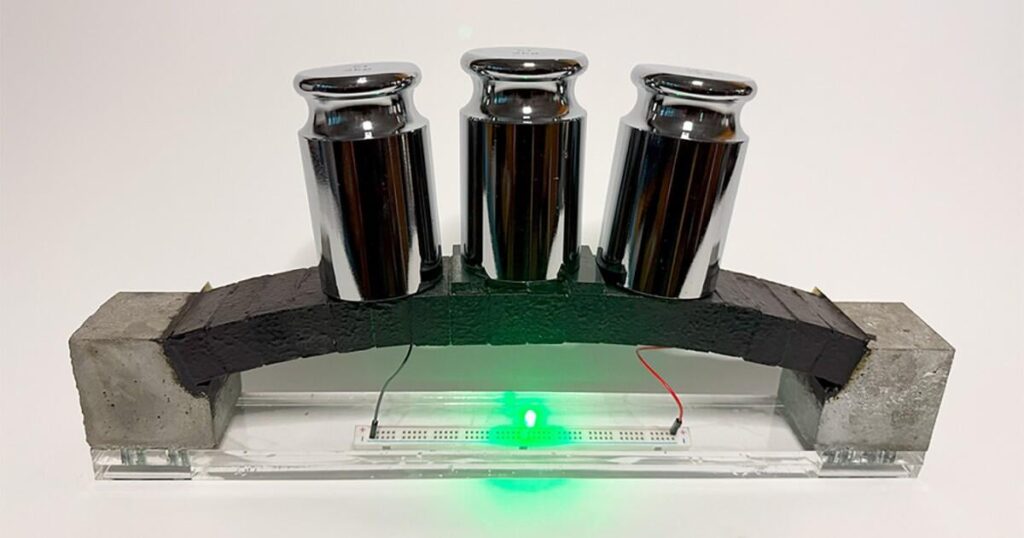
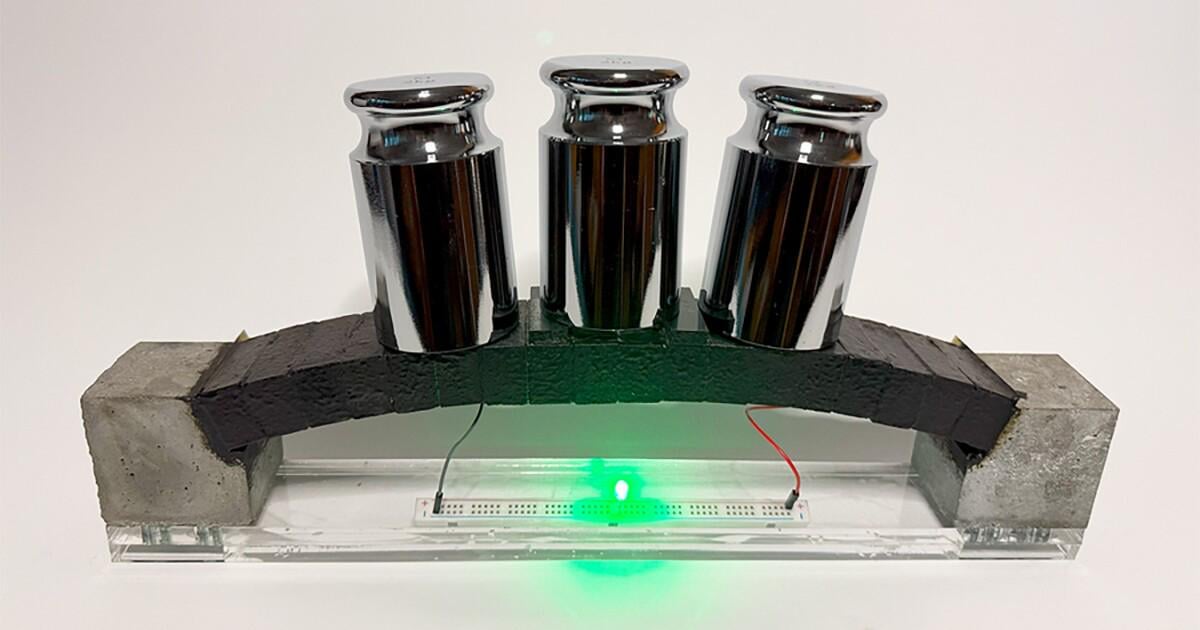
Inspired by ancient Roman architecture, the researchers – most of whom are part of a dedicated ec3 research hub at MIT – built a model-sized arch to demonstrate ec3’s structural load-bearing and energy storage capabilities. It powered an LED light, operating at 9 V. You can see it at the top of this article.
While we are making incredible leaps in science we are going backwards in social, economic, & political policy.
That is because politicians are dumber than rocks & their only motivation to get rich.
I wish politicians had to meet a minimum intelligence, & ethical standard. Presently most would fail out.
If you build a buildings foundation out of this it could store energy from a lightning strike that can be sold to a power company.
I wonder how it deals with cracks? I’ve yet to own a house with a concrete foundation that wasn’t cracked over time.
So if I drill into my wall, will i get electrocuted? Haha