
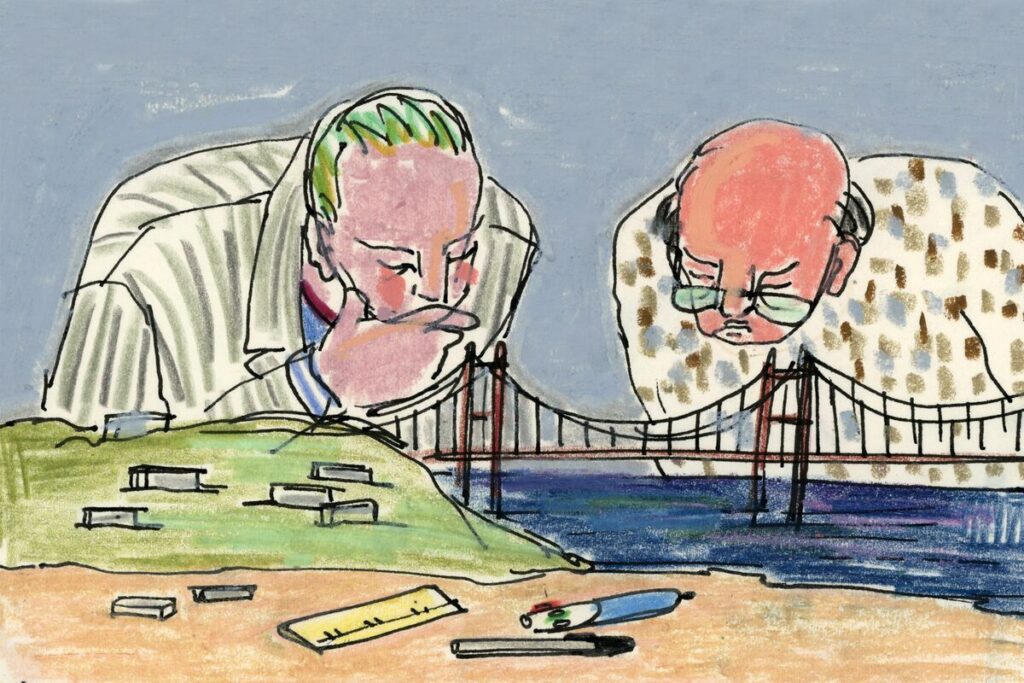
Mariolina De Francesco has lived in the same house in the village of Torre Faro, on the easternmost tip of Sicily, for 24 years. It is one of the hundreds of homes slated for demolition on both sides of the Strait of Messina, when — and if — work on Italy’s long-delayed €13.5 billion ($16 billion) bridge connecting the island to the mainland finally begins. But in the tranquil seaside community of low-rise properties, near the spot where a massive pylon would pierce the earth, De Francesco says she’s not going anywhere. “There won’t be a bridge,” the retired university professor of marine biology says.
The idea of linking Sicily dates at least as far back as ancient Rome, when elephants were supposedly moved across the strait on a temporary bridge of wooden barrels, according to Pliny the Elder. In the Middle Ages, Charlemagne and Roger II of Sicily are also said to have toyed with the notion. In the past five decades, there has been at least one major attempt to pull it off, in 2009, by the late premier Silvio Berlusconi, but he failed because of a lack of funding. The project is now the most advanced it’s ever been, with preliminary work, including piping, railway and highway approaches, set to begin between the year’s end and early 2026. If all goes according to official plans, a suspension bridge stretching 3,300 meters (2 miles) — the world’s longest of its type — will open to traffic by 2032.