

The NCSU INDEX OF NORTH CAROLINA LEADING ECONOMIC INDICATORS (the “Index”), an indicator of the direction of the state economy, declined slightly in August, the latest month with available data.
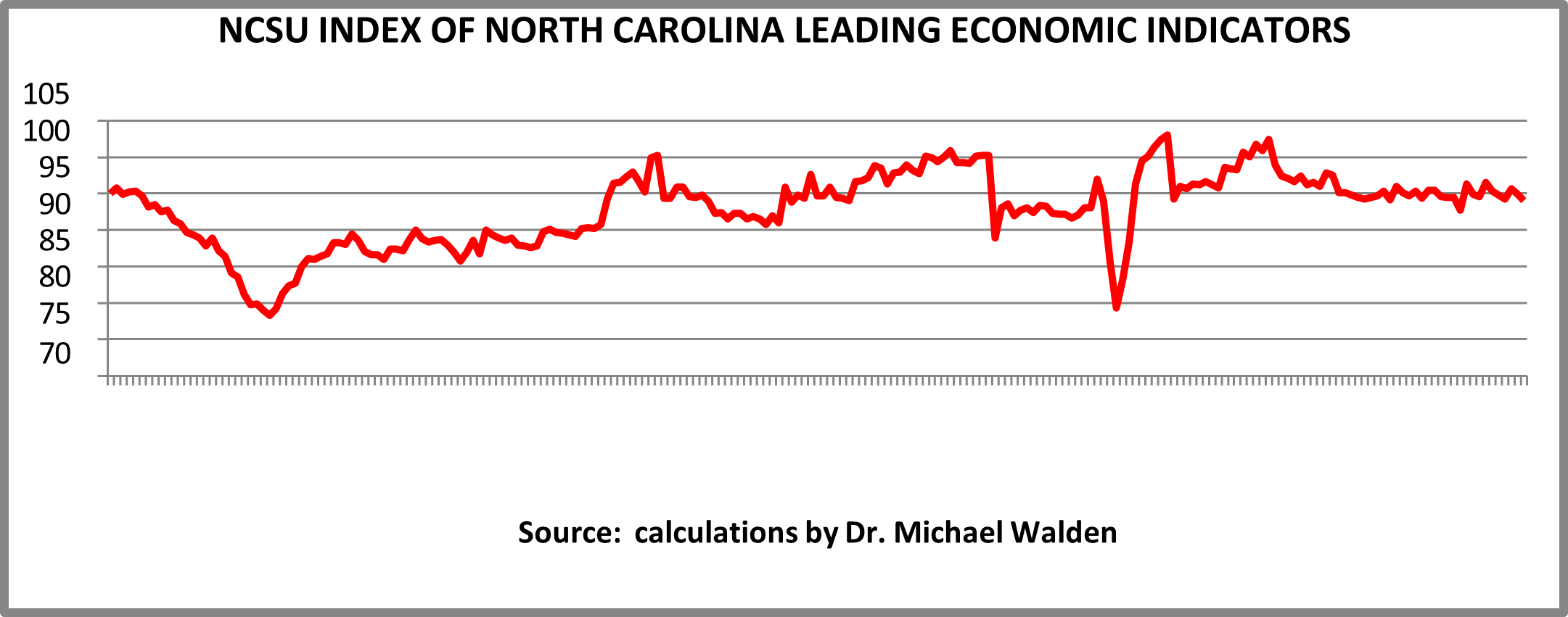
The retreat in the Index was broadly based, with each of the individual indicators contributing a negative impact. On a percentage basis, the largest adverse impact was a 6.6% rise in seasonally-adjusted initial jobless claims, suggesting a weaker outlook for the labor market.
The U.S. Leading index fell one-half percentage point, and building permits were down 0.4%. As the graph shows, the forecast for the state economy is not horrible.
Index
Index
Compared to pullbacks in the Index prior to the “Great Recession” of 2008-2010 and the Covid Recession in 2020, the recent downward trend in the Index is a hiccup.
Nonetheless, the Index’s recent path does signal caution for both consumers and businesses. Uncertainty continues about tariffs, international conflicts, and debt – both governmental and private. For those facing big decisions, a “wait and see” plan may be the most reasonable.
About the Index: The Index is composed of five components: the national leading index from the Conference Board, North Carolina initial claims for unemployment benefits, North Carolina building permits, average weekly hours of work of all North Carolina employees in manufacturing, and average weekly earnings of all North Carolina employees in manufacturing. All data are seasonally-adjusted and modified for differences in prices levels where appropriate. Data are from the U.S. Bureau of Labor Statistics, the U.S. Census Bureau, and the Conference Board. All calculations are done by Dr. Michael Walden, and comments can be sent to michael_walden@ncsu.edu.