
Reality at odds with statistics: Many women do not feel safe at night in Kosovo

Express newspaper
04/10/2025 15:20
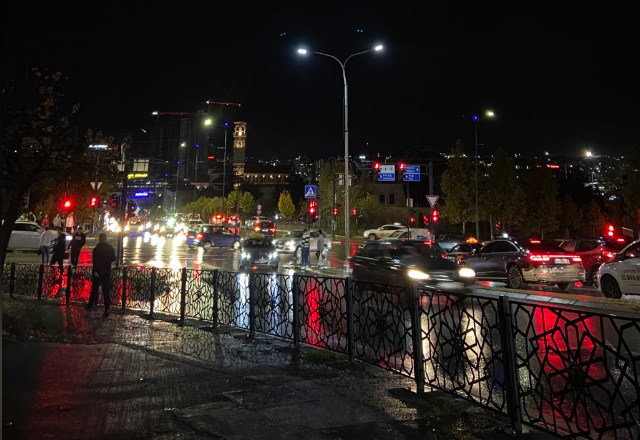
Two hours after midnight, Arlinda and several of her colleagues finish their work hours at a call center in Pristina, which provides services to customers in the United States of America., writes Radio Free Europe.
There are girls and boys in her group. And to avoid being put at risk, Arlinda and her colleagues have been advised by Kosovo Police officials to leave the office together in groups, or accompanied by male colleagues.
“One night, a colleague of mine was followed by a man from our office to where the taxi drivers sit,” Arlinda tells Radio Free Europe.
She prefers to remain anonymous so that her family members don’t worry about her safety.
But, the parents of many girls in Kosovo know that their daughters are not safe if they go out on the streets after dark.
“I have many friends who live in villages. But I know that when it gets dark, someone takes them to the bus, or they simply don’t go out at all,” Besarta Breznica, a feminist activist, tells Radio Free Europe.
“Don’t leave my dreams without breath,” reads a banner during a protest against violence against women and girls held in Pristina in 2022.
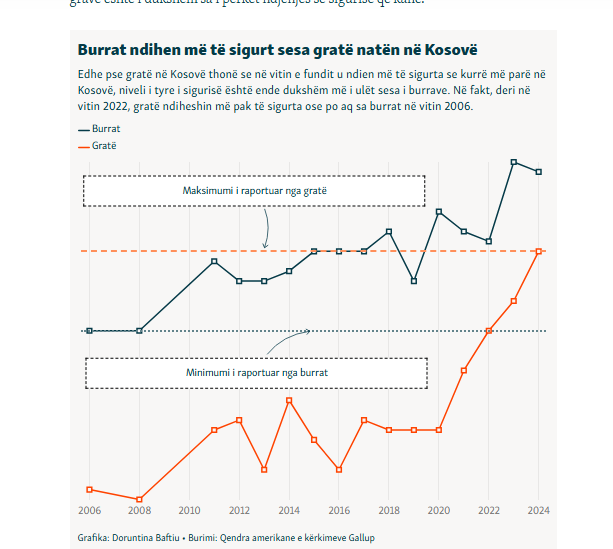
This reality, however, is not reflected in a study shared on social media by numerous public figures in Kosovo in recent days.
This is a report by the American research center, Gallup, which assessed that Kosovo is the third safest country in Europe, according to citizens’ perceptions.
In this report, safety refers to “how safe people feel in their communities” and is measured through four questions:
Do you feel safe walking alone at night in the city or area where you live?
Do you have confidence in the local police force in the city or area where you live?
Within the last 12 months, has money or property been stolen from you or any other family member?
Within the last 12 months, have you been attacked or robbed?
And through the answers to these four questions, Gallup said that 89 percent of Kosovo citizens feel safe – two percent less than in Norway, the same as in Denmark, and more than anywhere else in Europe.
Thus, Kosovo ranks 12th in the world.
Radio Free Europe has also contacted seven girls from Kosovo who have moved in recent years and now live in various countries in Western and Northern Europe, and all of them have said that they feel safer in the countries where they now live: Germany, Switzerland, Austria and Belgium.
But why does the graphic distributed since September 22nd, even by officials such as the acting Prime Minister of Kosovo, Albin Kurti, not reflect these realities experienced by many women from Kosovo?
Because it only shows the average in Kosovo. Radio Free Europe has requested gender-separated data from the Gallup Center, and they show that the difference between men and women is noticeable in terms of their sense of security.
Kosovo Police data shows that cases of sexual harassment and assault in Kosovo reached their highest levels last year – with 102 cases of sexual harassment and 74 cases of sexual assault.
As of September 29 of this year, 55 cases of sexual harassment, 54 cases of rape, and 38 cases of sexual assault have been reported in Kosovo.
Although REL has requested that the data be disaggregated by the victim’s gender, the Kosovo Police has not made it available. However, according to some data that this institution has previously provided, the majority of victims are women.
Besarta Breznica, from the Kosovo Women’s Network, emphasizes that, in reality, more such cases occur in Kosovo than are reported.
“First of all, there are many bureaucratic procedures, which place an enormous burden on victims. A victim has to make five statements to different institutions. Consequently, it is a huge burden for a victim,” says Breznica.
She adds that even the low sentences often imposed by basic courts, such as fines, discourage survivors from reporting cases.
Breznica also mentions many other problems that she says make life difficult for women in Kosovo and make the country less safe for them.
Among these problems is the lack of public lighting in many villages and towns, and even in some neighborhoods of Pristina. But, she says, the black market in weapons also remains a problem.
“As long as we have such a market, I don’t believe Kosovo can be the third safest country in Europe. There is still a lot to be done in terms of the safety of women and girls,” says Breznica.
Breznica explains the ignoring of this situation when Gallup’s general data was distributed by public officials with several possibilities.
“Because, women are seen as secondary persons and are known as the ‘second sex.’ Some are perhaps not even informed about what is happening in practice with women and girls,” she says.
“On the other hand, some ignore the problems of women and girls, because they see them as problems they cause themselves. Some decide to hide their problems, to believe in things that do not correspond to reality,” concludes Breznica.
From 2010 to March 2025, 59 women were killed in Kosovo – in most cases by their husbands. Human rights organizations have in some cases blamed the authorities for failing to protect women at risk of violence.
Authorities repeatedly pledge to strengthen legal mechanisms and increase oversight to prevent violence against women.