
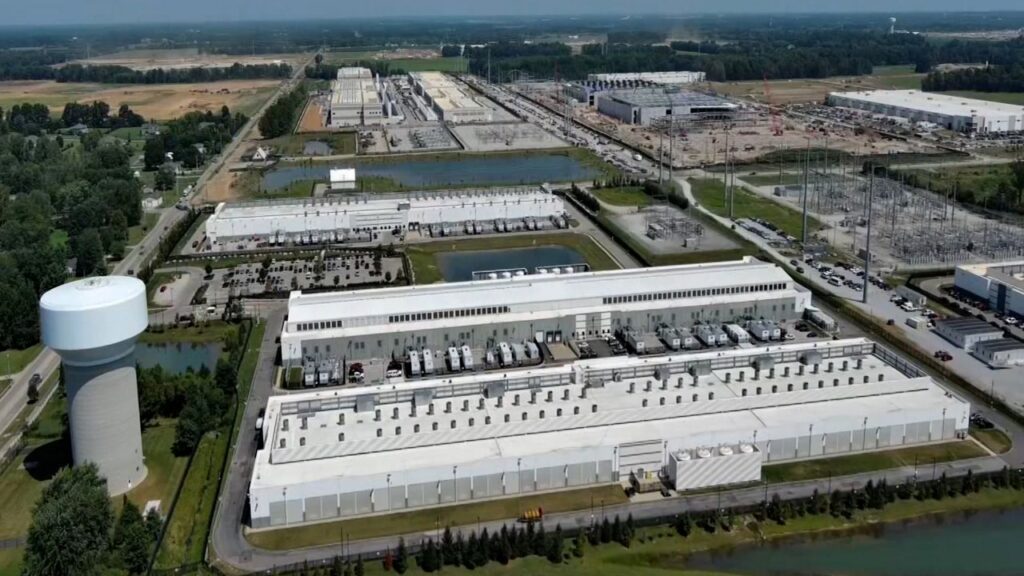
COLUMBUS, Ohio — Ohio’s growing data center industry is reshaping the state’s economy, supporting thousands of jobs and billions in economic activity, according to a new study released Thursday by the Ohio Chamber of Commerce Research Foundation.
The report shows that, by 2024, data centers in Ohio supported nearly 95,000 jobs and contributed about $12 billion to the state’s economy. Researchers project those figures could grow to more than 130,000 jobs and $20 billion in gross domestic product (GDP) by 2030. The study also found that for every $1 Ohio provided in tax incentives, the state and local governments received about $2.10 in return—helping to push annual tax revenue from the industry from about $430 million in 2017 to more than $1 billion in 2024.
The report highlights how Ohio has become one of the biggest data center markets in the world, with massive campuses built by Amazon Web Services, Google and Meta. Columbus now ranks fourth globally for total data center capacity and just behind northern Virginia among U.S. markets. Major companies have fueled billions in private investment across central Ohio, driving growth in other industries.
Saurav Roychoudhury, professor of finance and economics at Capital University and lead author of the study, said the benefits extend far beyond technology. Data centers are now viewed as a core part of Ohio’s economy, on par with the state’s automotive and agricultural sectors. The industry has attracted about $40 billion in private investment.
“Well, we found that data centers do generate a lot of jobs, labor income and contribute a lot to GDP. Not just directly, but, lot through indirect effects and induced effects,” Roychoudhury said.
Roychoudhury said he was surprised by the scale of the economic impact, noting that while much of it is tied to construction, the state can still expect long-term gains.
Roychoudhury said he was surprised by the scale of the economic impact and noted that while much of it is driven by construction, Ohio can still expect steady job growth and lasting economic gains even after the building phase slows.
The rapid expansion of data centers, however, comes with major infrastructure challenges. The report warns that while Ohio has abundant water resources, cooling these large facilities will put more pressure on supplies. Roychoudhury said one of the greatest challenges is energy demand, noting that no one can precisely predict how much electricity data centers will require because estimates vary widely.
To stay competitive, the report says Ohio must modernize its power grid, improve water systems and train more workers for the growing tech sector.
Roychoudhury said maintaining transparency and accountability will be key as the industry expands.
“We should put some claw backs in — some performance measures that help build community trust and show that it’s good for them,” he said.
Researchers concluded that if Ohio can keep pace with power and infrastructure needs, the data center industry could remain a major driver of growth in the state for years to come.